B2B manufacturing marketing is how a factory gets found, trusted and chosen by other businesses. Your buyer is a plant, a distributor, a contractor or a brand that needs parts, materials or machines. They don’t buy on a whim. A group checks you out, compares you with two or three rivals and signs off weeks later.
Contract shops sell capability, not a catalog. See contract manufacturing marketing for how to show proof under NDA and win RFQs.
That changes the job. You aren’t chasing clicks. You’re making it easy for five different people to say yes. This guide covers who those people are, what each one needs, which channels reach them, what to spend and what to do in the first 90 days.
What B2B manufacturing marketing is, in plain words
It’s marketing for companies that make things and sell them to other companies. A bearing maker selling to a pump builder. A sheet metal shop quoting enclosures for an electronics brand. A resin supplier selling to molders. A machine builder selling lines to food plants.
The goal is not “awareness”. The goal is a quote request from a person who can really buy, followed by an order, followed by a second order. Everything in B2B manufacturing marketing points at that chain.
Manufacturing is also big enough to be worth the work. The US National Institute of Standards and Technology reports that manufacturing contributed $2.4 trillion, or 10.2% of US GDP, in 2023. A lot of that money moves between companies, not to shoppers. If you sell to businesses, your competition for those orders is online before it’s anywhere else.
How it differs from consumer marketing
The ideas are the same: know the buyer, say something useful, make the next step easy. The weight is different.
| B2B manufacturing marketing | Consumer marketing | |
|---|---|---|
| Buyer | A company with a budget and rules | One person or a household |
| Deciders | 6 to 10 people | One or two |
| Cycle | Weeks to many months | Minutes to days |
| Order | Large, repeated | Small, single |
| Proof | Specs, certificates, samples, references | Reviews, brand, price |
| Risk if wrong | A line stops, a batch fails, a boss gets angry | A refund |
That last row matters most. A consumer who picks wrong returns the item. A buyer who picks the wrong supplier can halt a production line. So B2B buyers look for reasons to trust you, and your marketing has to hand them those reasons before they ask.
Who you’re really selling to
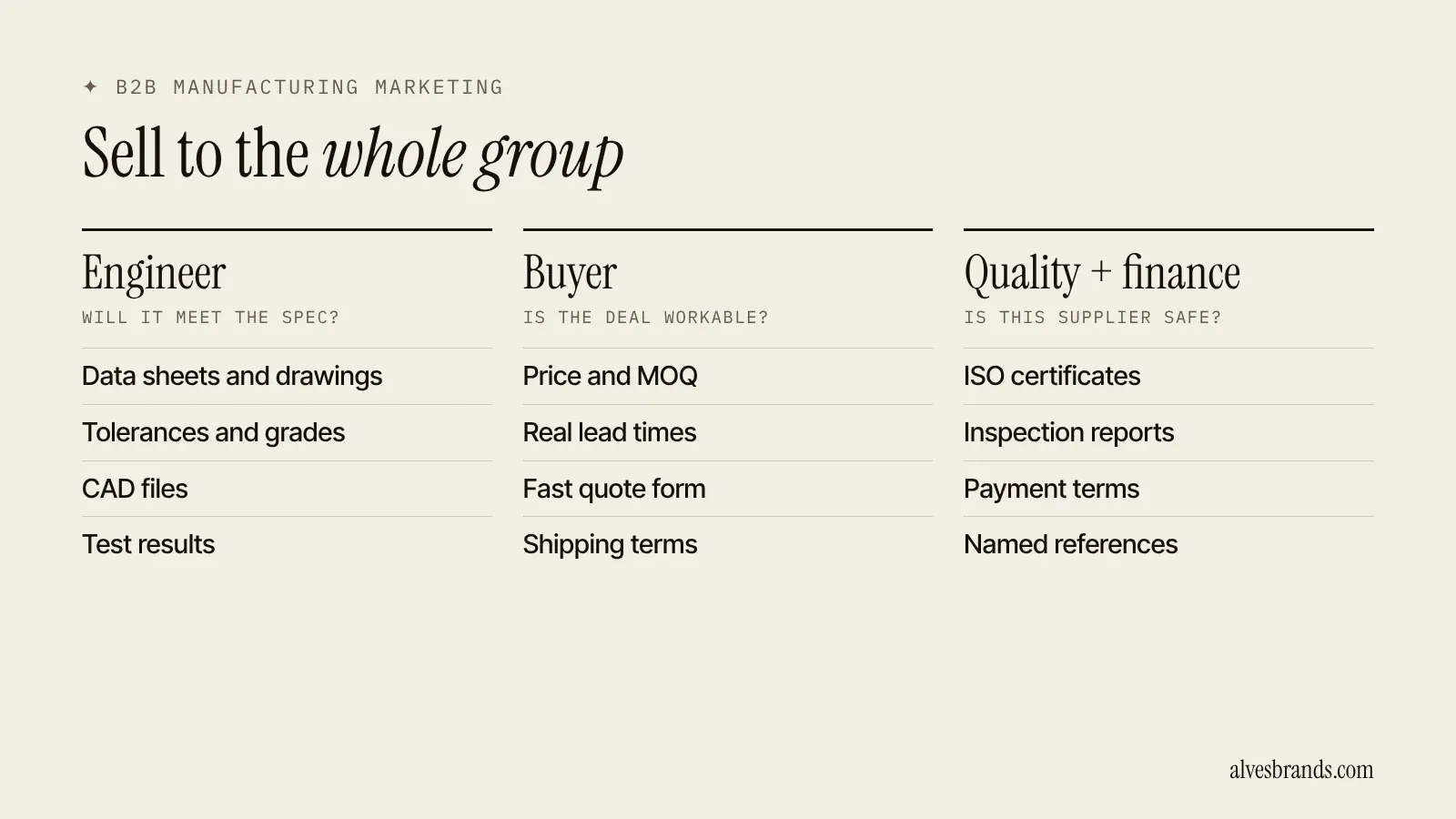
According to Gartner research on the B2B buying journey, a typical buying group for a complex B2B purchase includes 6 to 10 decision makers. In a manufacturing deal you can often name them. Each one reads your website with a different question in mind.
| Who | What they want to know | What to give them |
|---|---|---|
| Design or process engineer | Will it meet the spec, the tolerance, the material standard? | Data sheets, drawings, CAD files, material grades, test results |
| Purchasing or sourcing | Is the price fair, the lead time real, the minimum order workable? | Clear MOQ, lead times, incoterms, a fast quote form |
| Quality manager | Can you prove consistency? | ISO or industry certificates, inspection reports, sample reports |
| Finance | What does this cost over a year, and what are the payment terms? | Payment terms, volume pricing, delivery reliability |
| Plant or operations manager | Will it arrive on time and run without trouble? | On-time delivery record, spare parts, support contact |
| Owner or executive | Is this supplier safe to depend on? | Years in business, references, plant photos, named people |
Most B2B manufacturing marketing talks to one of these people, usually “the customer” in general, and loses the rest. Look at your own site. If a procurement person can’t find a lead time in under a minute, you’ve lost her. If an engineer can’t download a data sheet, you’ve lost him. The buyer who can’t find an answer doesn’t email you to ask. She opens the next tab.
Sales teams know this already. Ask them what buyers ask on the first call, and you have your content list for the year. A quick test: print your best product page and hand it to someone who knows nothing about your product. Ask them to circle what an engineer, a buyer and a quality manager each need. If any of the three circles is empty, that’s your first fix.
How B2B manufacturing buyers buy now
Three facts shape everything.
They research alone first. A 2026 Gartner survey of 646 B2B buyers found that 67% prefer a rep-free buying experience, and 45% had used AI during a recent purchase. The 6sense 2024 Buyer Experience Report found buyers are nearly 70% of the way through the process before they contact a seller, and 81% already prefer one vendor by then. By the time you hear from them, most of the decision is made, and it was made by your website, your listings and what an AI assistant said about you.
They use many channels. McKinsey’s 2024 B2B Pulse survey found that buyers use about 10 channels on average, up from about 5 in 2016. Google, supplier sites, directories, videos, email, LinkedIn, trade shows, AI assistants. You don’t need all of them. You need to be present and consistent in the three or four your buyers actually use.
They ask AI for supplier ideas. An engineer who types “who makes food-grade conveyor belts in Europe?” into an assistant gets a short list in seconds. If your pages are vague, your company doesn’t make the list. My guide on getting recommended by ChatGPT explains how that works. Google says there are no extra requirements to appear in AI Overviews or AI Mode beyond being a helpful, indexable page, which means the basics matter more, not less.
There’s a cost to ignoring this. Ahrefs found that AI Overviews cut the average click-through rate for the top-ranking page by 58%. Ranking first still helps, but a ranking alone brings fewer visits than it did. Being cited inside the answer counts too.
The four jobs of B2B manufacturing marketing
I like to cut the work into four jobs. Every tactic you’ve heard of fits under one of them, and when results are poor, one of the four is usually weak.
- Be found. The buyer searches and you show up.
- Be believed. The buyer opens your page and finds proof.
- Be easy to contact. The buyer can ask for a quote in one minute.
- Be remembered. The buyer thinks of you in six months when the project is real.
Job 1: Be found
Buyers find suppliers in four places: Google, AI assistants, directories and other people. Start with search, because it’s the one you own.
Write one page for each product or service, named the way a buyer types it. “Custom CNC machined aluminum parts” beats “Our capabilities”. Put the material, the size range, the tolerance, the industries you serve and the countries you ship to on that page, in text, not inside an image or a PDF. Add a clear title and a short description so the search result reads like an answer. My digital marketing guide walks through the setup step by step.
Then get listed where people already source. A profile on Thomasnet or an industry directory in your country puts you in front of buyers in a sourcing mindset. According to Thomas’s 2025 sourcing report, as summarized by Distribution Strategy Group, two-thirds of active buyers on Thomasnet are small and midsize businesses, so a mid-size supplier is not out of place there.
For AI answers, write the way you’d explain your product to a new engineer: plain claims, real numbers, named standards. Say who you make it for. Keep the same facts everywhere, because an assistant that finds three different versions of your capacity or certificates trusts none of them.
If you sell abroad, add the local language. A buyer in Spain searches in Spanish, often on Google.es. Start with how foreign buyers find suppliers online and run through the multilingual website checklist.
Job 2: Be believed
Once the buyer lands, you have about a minute to look like a safe choice. Proof does this better than adjectives. “Leading manufacturer since 1985” tells the buyer nothing. These do:
- Specs and ranges. Sizes, grades, tolerances, capacity per month.
- Certificates. ISO 9001, IATF 16949, CE, UL, FDA, whichever your buyers ask for, with the number and the issuing body.
- Photos and video from your floor. Real machines, real parts, real people. Stock photos make buyers suspicious.
- Case studies with numbers. The problem, what you made, how many, how it performed. Even a short one counts.
- Named references. With permission, a buyer’s name, role and company. An unnamed testimonial is worth little.
- Sample policy. If you ship samples, say how fast and at what cost.
The Content Marketing Institute’s manufacturing research fits this. In it, 74% of manufacturing marketers rated video the content type that works best, and 85% said LinkedIn gives them the most value. Video of a machine making a part is proof you can’t fake with a paragraph. If you only make one video this quarter, make that one.
Job 3: Be easy to contact
This is the cheapest job to fix and the one that leaks the most orders.
- Put a quote button on every product page and in the header.
- Keep the form short: name, company, email, what they need, quantity. Add file upload for drawings. Every extra field loses people.
- Show a phone number and, for export, a WhatsApp or direct email that works across time zones.
- Promise a reply time and keep it. One working day is a fair rule.
- Auto-reply with a clear note on what happens next.
A buyer who sends three quote requests and hears back from one supplier in two hours has already made a choice. Speed is a marketing channel. If your sales team is slow, no amount of SEO makes up for it.
Job 4: Be remembered
Most B2B buying cycles run long, and your buyer isn’t ready on the day they first find you. They bookmark you, forget you and come back when the budget opens. Your job in between is to stay visible without being annoying.
- Email. A short, useful message every month or two to people who’ve asked for a quote or downloaded a sheet. See my guide on email marketing for manufacturers.
- LinkedIn. Post what your engineers actually know: a tolerance lesson, a failure analysis, a before-and-after. The CMI B2B trends research found LinkedIn is the top channel for sharing thought leadership (76%).
- Retargeting. Light ads that remind past visitors who you are. Keep the budget small and the list tight.
- Customer care. Existing customers are your cheapest source of the next order. A check-in call after delivery pays back fast.
Which channels to pick
Don’t try all of them. Pick by the question: where does my buyer look, and how fast do I need leads?
| Channel | Job | Speed and cost | Best for |
|---|---|---|---|
| SEO (product pages, guides) | Found | 3 to 9 months, low to medium | Almost every manufacturer |
| Google Ads (exact match) | Found | Days, medium | Quick tests, narrow niches |
| Directories | Found | Weeks, low to medium | Suppliers of standard parts |
| AI search visibility | Found, believed | Months, low | Anyone selling to engineers |
| Website proof (specs, certs, cases) | Believed | Days to weeks, low | Everyone, first |
| Video | Believed, remembered | Weeks, low to medium | Machines, processes, plants |
| Remembered | Weeks, low | Anyone with leads or customers | |
| Remembered | 2 to 6 months, low | Named-account selling | |
| Account-based marketing | Found, believed | 3 to 6 months, medium | A short list of big targets |
| Trade shows | Found, believed | One event, high | Industries where everyone attends |
In the CMI manufacturing study, 68% of manufacturing marketers said search and pay-per-click gave them the best paid results. That fits what I see: people who type a product name into Google are close to buying. If you can only afford one thing, make it the product pages and the search listings behind them.
For a short list of big accounts, account-based marketing works differently: you pick 20 companies and speak to the whole buying group inside each one. In the 2018 ABM Benchmark Study by ITSMA, 77% of B2B marketers said ABM drove greater success with their target accounts. Those are survey answers, not audits. It costs more and takes longer, so start it after the basics are done.
For examples of firms doing this well, read my industrial marketing examples.
Content that wins orders
Good content in this field is not a blog calendar. It’s a small set of pages that answer the questions buyers ask before they trust you. Start with these, in this order:
- Product and capability pages. One per product, with the full specs.
- A buying guide per product family. “How to choose a stainless fastener for coastal use.” Written by your engineer, edited by a person who writes.
- Comparison pages. Material A vs material B, process A vs process B. Buyers search for these.
- Case studies. One per industry you want more of.
- FAQ pages. Lead time, minimum order, shipping, certificates, samples, payment.
The CMI manufacturing research found that 57% of manufacturing marketers say lack of resources is their biggest challenge, which means you aren’t alone if you can’t publish ten posts a month. Don’t try. One strong guide every month beats ten thin ones, and a few good pages will rank, get cited and earn trust for years. Google’s own advice is to focus on helpful, people-first content, and that is the point: write for the buyer, not the algorithm.
Let your engineers talk. Record a 20-minute chat with your best process engineer once a month, then have a writer turn it into a page. You get real knowledge without asking an engineer to write.
How to stand out when every supplier says “quality”
Open ten competitor sites in your niche. Most say the same four things: quality, service, experience, fair price. A buyer reading ten of those learns nothing, so they fall back on price. You get out of that trap by being specific about something a rival can’t copy in an afternoon.
Pick one of these and say it with proof:
- A narrow focus. “Gaskets for food and pharma lines” beats “industrial rubber products”. Buyers trust specialists.
- A hard capability. A tolerance, a size, a material, a run length few others handle.
- Speed. A real lead time, shown on the page, with the on-time rate behind it.
- A process promise. First-article inspection on every order, or one named engineer on each account.
- A market you know. You’ve shipped to Germany for 12 years and know the paperwork.
Then put it in the headline of the home page, the title of the product pages, the first line of your LinkedIn profile and the opening of every sales email. Repeat it until you’re sick of it. Buyers need to hear a claim several times before they believe it. Buyers should be able to repeat in one sentence what you’re best at. If your own sales team can’t, the market won’t either.
How the work changes by type of manufacturer
The jobs stay the same, but the weight moves.
| Type | Lean on | Watch for |
|---|---|---|
| Job shop or contract manufacturer | Capability pages, quick quotes, photos of work | Looking like every other shop |
| Component or material maker | Spec search, data sheets, directories | Buyers who only compare price per unit |
| Machine or equipment builder | Video, case studies, trade shows, long nurture | Cycles of 6 to 18 months, so email and follow-up matter most |
| Private-label or OEM supplier | Certificates, audits, references, samples | Brands that want proof of compliance first |
| Distributor of industrial goods | Catalog search, availability, fast shipping | Pages with thin product data |
A machine builder can sell on one video and one reference. A component maker lives or dies on how well the data sheets are found. Don’t copy the plan of a company that sells differently from you.
What to do about price
Buyers ask about price first and trust you least about it. Hiding every number makes them suspicious, but posting a catalog price for a custom part is false precision. Give them something they can use:
- A price range or a “from” price for standard items.
- A list of what moves the price: material, quantity, tolerance, finish, tooling.
- Minimum order and lead time in plain view.
- A fast, honest quote within one working day.
Pages that explain how you price get cited by AI assistants and shared by buyers with their bosses. They also filter out people who were never going to pay your price.
Make sales and marketing work as one team
The most common reason B2B manufacturing marketing fails isn’t the website. It’s the handoff.
Marketing sends a lead. Sales says it’s junk. Marketing says sales never called. Both are partly right, because nobody agreed on what a good lead is. Fix it in an hour:
- Define a qualified lead together. For example: a named company, a real product need, a quantity and a timeframe.
- Agree on reply time. Under one working day for every quote request.
- Log the source. Every lead gets a tag: Google, directory, LinkedIn, referral, trade show.
- Review lost deals monthly. Ask why the buyer went elsewhere. This is better research than any report.
- Share what buyers ask. Sales hears the real questions on every call. Turn the top five into pages.
Marketing and sales also share a number: quote requests that become orders. Track that, not just leads.
Where AI fits in B2B manufacturing marketing
AI shows up twice in your work: as a place buyers look, and as a tool your team uses.
As a place, it’s covered above. Keep your pages clear, your facts the same everywhere and your proof public. Then test it. Every quarter, ask ChatGPT, Gemini and Perplexity the ten questions a buyer would ask, such as “Who makes custom gaskets for food plants in Germany?”, and write down who gets named. If a rival shows up and you don’t, look at what their pages have that yours lack.
As a tool, the CMI’s 2026 B2B research found that 95% of organizations use AI-powered applications. It’s useful for rough drafts, call summaries and translation checks. It’s a bad idea for specs, tolerances and certificates. One wrong number on a data sheet can cost you an order and a customer. A good rule: AI drafts, an engineer checks every fact before it goes live.
A quick check: is your site ready for a B2B buyer?
Open your best product page and answer these in two minutes:
- Can I see the material, size range and tolerance without opening a PDF?
- Is there a lead time, a minimum order or a “from” price?
- Are certificates shown with numbers and the body that issued them?
- Is there a real photo of the product or the plant?
- Can I ask for a quote in one click, and upload a drawing?
- Does the page load in a few seconds on a phone?
- Does the page say who it’s for?
Seven yeses and the page is ready. Four or fewer and you’re sending buyers to a competitor. Run the same test on your next four pages, and fix them in that order. Start with the pages that already get the most visits, since a small fix there pays back fastest.
Budget and team
The Gartner 2026 CMO Spend Survey found marketing budgets average 7.8% of revenue. The 2025 CMO Survey put B2B product companies lower, at about 6.4%. Smaller factories often spend less than that, and that’s fine if the money goes to the right places.
A simple split for a small or mid-size manufacturer:
- Half on the website and search: product pages, guides, technical fixes.
- A quarter on proof: video, photos, case studies, certificates displayed well.
- A quarter on staying in touch: email, LinkedIn, a small paid test.
Who does the work? You have three options.
| Option | Good for | Watch out for |
|---|---|---|
| In-house person | Steady output, deep product knowledge | One person can’t cover SEO, video and writing |
| Freelancer or consultant | Specific projects, SEO, technical fixes | You still need someone inside to supply facts |
| Agency | Larger budgets, many channels | Agencies new to your field need months to learn it |
The best setup for a small plant I’ve seen: one internal owner who knows the products, plus an outside specialist for search and writing. The owner supplies the facts, the specialist turns them into pages that rank.
Measure what matters
A CMI study found 64% of manufacturing marketers find it hard to tie their content to revenue. You can avoid that trap with a short list of numbers, checked once a month.
| Metric | Why it matters | Where to find it |
|---|---|---|
| Quote requests per month | The real output | Your form or CRM |
| Quote requests by source | Shows which channel pays | Form field or UTM tags |
| Quote-to-order rate | Tells you if leads are good | Sales log |
| Search queries and clicks | Shows if buyers find you | Google Search Console |
| Reply time | Predicts lost deals | Email or CRM |
| Average order value by source | Shows the best customers | Sales log |
Skip likes, followers and raw traffic. Ten visitors who request quotes beat a thousand who bounce. Set up Search Console and Google Analytics in week one so you start collecting data from day one.
B2B manufacturing marketing for exporters
If you sell across borders, you add four things on top of everything above.
- Language. Translate the product pages, not just the home page, into the languages of your top markets. Use proper
hreflangtags so Google shows the right version, as described in Google’s guide to localized versions. - Trade terms. Show incoterms, ports, shipping options and export paperwork you handle.
- Local proof. Certificates and standards that buyers in that country recognize. Customers from that region, named.
- Local contact. A phone number, WhatsApp or email at a time-zone-friendly hour.
This is the part I do for clients, if you want help with it, see my international SEO service.
A 90-day order of work
You can’t do everything at once. Do it in this order.
Days 1 to 30: Foundation.
- Call five customers. Ask how they found you and what almost made them pick someone else.
- Rewrite your top five product pages with full specs, certificates and a quote button.
- Set up Search Console, Analytics and a lead source field on the form.
- Fix reply time. One working day.
Days 31 to 60: Visibility.
- Publish two guides from the questions customers asked.
- Record one machine video and one short case study.
- List the company in two relevant directories.
- Send a first email to past customers and open quotes.
Days 61 to 90: Compounding.
- Add a comparison page and an FAQ page.
- Start LinkedIn posts from your engineers, one a week.
- Review lost deals. Add what you learn to the pages.
- Pick the one channel that brought the best leads and give it more time.
For the full version with owners and dates, use my manufacturing marketing plan, and for the thinking behind it read the manufacturing marketing strategies guide.
Common mistakes
- Writing for “customers” in general. Name the engineer, the buyer and the quality manager, and write to each.
- Hiding specs in PDFs. Put them in text on the page, with the PDF as an extra.
- Chasing traffic. More visits mean nothing if the quote form is hard to find.
- No reply rule. A slow reply costs more than a weak ad.
- Copying consumer tactics. Giveaways and viral posts don’t buy bearings.
- Quitting at month three. SEO and trust take time. Judge results at six to nine months.
To turn this into quote requests, see the guide to manufacturing lead generation.
LinkedIn is where many B2B buyers see you first. See social media marketing for manufacturers for what to post and how to count the results.
Related reading: SEO for B2B companies shows how to get found by business buyers, and marketing for manufacturing companies helps you pick channels by business type.
For a full plan, use the B2B marketing plan template. Engineering firms can read marketing for engineering firms.
Frequently asked questions
What is B2B manufacturing marketing?
It’s the marketing a manufacturer does to win business from other companies. It covers the website, search, AI answers, directories, content, email, LinkedIn and sales follow-up, all aimed at getting qualified quote requests.
How is B2B manufacturing marketing different from B2C?
The buyer is a group, not one person. The cycle takes weeks or months, orders are bigger and repeated, and proof such as specs and certificates counts more than emotion or price tags.
What is the best marketing channel for B2B manufacturers?
Search, led by product pages that match what buyers type. Add directories and a strong website, then email and LinkedIn to stay in view. Pick two or three channels and do them well.
How much should a B2B manufacturer spend on marketing?
Benchmarks run from about 6% to 8% of revenue, per Gartner and the CMO Survey. Many small plants spend less. Start with the website, search and tracking, then add spend once you know what a quote request is worth.
How long does B2B manufacturing marketing take to work?
Ads can bring leads within days. SEO and trust-building usually take three to nine months. Fixing quote forms and reply time brings results in weeks.
Want more quote requests from your website? Ask me for a free website check. I’ll show you how buyers find you on Google and in AI answers, and what to fix first.