Manufacturing marketing strategies are the choices a factory makes about who to sell to, what to say to them and which channels to use to reach them. A strategy isn’t a list of tactics. It’s the reason behind the tactics: why these buyers, why this message, why these channels and not others.
That difference matters because manufacturers rarely lack ideas. They lack focus. Trade shows, a new website, LinkedIn, ads, a newsletter, a video, all good, but without a clear strategy they turn into a pile of small efforts that never add up.
This guide covers 12 manufacturing marketing strategies that work now, how to choose between them and how to build a manufacturing marketing strategy of your own. For the wider picture, read my complete guide to marketing for manufacturers. For a step-by-step planning template, use the manufacturing marketing plan.
Why manufacturing marketing strategies need to change
Three shifts are forcing the change. My industrial marketing trends guide covers the wider list.
Buyers research without you. In a 2026 Gartner survey of 646 B2B buyers, 67% said they prefer a rep-free buying experience. The 6sense 2024 Buyer Experience Report found buyers are nearly 70% through their process before they contact a supplier, and 81% already prefer one vendor when they do.
AI is part of the research. The same Gartner survey found 45% of buyers used AI during a recent purchase. And Ahrefs found that AI Overviews cut the click-through rate of the top Google result by 58% in their December 2025 desktop data. Fewer clicks reach websites, so being named inside the answer matters more.
Marketing and sales can’t work apart. Buyers move between your website, your content and your sales team without noticing the line between them. A strategy that stops at “generate leads” and hands them over cold wastes both teams’ work.
If a buyer decides most of the purchase before you hear about it, then strategy is really about one question: how do we become the supplier they already trust when they do reach out? To build one on a single page, follow my industrial marketing strategy guide.
What makes manufacturing marketing different
A few facts shape every strategy in this guide:
- Long cycles. A machine, a custom part or a supply contract can take months to close.
- Buying committees. Engineers, purchasing, finance, quality and management each care about different things.
- Technical proof. Specs, certifications, test results and customer references outweigh slogans.
- Large, repeat orders. A few good customers can change the year.
- Intermediaries. Distributors, agents and resellers often stand between you and the end user.
So manufacturing marketing strategies should aim at a small group of well-informed people and win through clarity and proof, not noise.
How to build a manufacturing marketing strategy
Before choosing tactics, answer six questions. Write the answers on one page.
1. Who do we want to win?
List your best customers. What do they have in common? Industry, size, country, the problem they bring you? Your best strategy starts with the buyers who already pay you well, repeat their orders and are easy to work with. Aim for more of them.
2. Who decides inside those companies?
Map the buying committee. A typical one has an engineer who sets the specs, a buyer who compares price and terms, a manager who approves and sometimes a quality or compliance lead. List what each one worries about. The engineer wants tolerances. The buyer wants delivery and price. The manager wants low risk.
3. Why us?
Find the real reason customers pick you. It’s rarely “quality”. It might be a low minimum order, short lead times, a rare material, a certification competitors lack or an engineer who answers the phone. Ask five customers. Their words are your message.
4. Where do they look?
Check where your buyers look for suppliers: Google, directories, trade shows, LinkedIn, distributor catalogs, referrals or AI assistants. Your strategy should put you in those places, not in the ones you like most.
5. What do we want them to do?
For most factories it’s one action: send an inquiry or request a quote. Pick the one main goal and a second smaller one, such as downloading a catalog or booking a call.
6. How will we know it works?
Choose three to five numbers before you begin: qualified inquiries, cost per qualified lead, quote-to-order rate and revenue from new customers. Without them you’ll argue opinions later.
12 manufacturing marketing strategies that work
You don’t need all twelve. Pick three or four that fit your buyers and your team, and do them well.
Strategy 1: Build a website that works like a sales engineer
Your website is the first thing a buyer checks, often before any contact. Treat it as your most important salesperson (the digital marketing for manufacturers guide covers the setup). Give every product or service its own page with specs, materials, sizes, minimum orders, lead times, certifications and a visible quote button. Add real photos of your plant and products. Many buyers leave if they can’t find a spec, and they rarely ask by email.
Check speed and mobile use too. Google’s Core Web Vitals measure loading, responsiveness and visual stability. A slow page loses buyers before they read a word.
Strategy 2: Capture demand with SEO
Some buyers already know what they need and are typing it into Google right now. SEO is how you show up for those searches: “aluminum die casting supplier”, “ISO 9001 certified PCB assembly”, “custom rubber gaskets manufacturer”.
Build one page per product and per major search intent. Use the words buyers use. Follow Google’s guidance on helpful, people-first content: show first-hand experience and give complete answers. Track results in Google Search Console.
SEO is slow, three to six months for the first movement, but it’s the strategy with the best long-term cost per lead, because traffic keeps coming after the work is done.
Strategy 3: Turn engineering knowledge into content
Your engineers and sales team know things buyers want to learn. Turn that into content:
- Guides: “How to choose a bearing material for high temperature”.
- Comparisons: “Cast aluminum vs extruded aluminum for enclosures”.
- Case studies: problem, solution and measurable result.
- Videos: a machine running, a quality check, a process step.
The Content Marketing Institute’s manufacturing research found 74% of manufacturing marketers rate video their most effective content type. Keep it simple. A phone video of a real process often beats a produced brand film.
A simple rule: every question a customer asks on a call is a page waiting to be written.
Strategy 4: Run search ads for fast, high-intent leads
SEO takes time. Google Ads fills the gap. Target narrow, high-intent searches and send visitors to the matching product page, not the homepage. Exclude waste with negative keywords like “jobs”, “free” and “used”. Test for four to six weeks before you scale, and judge by quote requests, not clicks.
Ads work well alongside SEO: they test which search terms bring real inquiries, and those insights feed your SEO plan.
Strategy 5: Use account-based marketing for key accounts
If you sell to a small number of large companies, broad campaigns waste effort. Account-based marketing (ABM) picks 20 to 50 target companies, maps the people who decide in each and reaches them with focused content, LinkedIn outreach and email. I explain the full method in account-based marketing for manufacturers.
It takes more manual work, so use it for high-value products. Start with five accounts and learn what works before you grow the list.
Strategy 6: Use LinkedIn the way your buyers do
LinkedIn is where engineers, buyers and procurement staff spend business time. Content Marketing Institute’s 2026 B2B research found that LinkedIn is the top channel for sharing thought leadership (76%), ahead of email newsletters (54%) and webinars or events (52%).
Post from the company page, but also from your team’s own profiles. People trust people more than logos. Show projects, plant news, certifications and technical tips. Connect with target accounts. Don’t pitch in the first message.
Strategy 7: Keep leads warm with email
Most visitors don’t ask for a quote on the first visit. Email keeps you in front of them. Build a list from quote requests, downloads and trade show contacts. Send something useful every month or two: a case study, a new capability, a guide or a lead-time update. Segment by interest, so a pump buyer doesn’t get valve news.
Existing customers are the cheapest source of new orders, and email is the cheapest way to reach them.
Strategy 8: Make trade shows and events pay off
In-person events still work in this industry. In the CMI manufacturing study, 51% of marketers rated them their most effective distribution channel. The strategy isn’t the booth. It’s what surrounds it:
- Before: tell target accounts you’ll be there and book meetings.
- During: capture every contact with the same short form.
- After: follow up within a week, mention what you discussed and add them to your email list.
Digital events help too. A 30-minute webinar on a technical topic attracts the engineers you want, and the recording keeps working.
Strategy 9: Be listed where buyers compare suppliers
Many buyers start in a directory, not on your website. Make sure your listing on Thomasnet or the main directory for your sector is complete and matches your website. If you sell through distributors, give them good product data, photos and sales material, since they will describe you the way you describe yourself.
Strategy 10: Prepare for AI search
Buyers now ask ChatGPT, Gemini, Claude and Perplexity for supplier ideas. To be named, you need clear pages that state what you make, where you sell and which certifications you hold. Keep company details consistent across your website and directories, and answer common questions plainly. I explain how in my guide on getting recommended by ChatGPT. Want to see how you show up today? Run the free AI visibility check.
Strategy 11: Go global with language and country pages
If you export, your strategy should speak your buyers’ languages. Build pages in each target language and tell Google which version belongs to which country, as Google’s guide to localized versions explains. See my multilingual website checklist and my guide on how foreign buyers find suppliers online.
Strategy 12: Align marketing and sales
The best manufacturing marketing strategies fail if leads fall through a gap. Agree on what a qualified lead is, how fast it gets a reply and who owns it. Hold a short monthly meeting where sales shares what customers asked and marketing shares what brought them in. That loop is where the best content ideas come from. I cover it in manufacturing industry marketing.
Positioning: how to stand out in a crowded field
Every strategy rests on positioning, meaning the short answer to “why should I pick you over the next supplier?” Most manufacturers sound alike. They list the same machines, the same certifications and the same promise of quality. Buyers can’t tell them apart, so they choose on price.
Good positioning narrows the claim and backs it up:
- Pick a niche you can own. “Precision parts for medical device makers” is easier to remember and trust than “custom manufacturing”.
- Name the problem you solve. “Short runs with two-week lead times” speaks to a buyer in a hurry.
- Prove it. Back each claim with a number, a certificate or a customer story.
- Say it everywhere. The same line on your homepage, LinkedIn page, directory listings and sales deck.
A narrow position feels risky because you turn some buyers away. In practice it works the other way. Buyers searching for a specialist trust a specialist, and you spend less time quoting jobs you don’t want.
Make your sales team part of the strategy
Sales hears what the market wants. Marketing builds what brings people in. Neither works well alone. A few habits tie them together:
- Share a lead definition. Agree on what counts as qualified, such as the right industry, a real need and a budget or timeline.
- Set a response time. One business day at most.
- Give sales the tools. Case studies, spec sheets, comparison pages and short videos they can send after a call.
- Collect objections. Ask sales for the five questions buyers raise most. Each one becomes a page, a video or an email.
- Close the loop. When a deal is won or lost, record why. Marketing learns what to say more of.
This is also where the buying committee shows up in real life. Sales meets the buyer who compares price and the manager who worries about risk. Marketing can then write for them directly.
Reputation, references and proof
Industrial buyers carry real risk. A late delivery or a bad batch can stop their line. So they look for signs that you’re safe to choose:
- Customer references and case studies. Even short ones, with the customer’s permission and real numbers.
- Certifications. ISO standards and sector certificates, displayed clearly with certificate numbers where you can.
- Years in business, plant photos and team photos. They show a real company behind the website.
- Reviews and ratings. On your Google Business Profile, directories and marketplaces where they exist.
- Samples and trial orders. The cheapest way to reduce a buyer’s risk.
Ask every happy customer for a short quote at the end of a project, while the result is fresh. A page of three real testimonials beats a page of adjectives.
Quote and pricing strategy
Price is a marketing question too. Many industrial buyers dislike sites that say nothing about price, because they can’t tell if you’re even in their range. You don’t have to publish a full price list. You can:
- Show starting prices or typical ranges for standard products.
- Publish minimum order quantities and standard lead times.
- Explain what drives price, such as material, volume, tolerance and finish.
- Offer a fast quote form, and promise a time to reply.
A buyer who understands your price logic arrives with better questions and fewer surprises. Quotes close faster and you waste less time on bad fits.
Using AI in your marketing without losing your voice
Marketing teams now use AI heavily. The CMI 2026 B2B report found that 95% of organizations use AI-powered applications, most often for content creation, and the report’s own summary is that AI “helps marketers type faster, not think better.”
That fits manufacturing. AI can speed up drafts, summaries and translations. It can’t know your tolerances, your customers or your plant. Use it this way:
- Let AI produce a first draft, then have an engineer correct the facts.
- Use it to summarize call notes into FAQ ideas.
- Never publish technical claims you haven’t checked.
- Keep the real photos, the real names and the real numbers. That’s what makes you different.
An example strategy for a mid-size machine shop
Here’s an illustrative example, not a real client, to show how the pieces fit. For real companies doing this well, see these industrial marketing examples.
A machine shop with 40 employees makes precision parts for the medical and aerospace sectors. Most orders come from five long-term customers. The owner wants more mid-size accounts and fewer price-only requests.
- Target: medical device makers with 50 to 500 employees, within the US and Germany.
- Committee: a design engineer, a sourcing manager and a quality lead.
- Position: “Precision machined parts with full traceability and two-week prototypes.”
- Capture: product pages for each material and process, plus SEO for “medical CNC machining prototype” style searches.
- Create: one guide per month from engineer questions, shared on LinkedIn and by email.
- Keep: a quarterly email to current customers with lead times and new capabilities.
- Goal: ten qualified inquiries per month in a year, with a quote-to-order rate above 25%.
- Metrics: qualified inquiries, quote-to-order rate, revenue from new accounts.
It’s a small set of choices, written down and repeated. That’s what a strategy looks like in practice, and you can write yours in an afternoon. Revisit it every quarter and change only what the numbers tell you to change. Small, steady adjustments beat big restarts.
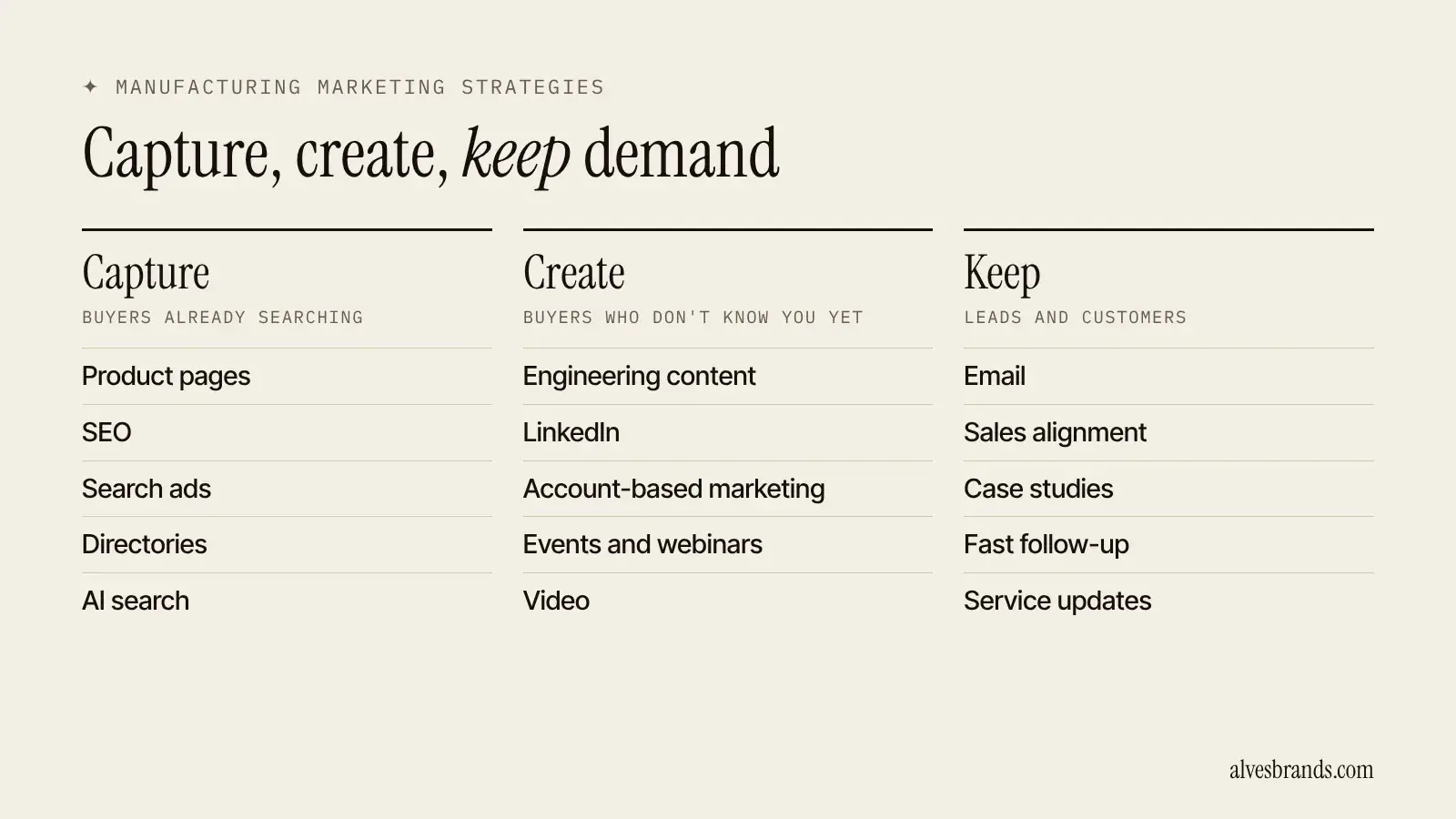
Capture demand, create demand, keep demand
A helpful way to organize the twelve strategies is by the job they do:
| Job | What it means | Strategies |
|---|---|---|
| Capture demand | Be the answer when someone is already searching | Website, SEO, search ads, directories, AI search |
| Create demand | Reach buyers who don’t know they need you yet | Content, LinkedIn, ABM, events, video |
| Keep demand | Keep customers and warm leads coming back | Email, sales alignment, case studies, service updates |
Most manufacturers overspend on creating demand (a new brand video) and underspend on capturing it (product pages that rank). Start with capture, because those buyers are ready now. Add creation once the base works, and don’t forget keeping, since repeat orders are the cheapest you’ll ever win.
Which strategies fit your company
There’s no single best mix. Use the situation, not trends, to choose.
| Your situation | Start with |
|---|---|
| Small team, few leads, low budget | Website product pages, SEO, directory listing, email to customers |
| Sell to a handful of large accounts | ABM, LinkedIn, trade shows, case studies |
| Sell through distributors | Distributor content kit, directories, product data, SEO |
| Exporter | Language pages, international SEO, directories in target markets |
| Established, need faster growth | Add search ads, video, webinars, marketing automation |
If you can only do three things, do these: a clear website with product pages, SEO for what buyers search and a reliable follow-up process.
Tools for manufacturing marketing strategies
You don’t need a big stack. Most factories can run well with:
- A website you can edit yourself.
- Google Analytics and Search Console. Both are free.
- A CRM. Even a simple one. It records every lead, its source and its status.
- An email tool. For newsletters, follow-ups and a signup form.
- A shared product data file. One place for specs and photos, so your website, catalogs and distributors all show the same facts.
Add automation only when you have steady leads and a clear process. Software can’t fix an unclear message.
Budget: how much to spend
Benchmarks give a range. The Gartner 2026 CMO Spend Survey found marketing budgets average 7.8% of company revenue. The 2025 CMO Survey found B2B product companies spend about 6.4%. For more benchmarks and a way to set your own number, read my manufacturing marketing budget guide.
Many smaller manufacturers spend much less. That’s fine if you start with the cheap, high-return work: the website, SEO, directory listings and email. Spend on ads and events once you know what a lead is worth.
Common challenges, and how to handle them
Content Marketing Institute’s manufacturing research shows what holds teams back:
- Limited resources. 57% say it’s their top challenge. Fix: choose fewer strategies and do them well.
- Content that doesn’t lead to action. 66% struggle here. Fix: end every page with a clear next step and a quote button.
- Proving results. 64% find it hard to tie content to revenue. Fix: record the source of every lead in a CRM.
- No repeatable way to produce content. 54% lack a scalable model. Fix: set a simple schedule, such as one guide per month, and use the questions your sales team hears.
The 2026 B2B research adds a general point: 40% of marketers struggle to create content that drives action, 39% name limited resources and 33% struggle to measure effectiveness. If your team feels stretched, you’re in the majority.
Mistakes to avoid
- Doing everything at once. Three channels done well beat eight done badly.
- Starting with tactics. A new video or website without a clear buyer and message wastes money.
- Ignoring the buying committee. If your content only speaks to the engineer, purchasing and management never hear from you.
- Generic claims. “Quality, service, innovation” fits every competitor. Use numbers, materials, certifications and customer names.
- Letting leads go cold. A reply after three days loses to a supplier who answered in three hours.
- Judging too early. SEO and content need months. Ads need weeks of testing.
- Copying consumer tactics. Viral reach isn’t the goal in B2B.
How to measure manufacturing marketing strategies
Skip vanity numbers like followers and page views. Track what connects to revenue:
- Qualified inquiries per month
- Cost per qualified lead
- Quote-to-order rate
- Revenue from new customers
- Organic traffic to product pages, by country
- Lead source for each new customer
Install Google Analytics and set a key event for form submissions, quote clicks and phone-number clicks. Add UTM tags to links in emails and ads. Review the numbers monthly with the sales team. Keep what brings orders, fix what doesn’t and stop what produces nothing after an honest three months.
A 90-day plan to put your strategy to work
Days 1 to 30: decide and fix the base
- Write the one-page strategy: target buyers, buying committee, why us, channels, goal and metrics.
- Give each main product its own page with specs and a quote button.
- Set up Search Console, Analytics and a simple CRM.
Days 31 to 60: launch the first channels
- Publish two guides from questions your sales team hears.
- Share each one on LinkedIn and by email.
- Complete your directory listings.
Days 61 to 90: follow up and learn
- Reply to every inquiry within one business day.
- Collect two case studies from happy customers.
- Review the metrics, keep the winners and drop what didn’t work.
A one-page strategy checklist
Before you commit time or money to any new tactic, check that you can answer yes to each line:
- We know our best customer type and can describe it in one sentence.
- We know who decides inside those companies and what each one worries about.
- We can say in one line why a buyer should pick us, and prove it.
- Every main product has a page with specs, photos and a quote button.
- We know where our buyers look for suppliers, and we appear there.
- Every inquiry gets a reply within one business day.
- We record where each lead came from.
- Sales and marketing meet once a month.
- We review the numbers and drop what doesn’t work.
If you answer no to three or more, fix those first. They’ll lift every channel you add later. Share the finished page with sales and the owner, so everyone pulls in the same direction.
For the search side in detail, see SEO for manufacturers.
Related reading: marketing for manufacturing companies and SEO for B2B companies.
Frequently asked questions
What are manufacturing marketing strategies?
They’re the choices a manufacturer makes about which buyers to target, what to tell them and which channels to use. Examples include SEO, content, search ads, LinkedIn, email, trade shows and account-based marketing.
What is the best marketing strategy for a manufacturing company?
For most, it’s a clear website with product pages, SEO for what buyers search and a fast follow-up process. Add LinkedIn, email and events once that base works.
How do you create a manufacturing marketing strategy?
Answer six questions: who you want to win, who decides inside those companies, why they should pick you, where they look, what action you want and how you’ll measure it. Then choose three or four tactics that fit.
How long do manufacturing marketing strategies take to work?
Ads can bring leads in days. SEO and content usually take three to six months. Email and event follow-ups can bring orders within weeks.
How much should a manufacturer spend on marketing?
Gartner’s 2026 survey found an average of 7.8% of revenue. Smaller manufacturers often spend less. Start with low-cost, high-return work and expand as results come in.
Should manufacturers use social media?
Mostly LinkedIn. It’s where buyers, engineers and procurement staff look for suppliers. Other networks help if you sell to consumers or want to recruit, but they aren’t a priority for most B2B factories.
What’s the difference between a strategy and a plan?
A strategy explains the choices: who you target, what you say and where. A plan turns those choices into tasks, owners, dates and a budget. Write the strategy first, then use the manufacturing marketing plan template to carry it out.
Does marketing work for small manufacturers?
Yes. See how to market a manufacturing company from zero. A small company with a clear website, a few useful guides and honest case studies can win orders from buyers it would never meet otherwise. The SBA’s guide to planning your business is a good free place to start.
If you want to know where your company stands today, ask me for a free website check. I’ll show you how you appear on Google and in AI answers in your most important markets, and what to fix first.