The best industrial marketing examples don’t look like marketing at all. They look like a catalog that saves an engineer ten minutes, a quote tool that answers in seconds or a magazine farmers keep reading for a century. That’s the common thread: they help the buyer do their job.
If you sell, install or service equipment instead of making it, read marketing for industrial companies.
Below are seven real examples from manufacturers and industrial suppliers, each with a source you can check. For every one, I explain what they did, why it worked and what a small factory can copy on a small budget. Once you know what to copy, put it in your industrial marketing strategy.
If you want the strategy behind these tactics, read my manufacturing marketing strategies guide after this one.
What is industrial marketing?
Industrial marketing is how companies that make or supply industrial products sell to other businesses. The buyers are engineers, plant managers and procurement teams, not consumers. The products are machines, parts, materials, tools and services. For a fuller definition, see what is industrial marketing.
It differs from consumer marketing in a few ways:
- Fewer buyers, bigger deals. You might have 200 possible customers, not 2 million.
- Groups decide. A buying group for a complex B2B purchase usually has 6 to 10 people, according to Gartner.
- Facts beat emotion. Specs, tolerances, certifications and lead times matter more than slogans.
- Long cycles. Deals can take months, so trust is built over many contacts.
- Buyers research alone. In a 2026 Gartner survey, 67% of B2B buyers said they prefer a rep-free buying experience.
That last point is why these examples matter. If buyers decide before they talk to you, your website, content and tools have to do the selling.
7 industrial marketing examples
1. McMaster-Carr: a catalog built for speed
McMaster-Carr sells industrial parts, and its website is famous among engineers for one reason: it’s fast and easy. A Design News column from 2005 called it “the perfect site” and noted that its 420,000-plus products were all within two clicks of the home page. No animations, no corporate slogans, just products, clear headings, search by part number and pages that look like a clean printed catalog.
Why it works: engineers don’t want to be entertained. They want the right part, now. A site that respects their time becomes the first place they look, again and again.
What a small manufacturer can copy: give every product its own page with specs, drawings, materials and a quote button. Organize by what buyers search for, not by your internal product codes. Make search work with part numbers. Cut anything that slows the page down, because engineers leave slow pages fast.
2. Xometry: an instant quote engine
Xometry, a marketplace for custom manufacturing, built its marketing around one tool. On its instant quoting page, you upload a 3D model and get pricing and lead times right away, instead of waiting days for a reply.
Why it works: the slowest part of buying custom parts is the RFQ. Removing that wait wins buyers who are in a hurry, and the tool itself becomes the reason people visit and come back.
What a small manufacturer can copy: you don’t need an AI pricing engine. Start with a short quote form that accepts drawings, promise a reply time and keep it. Even “quote within 24 hours” in big letters beats a generic contact form. If your parts have standard options, a simple price table or calculator is a strong next step. You can test your own site with the free website enquiry check.
3. Protolabs: design tips for engineers
Protolabs, a digital manufacturer of prototypes and low-volume parts, runs a large library of design tips. It covers how to design plastic and metal parts for injection molding, CNC machining, 3D printing and sheet metal, with guides on cutting cost, avoiding defects and picking materials, plus videos.
Why it works: engineers search for these answers every day. Each tip is a chance to be found on Google, and it shows Protolabs knows the process better than the competition. When the engineer is ready to order, they already trust the company that taught them.
What a small manufacturer can copy: write down the ten questions your engineers answer for customers most often. Turn each one into a short guide with a drawing or photo. “How to design a part for laser cutting” or “What tolerance can you really hold on aluminum?” are perfect topics. This is one of the cheapest industrial marketing examples to copy, and it keeps working for years.
4. Caterpillar: a video that showed what the machines can do
In 2014, Caterpillar released “Stack”, a video where five construction machines built a giant Jenga tower out of 600-pound blocks. According to MarTech, the video passed 1.5 million YouTube views and an estimated 28.3 million Twitter impressions. The team said it wanted to show a side of Caterpillar people hadn’t seen, instead of a standard product video.
Why it works: it’s still a product demo. It proves precision and operator skill. But it’s fun to watch and easy to share, so it reached far more people than a spec sheet ever could.
What a small manufacturer can copy: you don’t need a big budget. Film your machines doing something precise or surprising: a perfect weld, a part with a mirror finish, a test where your product survives where others fail. Keep it under a minute and post it on LinkedIn and YouTube. Real footage from your shop floor builds more trust than stock photos.
5. John Deere: a magazine since 1895
John Deere has published The Furrow since 1895. According to Contently’s history of the magazine, it reached more than 4 million readers in 1912 and about 2 million worldwide in 2013. The key choice: it focuses on farmers and their stories, not on John Deere equipment. Today the The Furrow page still describes it as a magazine about people and their connection to the land.
Why it works: it gives farmers something useful and interesting, so they welcome it every month. The brand stays in their mind without a sales pitch. It’s often called one of the oldest examples of content marketing.
What a small manufacturer can copy: a monthly email newsletter for your customers and prospects. Share one useful idea, one customer story and one short company update. No hard sell. Over a year, that’s twelve reasons for buyers to remember you. I explain how to set it up in email marketing for manufacturers.
6. Grainger: a know-how hub
Grainger, an industrial supplier, runs Grainger KnowHow, a library of practical content for people in safety, metalworking, manufacturing and facilities. It includes equipment guides, safety tips, operations advice, industry news, videos and case studies.
Why it works: maintenance and safety managers have problems every week. If your site answers those problems, they come back, and when they need to buy, you’re already on the list. The content also ranks in search for thousands of questions buyers type into Google.
What a small manufacturer can copy: pick one audience, such as maintenance managers in food plants, and build a small hub for them: five to ten useful guides, a checklist and a page about the problems your product solves. Link them together so Google and visitors see them as one topic.
7. Festo: innovation projects that show expertise
Festo, a German automation company, started the Bionic Learning Network in 2006. Engineers, designers and biologists, with universities and research partners, build robots and systems inspired by nature, like flying objects and soft grippers. Festo uses them as development platforms to test new ideas and support customer projects.
Why it works: the projects are striking, so they get attention at trade shows and online. More importantly, they prove that Festo’s team can solve hard technical problems. That reputation helps sell everyday products.
What a small manufacturer can copy: show off a hard job you solved. A short case study with photos of a tricky part, the problem, how your team fixed it and the result. One strong story like this does more for your reputation than a list of capabilities.
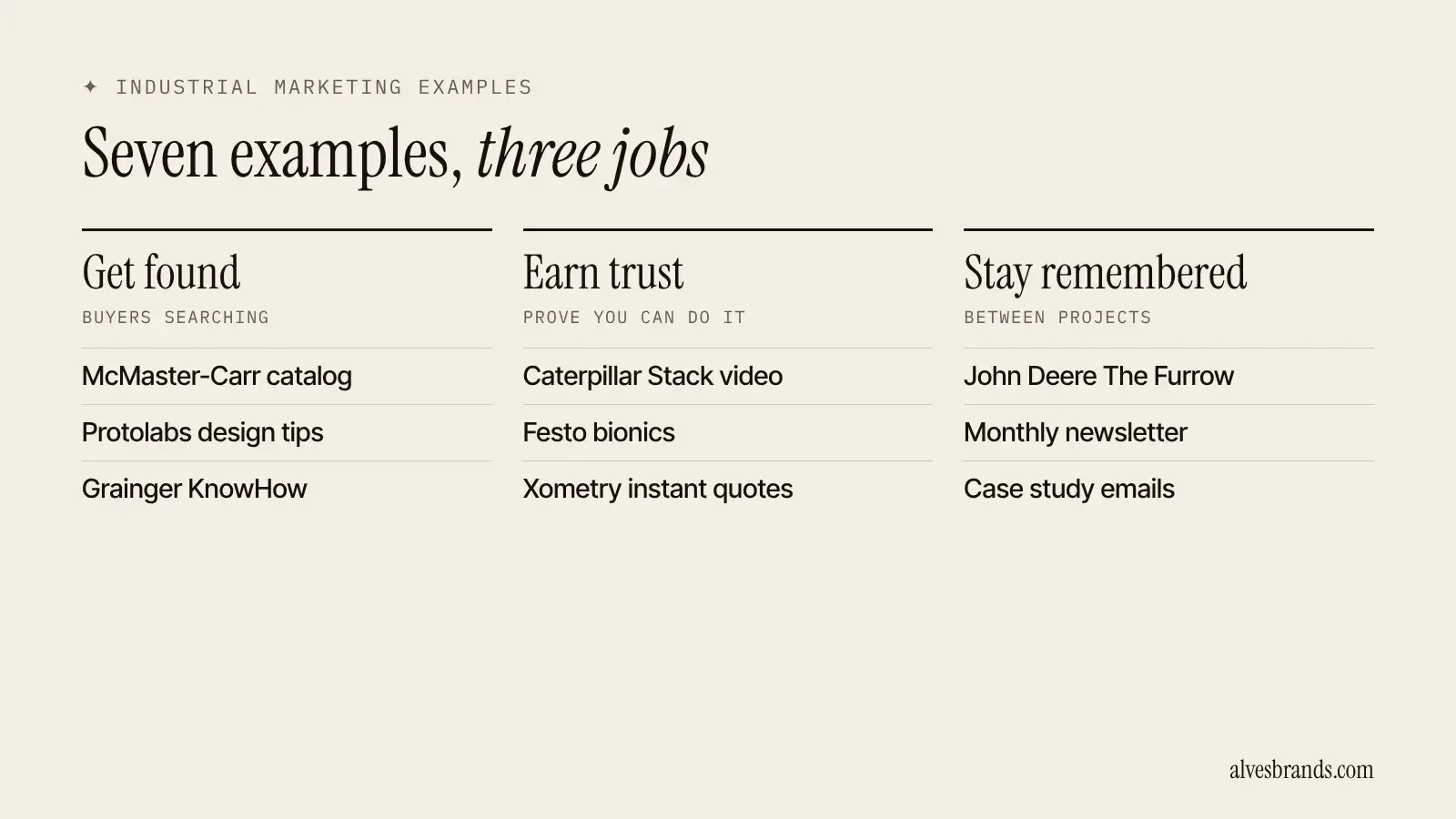
What these industrial marketing examples have in common
Look at the seven together and a pattern shows up:
| Company | Tactic | Main job | Cost to copy |
|---|---|---|---|
| McMaster-Carr | Fast, clear product catalog | Get found, save time | Low to medium |
| Xometry | Instant quote tool | Turn visits into orders | Low (form) to high (engine) |
| Protolabs | Design tips for engineers | Get found, earn trust | Low |
| Caterpillar | Product demo video | Earn attention | Low to high |
| John Deere | Customer magazine | Stay remembered | Low (email) |
| Grainger | Know-how content hub | Get found, come back | Low to medium |
| Festo | Innovation projects | Prove expertise | Medium to high |
Three takeaways:
- Help first, sell second. Every example gives the buyer something useful before asking for anything.
- Show, don’t claim. Videos, case studies, data and tools prove what slogans only say.
- Stay consistent. The Furrow has run for more than a century. A good tactic needs years, not weeks.
Notice what’s missing, too. None of these industrial marketing examples depends on a clever slogan or a big ad budget. Most of them started small: one catalog, one tool, one video, one newsletter. They grew because buyers found them useful and kept coming back. That’s good news for a small factory, because usefulness is the one thing big competitors can’t simply buy.
More ideas by channel
Not every example has to be a big campaign. Here are smaller industrial company marketing ideas by channel:
- SEO: a page for each product and each industry you serve, with real specs. My guide to digital marketing for manufacturers shows how to set these up.
- Search ads: bid on exact part and process names with high intent, like “5-axis CNC machining services”.
- LinkedIn: short posts from your engineers showing real jobs. People trust people more than logos.
- Directories: a complete, up-to-date profile on Thomasnet and the directories your buyers use.
- Trade shows: book meetings before the show, then follow up within a week with something useful.
- Webinars: a 30-minute technical session on a common problem, recorded and reused as content.
- Website chat or RFQ form: answer quote questions fast. Speed is a selling point in itself.
- Account-based marketing: for big target accounts, coordinated campaigns to the whole buying group. See account-based marketing for manufacturers.
How to apply these examples in your company
Don’t try all seven at once. Pick the one that fixes your biggest problem:
- Nobody finds you online? Start with McMaster-Carr and Protolabs: clear product pages and useful technical guides.
- Visitors don’t ask for quotes? Copy Xometry: a fast, simple quote process with a promised reply time.
- People find you but don’t trust you? Copy Caterpillar and Festo: real videos and case studies from your floor.
- Buyers forget you between projects? Copy John Deere and Grainger: a regular newsletter and a resource hub.
Give each tactic at least three months before judging it, and track quote requests, not likes. If you need help putting the pieces in order, my manufacturing marketing plan walks through it step by step.
Industrial marketing examples for exporters
If you sell abroad, every example above still works, with two changes. First, translate the pages that matter most, such as product pages, quote forms and your best case study, so foreign buyers can read them in their own language. My multilingual website checklist shows how. Second, make sure those pages show up in the search engines and AI tools buyers use in each country. I explain what that looks like in how foreign buyers find suppliers online.
Frequently asked questions
What are some good industrial marketing examples?
McMaster-Carr’s fast product catalog, Xometry’s instant quote tool, Protolabs’ design tips, Caterpillar’s “Stack” video, John Deere’s Furrow magazine, Grainger’s KnowHow hub and Festo’s Bionic Learning Network are all strong examples.
What is the difference between industrial and consumer marketing?
Industrial marketing sells to businesses, often through groups of engineers, managers and buyers, with long sales cycles and a focus on specs and proof. Consumer marketing sells to individuals and leans more on emotion and brand.
Which industrial marketing tactic is cheapest to start with?
Useful technical content and clear product pages. They cost mostly time, and they keep bringing visitors from Google for years.
Do these examples work for small manufacturers?
Yes. Each one has a small version: a quote form instead of a quote engine, a phone video instead of a film crew, a monthly email instead of a print magazine.
Want to see which of these ideas would bring you the most quote requests? Ask me for a free website check. I’ll show you how buyers find you on Google and in AI answers, and what to fix first.