SEO for B2B companies is the work of getting your pages in front of business buyers when they search Google, and now when they ask AI assistants, so that the right people contact you. The goal is not traffic. The goal is a quote request, a demo request or a call from a company that can actually buy from you.
That one difference changes almost every choice you make. B2B buyers search for fewer things, they search for them in more specific ways, and they take weeks or months to decide. A page with 40 visits a month can be worth more than a page with 4,000, if the 40 are the right ones.
This guide is the version I’d give a business owner or marketing manager who has to start from zero: how to pick keywords, which pages to build first, how to earn links and trust, how AI search changes things, what to measure and what to do in the first 90 days. I work with manufacturers and exporters, so if that’s you, my guide to SEO for manufacturers goes deeper on the industrial side.
Key takeaways
- SEO for B2B companies works on many small, specific phrases. B2B SEO volume is low and each visit is worth a lot.
- One keyword, one page. Two pages for the same search fight each other.
- Service, industry and case study pages bring leads. Blog posts bring trust and links.
- Proof wins deals: names, numbers, photos and certificates beat claims.
- Count qualified leads, not visits. Rankings are a signal, leads are the result.
- Plan on three to six months before the numbers move.
What SEO for B2B companies means
SEO stands for search engine optimization. It means making your website easy for search engines to find, understand and trust, and making each page the best answer to a question a buyer types. When a page matches a question well, Google shows it near the top and the buyer clicks.
For B2B companies, the buyer is usually a person doing research for their employer. A purchasing manager looks for a supplier. An operations director compares software. An engineer checks whether a vendor can meet a spec. They are not browsing for fun. They have a task, a deadline and a boss to convince.
That is why SEO for B2B companies has three jobs:
- Be found when a buyer searches for the problem you solve, the product you sell or the type of supplier they need.
- Be believed once they land on your page, with proof, specifics and a clear way to check you out.
- Be easy to contact with a form, a number or a booking link that doesn’t ask for too much.
If any of the three is missing, the other two don’t pay off. Rankings without proof lose the visit. Proof without rankings never gets read. Both without a clear next step leave the buyer to wander off.
How SEO for B2B companies differs from B2C SEO
The tools are the same. The thinking is not. Here are the differences that matter most.
| Area | B2C SEO | SEO for B2B companies |
|---|---|---|
| Who decides | One person, often on impulse | A group, over weeks or months |
| Search volume | High volume, short terms | Low volume, long and specific terms |
| Sales cycle | Minutes to days | Weeks to a year or more |
| Page goal | Purchase | Lead, quote request, demo or call |
| Content | Short, product and price focused | Deep, proof focused, answers hard questions |
| Conversion rate | Higher | Lower, but each conversion is worth more |
| Success measure | Sales and revenue per visit | Qualified leads and pipeline |
Complex sales cycles
A B2B purchase rarely happens in one visit. Gartner research on the B2B buying journey says a typical buying group for a complex B2B solution has 6 to 10 decision makers. Each one reads your site with a different question. The engineer wants specs. Procurement wants price and terms. Finance wants risk. The person who will use it wants to know it works.
So one page can’t do everything. You need pages for each question, linked together, so the group can move from one to the next without leaving.
Low search volume is normal
A B2B keyword with 50 searches a month can be a good keyword. The people behind those 50 searches are usually close to a decision. Chasing keywords with thousands of searches often brings students, job seekers and competitors. I’ve seen sites grow traffic by 300% and not get one more enquiry, because the new traffic had no intention to buy.
When you read a keyword tool, the volume number is a guide, not a goal. Ask who types this phrase and what they want next.
Buyers research before they talk to you
A 2026 Gartner survey found that 67% of B2B buyers prefer a rep-free buying experience, and the 6sense 2024 Buyer Experience Report found buyers are nearly 70% through the process before they contact a seller. If your site doesn’t answer their questions, you are not in the race, and you won’t know you lost.
Lower conversion rates, higher value
A B2B site converts fewer visits than a shop does, but one lead can be worth thousands. Every visit counts, so measure leads and deals, not just visits.
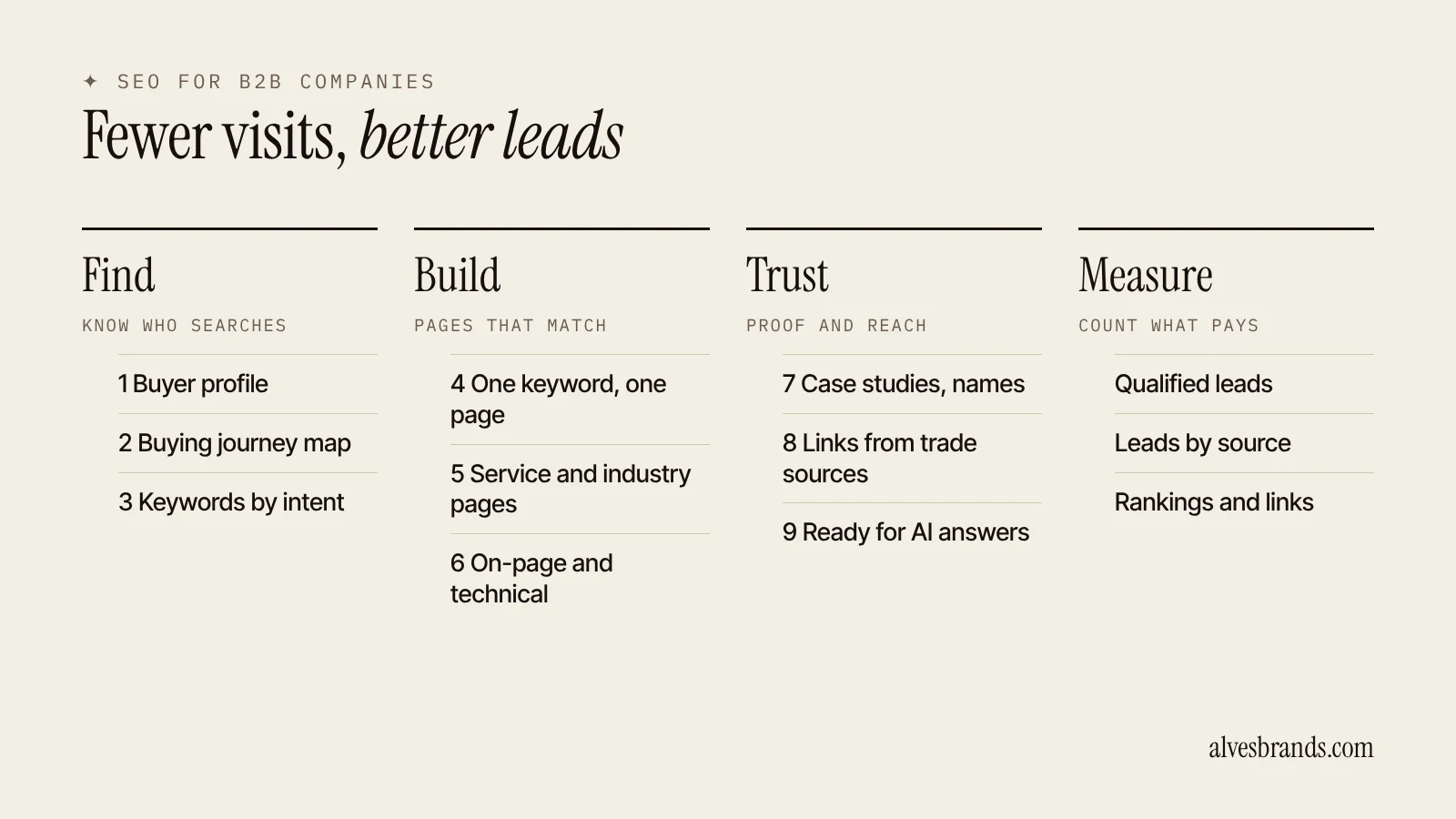
One more point: only a small share of your market is ready to buy today. A common rule of thumb says about 5% are in the market and 95% are not yet. SEO reaches both groups. Bottom-of-funnel pages catch the 5%, and guides keep you in sight for the 95% who will buy later.
The main types of SEO for B2B companies
Not every B2B company needs the same kind of SEO. Pick the one that fits your model, then add the others when you’re ready.
- B2B SaaS SEO. Software companies compete on comparison pages, "alternative to" pages, use cases and integrations.
- B2B ecommerce SEO. Wholesale and trade shops need clean category pages, product data, account-gated pricing handled well and strong filters.
- Enterprise SEO. Large sites with thousands of pages need clear structure, strong templates and a process to stop pages competing with each other.
- Industrial and manufacturing SEO. Factories and suppliers rank for processes, materials, standards and certificates, often with part numbers and specs. See my guide on industrial marketing strategy for how it fits with other channels.
- International SEO. If you sell in several countries, each market needs the right language, currency and local proof. My international SEO page explains the setup.
- Local SEO for B2B companies. Service firms that sell to nearby companies, such as accountants, installers and engineers, need a Google Business Profile and local pages.
Step 1: Decide who you want to find you
In B2B you rarely sell to one person. A buying committee of several people each reads your site with their own question, so write down who they are: the user, the technical checker, the budget holder.
Before you touch a keyword tool, write down who you sell to. Be specific. "Manufacturers" is too broad. "Procurement managers at food packaging plants in the UK with 50 to 500 staff" is something you can write a page for.
Look at your last five or ten best customers and write down:
- What they bought, and how much.
- Their industry, size and country.
- The job title of the person who first contacted you.
- How they found you.
- How long it took from first contact to order.
- What worried them before they said yes.
The last point is gold. Worries become pages. If three customers worried about delivery times, write a page on lead times. If two worried about certificates, make a page for each certificate.
Then list the other people in the buying group. A design engineer, a purchasing manager and a finance director each ask different things. If you don’t answer all three, the one you ignore can stop the deal.
Write this up as a short buyer profile, one page per type of buyer. It is the base of every other step. A weak profile gives you weak keywords and weak pages.
Step 2: Map the buying journey to your pages
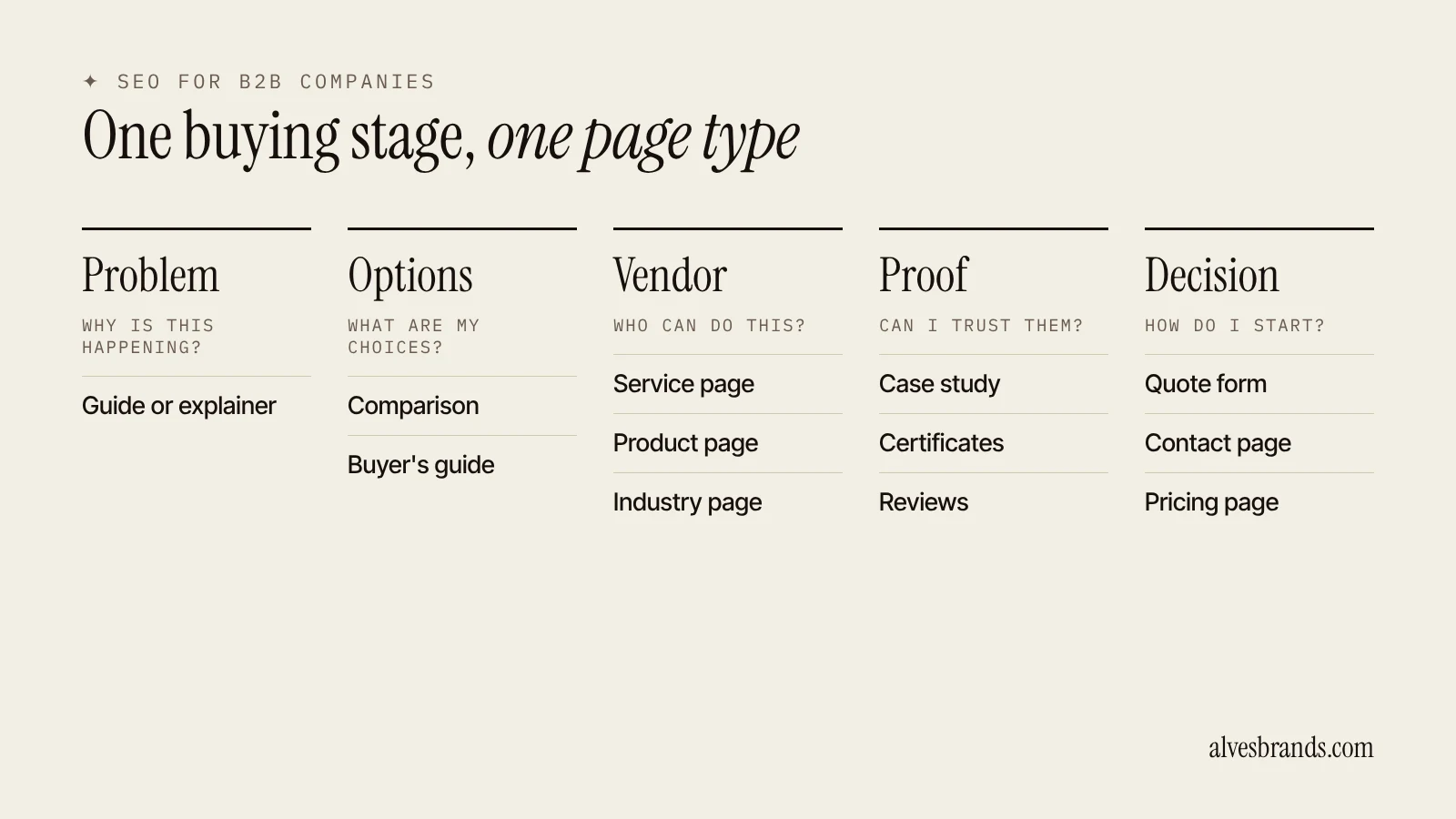
A buyer moves through stages. They notice a problem, look for ways to solve it, compare options and pick a supplier. Your site needs a page for each stage, and the stages need to link to each other.
| Stage | What the buyer asks | Page type | Example |
|---|---|---|---|
| Problem | Why is this happening? | Guide or explainer | "Why do welded joints fail?" |
| Options | What are my choices? | Comparison, buyer’s guide | "Laser cutting vs waterjet" |
| Vendor | Who can do this? | Service, product or industry page | "Sheet metal fabrication for food plants" |
| Proof | Can I trust them? | Case study, certificate, reviews | "ISO 9001 certificate and audit results" |
| Decision | How do I start? | Quote form, contact, pricing page | "Request a quote" |
Most companies build only the vendor stage, and only with a "Services" page that lists everything in one block. That page can’t rank for twenty different searches.
The best first pages are at the vendor stage, because the buyer there is close to a decision. Build those first, then add proof, then the options stage, then the problem stage. That order brings leads sooner.
Step 3: Do B2B keyword research
Good B2B SEO starts with the words buyers type. Keyword research tells you what words your buyers type. For B2B, three habits help.
Start with your own words and your sales team
Ask your sales team what questions buyers ask. Read old emails and quote requests. Write down the exact words customers use for your products, which are often different from yours. A customer might say "stainless tank" when you say "pressure vessel."
Use a tool, then check the result by hand
Tools like Ubersuggest, Semrush and Ahrefs show volume, difficulty and related terms. Put in a seed term, such as "CNC machining" or "invoice software", and look at the related searches.
Don’t trust volume numbers too much. B2B terms often show zero or very low volume in tools, even when real buyers search them. Then do the human check: search the phrase on Google and look at the results. If the top results are suppliers like you, you’ve found a real, commercial keyword. If they’re dictionaries and forums, the intent is different.
Use Google Search Console for free data
If your site is live, Google Search Console shows the searches that already bring people to you. Terms where you rank on page two or three are the fastest wins.
Prefer long, specific phrases, and check competitor gaps
"Aluminum die casting for automotive parts UK" brings fewer clicks than "die casting", but the person who types it has a clear need, and it’s easier to rank for. List the terms three competitors rank for and you don’t, then pick the ones that fit your offer.
Group keywords by search results, not by words
Two keywords that look different can show the same Google results. If so, one page can serve both. Two keywords that look similar can show different results. Then they need different pages. To check, search each keyword and compare the top 10 results. If three or more pages are the same, one page can cover both phrases. If not, use two. For a quick starting list, try the free buyer search generator.
This also protects you from keyword cannibalization, which is when two of your own pages compete for the same search and neither wins.
Step 4: Match each keyword to one page
Then group your pages in topic clusters: one main page for each topic, linked to the supporting pages around it. That shows Google which page leads each topic and builds topical authority.
This step keeps SEO for B2B companies tidy: every page has one job and one main phrase.
Write a simple map in a spreadsheet. Each row is a page. The columns are the main keyword, two or three related keywords, the buying stage, the buyer type, the page URL and a status.
Rules that keep the map clean:
- One main keyword per page.
- One page per main keyword.
- No page without a next step, such as a link to a related page or a contact form.
- Every page links to at least two other pages on your site, and at least two pages link to it.
This map is also your content plan. When you’re not sure what to write next, open the map and pick the empty row with the best chance of bringing a lead.
Step 5: Build the pages that bring leads
For B2B, a short list of page types does most of the work.
Service, product and industry pages
These are your money pages. Each one targets one product, one service or one industry, with the exact words buyers use. Include:
- A clear headline that says what you do and for whom.
- The specs, capacity, materials, standards or features that buyers check.
- Proof: customer names with permission, numbers, certificates, photos of real work.
- Pricing guidance or a range, if you can. Buyers hate hidden prices, and a rough range filters out the wrong people.
- A short form and a phone or email option.
Comparison and alternative pages
Buyers compare before they buy. Pages like "X vs Y" or "alternatives to X" catch people at the moment they choose. Say who each option fits and who it doesn’t. Honest comparisons earn trust and links.
Case studies
A case study answers the buyer’s biggest worry: will it work for someone like me? Keep it simple: the problem, what you did, the result in numbers, a quote from the customer. If you can’t name the client, describe the industry and size. Don’t invent results.
Guides and explainers
These catch buyers early, when they’re learning. Write them for the people in the buying group: the engineer, the buyer, the finance lead. Answer real questions, link to your service pages and add a clear next step. Google’s advice is to create helpful, people-first content, which is a good rule for B2B pages too.
Pricing, process and FAQ pages
A page that says how you work, how long it takes and what it costs answers the questions buyers are afraid to ask. It also brings searches like "how much does X cost" that are close to a decision. My manufacturing lead generation guide shows how to pair these pages with a quote form that works. For a quick estimate, use the free SEO cost calculator.
About, team and contact pages
B2B buyers check who is behind the company. Show real names, photos, address, registration details and ways to reach you. They support trust and quality signals.
Step 6: Get the on-page basics right
On-page work is the cheapest part of SEO for B2B companies, because you control all of it.
On-page SEO means the parts of each page that tell search engines and people what it is. Cover these on every page:
- Title tag. Around 50 to 60 characters, with the main keyword near the start.
- Meta description. 150 to 160 characters that say what the page offers and invite the click.
- One H1. It should say what the page is about in plain words.
- H2 and H3 headings. Use them to break up the page and include related terms naturally.
- URL. Short and descriptive, like /services/cnc-machining/.
- Internal links. Link to related pages with words that describe them, not "click here."
- Images. Real photos with descriptive file names and alt text, compressed so they load fast.
- Structured data. Add structured data for your company, articles and FAQs so search engines can read your page more clearly.
Write for people first. Don’t stuff the keyword. Use it where it fits and use natural variations everywhere else.
Step 7: Fix the technical foundations
Technical problems quietly cap the results of SEO for B2B companies, so check them early.
Technical SEO is what lets search engines crawl and index your site. If it’s broken, the best content stays invisible. Check these:
- Indexing. Make sure the pages you want are in Google’s index. Search Console shows errors.
- Speed and mobile. Many buyers open links on a phone. Google measures page experience with Core Web Vitals. Compress images, skip heavy sliders and test your key pages in PageSpeed Insights.
- Secure site. Use HTTPS everywhere.
- Sitemap and robots file. Give search engines a list of pages and don’t block good pages by mistake.
- Duplicate pages. Use canonical tags so similar pages don’t compete.
- Broken links and redirects. Fix 404s and use 301 redirects when you move a page.
- International setup. If you have several languages, use Google’s guide to localized versions and hreflang tags.
My technical SEO page lists what I check in an audit. If you want a quick start, the SEO audit finds the ten biggest problems and ranks them.
Step 8: Show experience, expertise and trust
In B2B SEO, trust signals do a lot of the selling. Thought leadership and original research set you apart. Your own survey, test results or customer data gives others a reason to cite and link to you, and it shows buyers you know the field.
Google says it looks for signs of experience, expertise, authoritativeness and trust, often called E-E-A-T. For B2B, that means proof that real people with real knowledge are behind the page. You can build it with simple things:
- Author names and bios. Put the name and role of the person who wrote the page.
- First-hand detail. Share what you saw, measured or learned. "In our plant we run X at Y tolerance" beats a general statement.
- Sources. Link to standards, studies and official pages when you cite a fact.
- Customer proof. Logos, quotes, case studies, reviews on third-party sites.
- Clear contact details. A real address, phone, email and company number.
- Up-to-date content. Add dates and refresh pages when facts change.
None of this needs a big budget. It needs honesty and a bit of time.
Step 9: Earn links from the right places
Links still matter in SEO for B2B companies, but a few relevant ones beat many random ones.
Links from other sites tell search engines your site is worth trusting. For B2B, a few good links beat many weak ones. Start with:
- Trade and industry directories that list real companies in your field.
- Industry associations and chambers of commerce where you’re a member.
- Suppliers and customers who can mention you on their sites with permission.
- Industry media. Offer a short, useful comment or data point to trade magazines and blogs.
- Original data. A survey, a benchmark or a simple dataset gives others a reason to link.
- Events and talks. A speaker page on a conference site is a strong link.
Don’t buy links. Google’s spam policies list buying or selling links for ranking purposes as link spam, and the penalty lands on your site. My link building page explains how I earn links from trade sources without risk.
Step 10: Prepare for AI search
Buyers now ask ChatGPT, Gemini, Perplexity and Google’s AI Overviews to build short lists of suppliers. Forrester’s 2025 Buyers’ Journey Survey, cited by WebFX, found that 94% of business buyers say they use AI in their buying process. Ahrefs found that AI Overviews cut the average click-through rate for the top-ranking page by 58%. A ranking alone brings fewer visits than it used to, and being named in the answer counts too.
The good news: Google says there are no extra requirements to appear in AI Overviews or AI Mode beyond being a helpful, indexable page. So the basics matter more, not less. Some habits help:
- Answer the question early. Put a short, direct answer in the first paragraph of the page.
- Be specific. State what you make, where, for whom, with what certificates, in plain words.
- Use clear headings and tables. They make facts easy to pull out.
- Keep your company facts consistent across your site, LinkedIn, directories and press mentions.
- Get mentioned elsewhere. AI tools draw on many sources, so mentions on trusted sites count.
My guide on how to get recommended by ChatGPT explains this in detail, and my AI search optimization page shows how I help clients with it.
What content works best for SEO for B2B companies
If you can only write a few pages this quarter, pick from this list in this order:
- Core service or product pages for your top three offers.
- Industry pages for your top two or three sectors.
- A pricing or "how we work" page.
- Two or three case studies.
- Comparison pages for the choices your buyers make.
- Guides that answer the top ten questions your sales team hears.
- A glossary if your field has terms buyers search for.
Notice that guides come late. Many companies start with a blog and wait a year for results. Start with the pages closest to a sale. For more on what to write, see my content marketing for manufacturers guide.
SEO for B2B companies: the metrics to track
Track fewer numbers and track them well. These are the ones I’d watch:
| Metric | Why it matters | Where to see it |
|---|---|---|
| Qualified leads | The real goal | Your form, CRM or inbox |
| Leads by source | Shows what SEO brings | Analytics, CRM |
| Organic traffic to money pages | Shows if the right pages work | Analytics, Search Console |
| Rankings for target keywords | Early sign of progress | Search Console, rank tracker |
| Click-through rate | Tests your titles | Search Console |
| Conversion rate | Tests page and form | Analytics |
| Backlinks from trusted sites | Authority growth | Link tool, Search Console |
| Branded searches | Awareness growth | Search Console |
| Brand mentions in AI answers | AI visibility | Manual checks of AI tools |
Traffic alone says very little. Ask your sales team to note where each new lead heard of you, and record it. Add a field to your form such as "How did you find us?" and read the answers. It’s a simple way to link SEO to money when the buyer takes months to decide.
Be patient with the numbers
Technical fixes can show results in weeks, new pages often take two to four months, and full effect can take a year. Google warns about SEO providers that guarantee rankings.
Attribution is never perfect. A buyer may read three guides, leave, and come back through a direct visit months later. Add a "How did you hear about us?" field to your forms and compare it with your analytics. The two together give a fair picture.
The ROI of SEO for B2B companies
B2B SEO is easier to defend when you count money. Work out the return in three steps. Count the qualified leads that came from search each month. Multiply by your close rate and your average deal value. Compare that to what you spent on SEO. As an illustration, 5 leads a month with a 20% close rate and a £10,000 deal is £10,000 of new business a month. SEO costs build up front, and the return comes later and keeps coming, so judge it over 12 months, not one.
Common mistakes in SEO for B2B companies
These are the mistakes I see most.
- Chasing high-volume keywords. Big numbers bring the wrong visitors. Aim for specific, commercial phrases.
- Ignoring the buying journey. A site with only blog posts or only a services page misses half the buyers.
- Weak landing pages. Vague text, stock photos and no proof lose visits that you paid hard to win.
- No next step. A page without a form, a link or a call to action is a dead end.
- Skipping trust signals. No names, no address, no proof. Buyers leave.
- Not matching sales and SEO. If sales don’t tell SEO what buyers ask, you write the wrong pages.
- Copying B2C tactics. Listicles, clickbait and thin pages don’t work on engineers and buyers.
- Writing for search engines, not people. Keyword stuffing and thin text hurt.
- No tracking. You can’t improve what you don’t measure.
- Giving up too soon. Many sites quit at month three, right before results start.
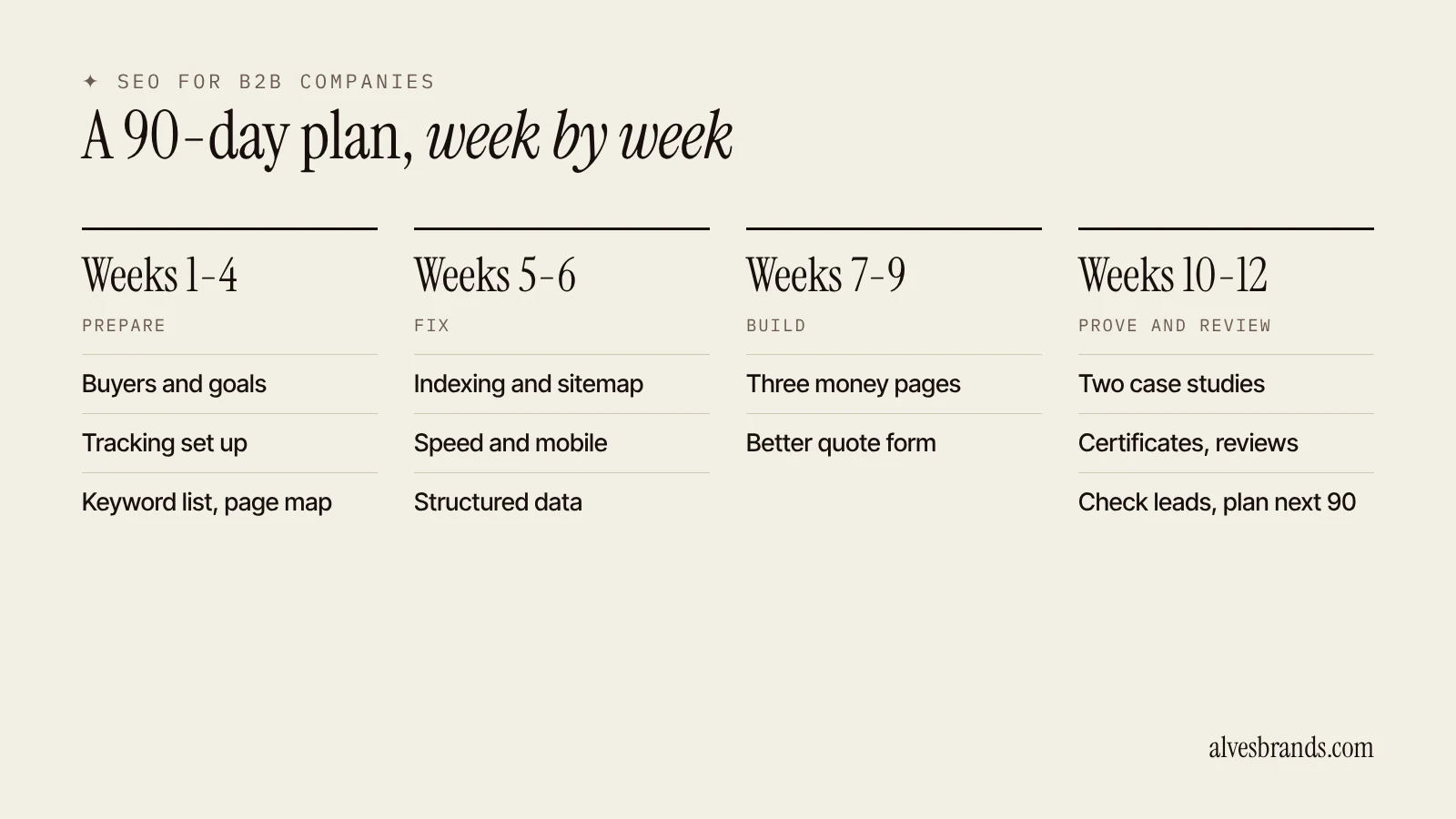
A simple 90-day plan
Here is how I would start SEO for B2B companies if I joined your team tomorrow.
If you start from scratch, here is a plan that works for a small team.
| Weeks | Focus | Output |
|---|---|---|
| 1 to 2 | Buyers and goals | Buyer profiles, goal for leads, tracking set up |
| 3 to 4 | Research | Keyword list, competitor review, page map |
| 5 to 6 | Technical fixes | Indexing, speed, mobile, sitemap, structured data |
| 7 to 9 | First money pages | Three service or product pages, form improved |
| 10 to 11 | Proof | Two case studies, certificates, reviews, about page |
| 12 | Review | Check rankings, leads, plan the next 90 days |
In the second quarter, add industry pages, comparison pages and your first guides. Start link building with directories and partners. Check AI answers for your top questions and fix gaps.
A quick example of the whole method
Say you sell packaging machines to food factories. You pick one buyer, the plant manager, and find she searches for "tray sealing machine for ready meals" and "how to cut packaging downtime". You build one page for the machine, one for the food industry, one case study with real downtime numbers and one guide on cutting downtime. Each links to the others and to a quote form. Then you ask two happy customers for a quote and a link. That is SEO for B2B companies in one paragraph: a real buyer, her real searches, one page for each, proof and a clear next step.
Tools you need
Start with three free tools: Google Search Console for real searches, Google Analytics 4 with form submissions and calls set up as events, and a crawler such as Screaming Frog’s free plan. Add Ubersuggest, Semrush or Ahrefs for volume and competitor pages when a question needs them.
In-house, freelancer or agency?
You can do SEO for B2B companies in three ways.
- In-house. Best if you can hire or train someone who knows the product and SEO. You control it, but you need time and tools.
- Freelancer or consultant. Good for a focused plan, audits and training. You get senior thinking at a lower cost than an agency.
- Agency. Good if you need many people, many pages and many markets.
Ask any provider these questions: who will do the work, which pages will they change, how will they measure leads, what do they need from you and how do they build links. If an answer is vague, keep looking. My guide on how to choose a manufacturing marketing agency has ten more questions that work for any B2B firm.
On cost, there’s no standard price. Prices depend on the size of your site, how many markets you sell in and how competitive your keywords are. Compare what each provider will do, not just the monthly fee.
SEO for B2B companies for manufacturers and exporters
Buyers search by process, material, standard and country, and want specs, certificates, lead times and shipping terms. If you sell abroad, add an export page and translate your top pages. See how foreign buyers find suppliers, the multilingual website checklist, B2B manufacturing marketing and account-based marketing for manufacturers.
Once SEO is in place, build the rest of your B2B marketing plan.
Looking for a partner instead? See the B2B SEO agency page or hire an SEO consultant.
For the step-by-step plan, read the B2B SEO strategy guide.
Frequently asked questions
What is SEO for B2B companies?
It’s making your website rank in search results, and appear in AI answers, when business buyers look for what you sell. It aims at qualified leads, not just visits.
How is SEO for B2B companies different from B2C SEO?
B2B buyers search with more specific words, decide as a group and take longer. Pages need more proof, and the goal is a lead, not an instant sale.
How long does SEO for B2B companies take to work?
Technical fixes can help within weeks. New pages usually take two to four months, steady growth shows around three to six months, and the full effect can take a year.
How much does SEO for B2B companies cost?
It depends on your site, markets and competition. Compare scope, not just price: which pages, how links are earned and how leads are tracked.
Which B2B keywords should I target first?
Commercial keywords close to a purchase: your service plus the industry, material, standard or location. Then comparison terms and guides.
Do B2B companies need a blog?
Not first. Build service, industry, proof and pricing pages, then add guides around real buyer questions.
How do I get leads from SEO?
Match pages to buyer questions, make the next step obvious, answer fast and track each lead’s source. My manufacturing lead generation guide covers follow-up.
Does AI search kill SEO for B2B companies?
No, but it changes it. Click-through rates on top results can fall, so being named in AI answers matters too. Clear pages, proof and mentions on trusted sites decide who gets named.
Can I do SEO for B2B companies myself?
Yes, if you can spend a few hours a week for several months. Start with the 90-day plan above, and ask for a free website check if you want someone to review your work.
Want to know where your company stands in Google and in AI answers? Ask me for a free website check. I’ll show you what buyers see and what to fix first.