Social media marketing for manufacturers means using LinkedIn, YouTube and a couple of other channels to get in front of the engineers and buyers who pick suppliers. It won’t close a deal on its own. It makes sure your name is already familiar when a buyer starts looking.
That’s a smaller job than most agencies sell, and it’s the honest one. Your factory doesn’t need a viral video or ten thousand followers. It needs the right 300 people to see real proof of your work, again and again, until one of them has an RFQ to send.
This guide shows what social media can and can’t do for a factory, which platforms to pick, what to post, a weekly routine that takes about three hours and how to count the results. For the bigger picture, read the manufacturing marketing plan next to it.
What social media can do for a factory (and what it can’t)
Let’s start with the number that most social media guides skip. A Thomas survey of 266 industrial buyers found that 73% focus on the company website when judging a supplier, and only 10% focus on social media. The survey is from 2019, but the pattern holds up: buyers check your website to decide, not your feed.
So social media is not your sales channel. Think of it as three jobs:
- Be remembered. A buyer who saw your shop-floor video last month picks up the phone faster.
- Prove you’re real. Photos, certificates and customer stories show a working factory with real people.
- Send people to your site. Every post should lead somewhere that sells, like a capability page or a case study.
If your website is weak, fix that first. A post that sends a buyer to a thin page wastes the click. The manufacturing lead generation guide shows what a page needs to turn a visit into an RFQ.
Which platforms to pick
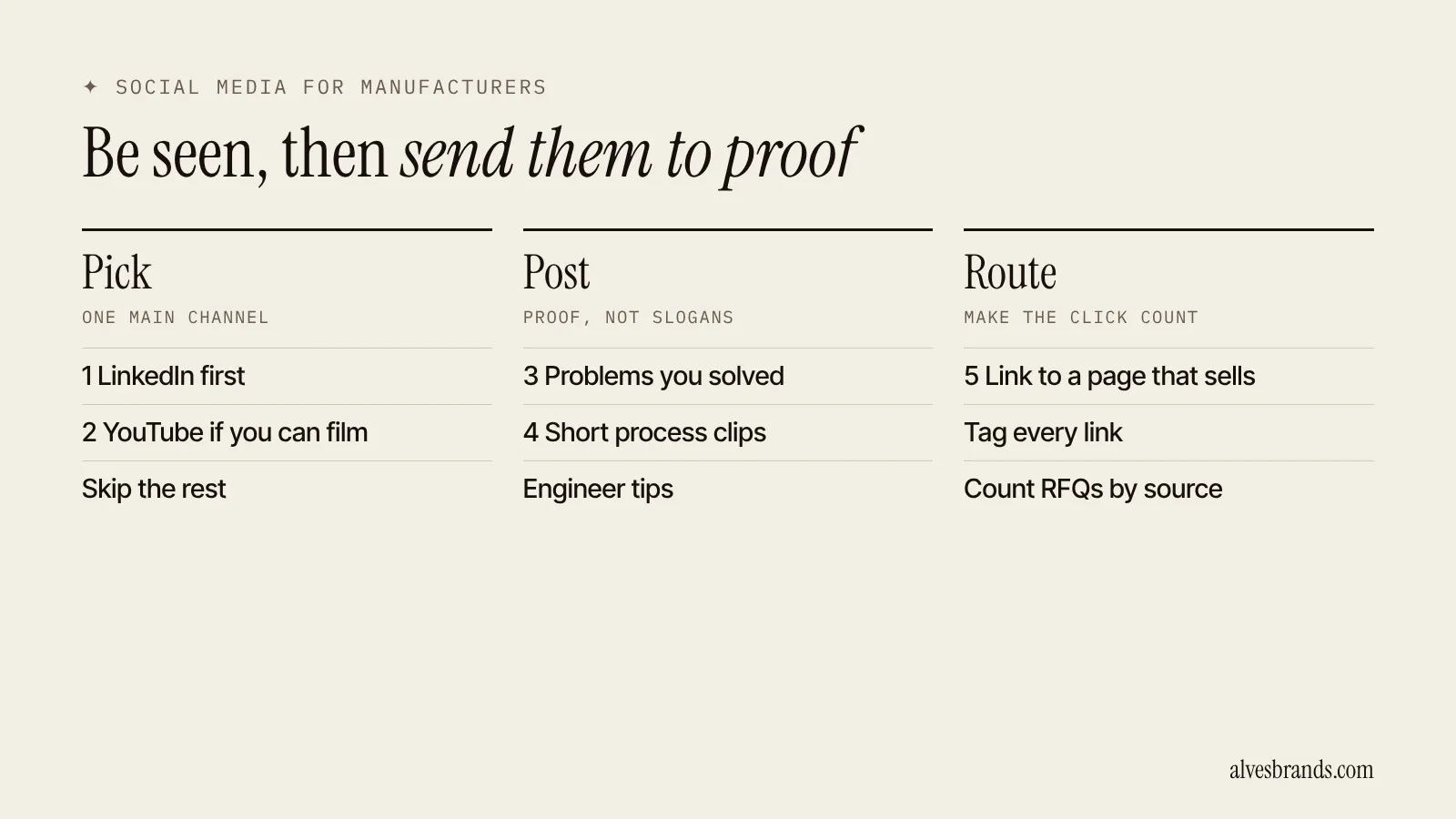
You don’t need every platform for social media marketing for manufacturers. Pick one main channel, one backup and ignore the rest until the first two run on their own.
| Platform | Who’s there | Best use for a factory | Effort |
|---|---|---|---|
| Engineers, purchasing managers, distributors | Company news, case studies, engineer posts, outreach | Medium | |
| YouTube | Engineers who want to see a process | Short shop-floor and how-it-works videos | High at first, then low |
| Facebook and Instagram | Local community, job seekers | Hiring, culture, events | Low |
| Existing customers and agents | Quick replies, quote follow-ups | Low | |
| X, TikTok | Mixed | Skip until the first two work | N/A |
LinkedIn is the main channel for almost every B2B factory. In the Content Marketing Institute’s manufacturing study, 85% of manufacturing marketers said LinkedIn gives them the most value, and 74% rated video the best-performing content type. LinkedIn says it has more than 1 billion members in more than 200 countries and territories, so your buyers are almost certainly there.
YouTube is your second pick if you can film. Engineers love watching a process they can’t see at their own desk. A two-minute clip of your machine running does more than a page of adjectives.
One warning for exporters. In some countries buyers network on other platforms. Ask your three best foreign customers where they spend time for work. Their answer beats any chart.
Set one goal and one audience
“Get more followers” is not a goal. Pick one of these instead:
- Get ten RFQs a quarter from a named industry.
- Book five calls with distributors in one country.
- Fill two open jobs on the shop floor.
Then write down who you want to reach. One sentence is enough: “Purchasing managers at medical device makers in Germany and the Netherlands.” Every post speaks to that person. If you try to reach everyone, you reach nobody.
What to post
Your engineers know things your buyers want to learn. Turn that knowledge into short posts. These formats work for factories because they show proof instead of slogans:
- A problem you solved. One customer, one problem, one result. Add a photo of the part.
- A how-it-works clip. Thirty to ninety seconds of a process, with a plain caption.
- An engineer’s tip. “Why we change the tool at 400 parts, not 500.” Real details beat generic advice.
- A new capability. A new machine, a new certificate, a new material you can cut.
- A trade show recap. Who you met and what you showed. The trade show marketing guide covers the follow-up.
- A people post. A new hire, an apprentice, a 20-year employee. Buyers like knowing who they’ll work with.
- A hard number. Lead time, scrap rate, on-time delivery. Use only numbers you can back up.
Keep the writing plain. Say what the part is, what the problem was and what you did. Skip “we’re excited to announce” and the stock photos.
A weekly routine that takes three hours
Consistency beats volume. This routine fits a small team:
| Day | Task | Time |
|---|---|---|
| Monday | Ask one engineer for a story, photo or video from the week | 20 min |
| Tuesday | Write and schedule the main post | 40 min |
| Wednesday | Reply to every comment and message | 20 min |
| Thursday | Comment on five posts from customers, partners or target buyers | 30 min |
| Friday | Check what worked, note one lesson | 20 min |
That’s two and a half hours, plus a little slack. Once a month, spend an extra hour planning the next four weeks of topics from your engineers’ answers and the questions customers ask.
Thursday is the day most factories skip, and it matters. Commenting on other people’s posts puts your name in front of their audience. It’s the closest thing to free outreach.
Use your people, not just the company page
A company page has a small reach. People get seen more. Ask your sales lead, your head engineer and your founder to post from their own profiles. Give them the facts and let them say it in their own words.
Set a few simple rules so it doesn’t get messy:
- The company page posts the official news.
- Engineers post what they learned.
- The sales lead shares customer stories and follows up on comments.
- Everyone links to the same pages on your site.
Social media marketing for manufacturers that export
If you sell abroad, social media has a second job: showing buyers in other countries that you’re real and reachable. Here’s how to adapt.
Post for the market, not just the language. A translated post that talks about a problem nobody has in that country falls flat. Pick the issues your buyers there actually face.
Mind the time zones. Schedule posts for the morning in the country you target, not your own.
Tag partners. Agents, distributors and trade bodies in your target countries can share your posts and give you their audience. Ask them first.
Link to the translated page. If the post is in German, the link goes to the German page. Sending a German buyer to an English-only site loses them. My multilingual website checklist covers what to translate first.
Show your certificates and export experience. Buyers abroad check whether you’ve shipped to their country before. Post about it.
Foreign buyers also look for you on Google before they trust a feed. How foreign buyers find suppliers walks through what they search for and where.
Send social traffic to a page that sells
Every post needs a next step. Pick the one page that fits the post and link to it. A case study post links to the case study. A capability post links to the capability page. A hiring post links to the jobs page.
Check these things before you push traffic:
- The page loads fast on a phone.
- The phone number and the RFQ form are easy to find.
- The page matches what the post promised.
- It’s clear what to do next.
Add a tracking tag to each link so you can see which post sent the visitor. A free tool like Google’s Campaign URL Builder does this in a minute. Without tags, social traffic shows up as “direct” and you learn nothing.
What to measure
Skip likes. They feel nice and tell you almost nothing. Track these:
- RFQs and calls by source. Ask “how did you find us?” on every form and call. Write the answer down.
- Visits from social to your key pages. Use the tags from the step above.
- Profile views and connection requests from your target buyers.
- Replies and comments from people on your target list. One reply from a purchasing manager beats a hundred likes from classmates.
Review the numbers once a month. If a post type brings replies from the right people, make more of it. If nothing brings the right people after three months, change the topic, not the platform.
Be patient. Social media marketing for manufacturers builds slowly. Give it six months of steady posting before you judge it. And keep it in proportion: it supports your content marketing and your email follow-up, it doesn’t replace them.
Mistakes to avoid
- Posting without a goal. Without one you can’t tell if it works.
- Only posting company news. Nobody follows a press release feed.
- Going on every platform. Do one well first.
- Ignoring comments. A comment is a buyer talking to you. Answer within a day.
- Linking to a weak page. The click is wasted.
For construction firms, see digital marketing for construction companies.
Frequently asked questions
Do manufacturers need social media?
Yes. Social media marketing for manufacturers works best as a small version: a tidy LinkedIn page and regular posts from your engineers are enough to start. Your website matters more, so build that first.
Which social media platform is best for manufacturers?
LinkedIn, for almost every B2B factory. Add YouTube if you can film short process videos.
How often should a manufacturer post?
Two to three times a week on LinkedIn is plenty. One steady post a week beats a burst of ten followed by silence.
What should a manufacturer post on social media?
Solved problems, short process clips, engineer tips, new capabilities, trade show recaps and people stories. Show proof, not slogans.
How do I get RFQs from social media?
Post proof, link every post to a page that sells and answer every comment. Ask new customers how they found you so you can see which posts work.
How much does social media marketing cost for a manufacturer?
You can start with about three hours a week of your own team’s time. Costs rise if you hire a writer, a video editor or an agency, or run paid ads. Track cost per RFQ to see if it pays.
How long does it take to see results?
Replies and connection requests can come in weeks. RFQs from social usually take three to six months of steady posting.
Not sure if your website is ready for social traffic? Ask me for a free website check. I’ll show you what buyers see when they click and what to fix first.