Digital marketing for manufacturers is everything a factory does online to get found, trusted and chosen by business buyers: its website, search engine optimization (SEO), content, paid ads, email, LinkedIn and the way it tracks leads. The goal isn’t traffic. It’s quote requests from companies that can actually buy.
A few years ago a manufacturer could get by with a catalog, a trade show booth and a good sales rep. That still helps. But the first look at your company now happens on a screen, often before anyone on your team knows it happened. This guide shows how to build that first impression and turn it into leads.
If you want the wider picture, start with my complete guide to marketing for manufacturers. If you’re choosing what to do first, the manufacturing marketing plan puts it in order. For the choices behind each channel, see manufacturing marketing strategies.
Why digital marketing for manufacturers matters
Industrial buyers research online, and they do it alone. A 2026 Gartner survey of 646 B2B buyers found that 67% prefer a rep-free buying experience, and 45% had used AI during a recent purchase. The 6sense 2024 Buyer Experience Report found buyers are nearly 70% through the process before they speak to a supplier, and 81% already have a favorite by then. New to the term? Start with what is industrial marketing.
So your sales team joins late. Digital marketing is how you show up early, while the buyer is still building a shortlist.
It also reaches further than a rep can. A buyer in Poland, Mexico or Vietnam can find your product page at 2 a.m. and send a request while your plant is closed. For exporters, that reach is the main reason to invest.
How digital marketing differs for manufacturers
Selling to consumers is fast and emotional. Selling industrial products is slow and careful, which changes what works online:
- Searches are specific. Buyers type part names, materials, standards and process names, not brand slogans. Volumes are small, but each search can be worth a large order.
- Several people decide. Engineers read specs, purchasing compares price and terms, and managers look for risk. Your site needs something for each of them.
- The cycle is long. A buyer may visit three or four times over several months before sending a request. You need to stay visible the whole time.
- Proof comes first. Data sheets, certifications, tolerances and customer references count for more than design.
Keep this in mind for every choice below. You’re not trying to impress a crowd. You’re trying to be the obvious, checkable answer for a small group of well-informed buyers.
The building blocks of digital marketing for manufacturers
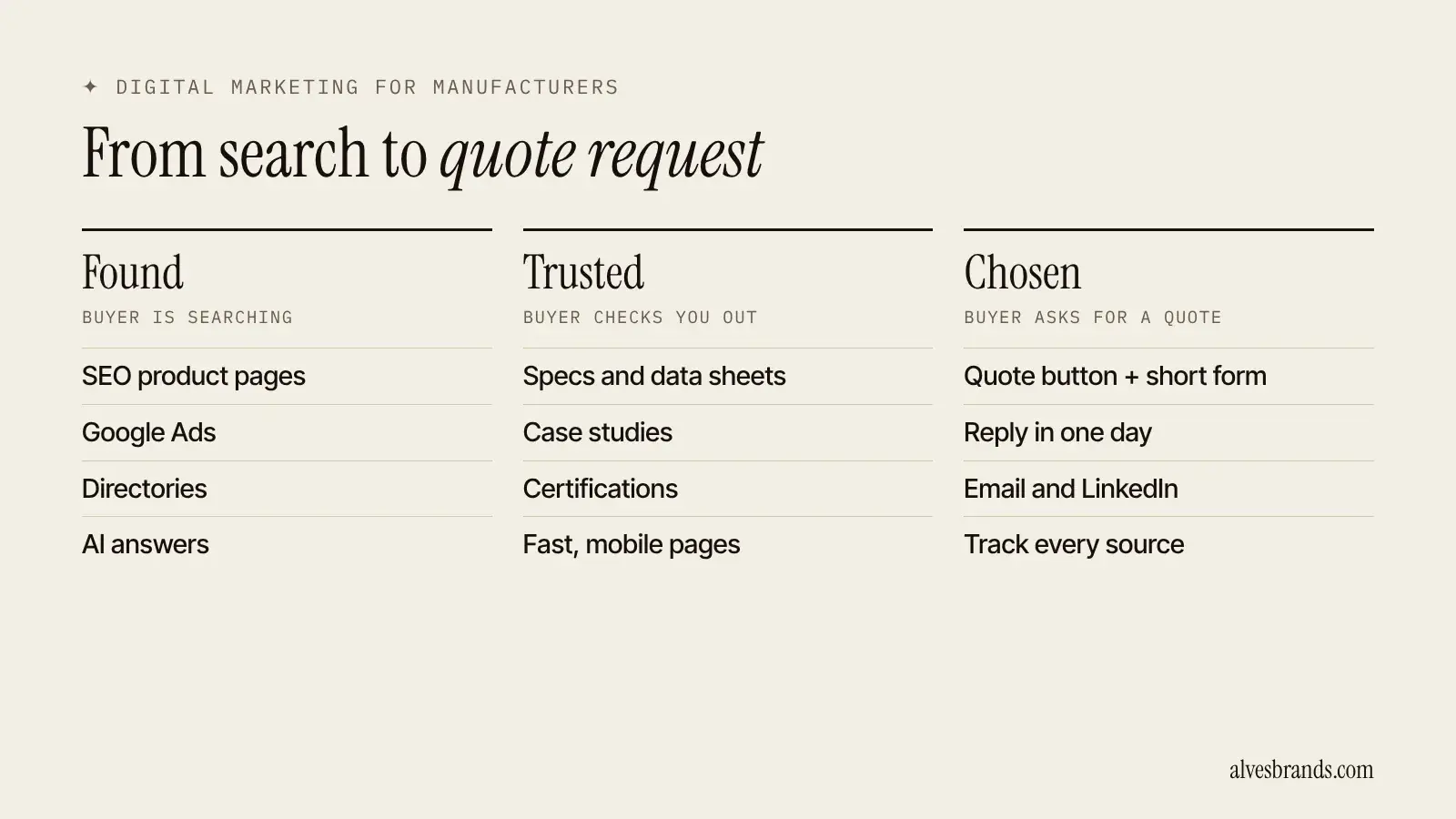
Think of digital marketing for manufacturers as a chain. Each link depends on the one before it.
- A website that explains what you make. This is the base. Everything else sends people here.
- Search visibility. SEO puts your pages in front of buyers who are already looking.
- Content that answers questions. Guides, case studies and videos earn trust and links.
- Paid ads. They speed things up while SEO builds.
- Email and LinkedIn. They keep you in front of leads and customers.
- Tracking and follow-up. They show what works and make sure no inquiry is lost.
If the first link is weak, the rest leak. A big ad budget sent to a vague homepage is the most common way I see manufacturers waste money.
Step 1: Build a website that sells
Your website is your digital sales rep. It works every hour and talks to every buyer.
Show the product clearly
Give each product, material or service its own page. Include specs, sizes, materials, tolerances, certifications, minimum order quantities, lead times, photos and downloadable data sheets. Buyers who can’t find a spec move on to the next supplier. They rarely send an email to ask.
Make it fast and mobile friendly
Many buyers open links from email or search on a phone, even in industrial sectors. Slow pages lose them. Google measures this with Core Web Vitals: loading speed, responsiveness and visual stability. Compress images, avoid heavy sliders and test your key pages for free in PageSpeed Insights.
Make the next step obvious
Put a “Request a quote” button on every product page and a short form: name, company, email, what they need, quantity. Add a phone number and an email address. If you sell abroad, add WhatsApp or the messaging app your buyers use.
Add trust signals
Show certifications, customer logos you’re allowed to use, years in business, factory photos and short case studies with numbers. These answer the question every buyer has: “Can I trust this company?”
A quick website check
Open your own site on a phone and ask:
- Can I tell what this company makes within five seconds?
- Does every product have a page with specs, not only a photo?
- Is the quote button visible without scrolling?
- Does each page load in about three seconds or less?
- Do I see proof: certifications, customers, a real address?
Every “no” is a leak. Fix those before you spend on ads.
Step 2: Get found with SEO
SEO means making your pages the best answer to what buyers search. For manufacturers it comes down to four habits.
Research the words buyers use. Talk to sales and ask what customers say on calls. Check them in a keyword tool or in Google Search Console. Buyers say “aluminum extrusion supplier”, not “metal solutions provider”.
Match one page to one search intent. A product page for “stainless steel flanges supplier”, a guide for “how to choose a flange material”. Don’t cram everything onto one page.
Write for people first. Google’s guidance on creating helpful, people-first content says to show first-hand experience and give real answers. Your engineers know things competitors’ marketing teams don’t. Use that.
Fix the technical basics. Use clean page titles, short descriptive URLs, a sitemap and secure hosting. Add structured data for your company and products so search engines understand them.
SEO takes time. Expect the first movement in three to six months for low-competition searches, and more after that. It’s slower than ads, but the traffic doesn’t stop when you stop paying.
Step 3: Publish content that answers real questions
Content is how you earn trust before the first call. The Content Marketing Institute’s manufacturing research found that 74% of manufacturing marketers rated video their most effective content type. Good formats for a factory:
- Guides and how-tos. “How to choose a bearing material”, “What tolerance can CNC machining hold”. Pull the questions from your sales team’s inbox.
- Case studies. Problem, solution, result, with numbers and, if possible, the customer’s name.
- Short videos. A machine running, a quality check, a product being packed. Phone quality is fine.
- Spec and comparison pages. Material A against material B, with the reasons each is used.
- Downloads. CAD files, data sheets and catalogs, ideally behind a simple form when the file is valuable.
CMI’s 2026 B2B research found that LinkedIn is the top channel for sharing thought leadership (76%), then email newsletters (54%) and webinars (52%). So write once and share in all three places.
The same research shows what holds teams back: 40% struggle to create content that drives action and 39% name limited resources. Plan fewer pieces and make each one end with a clear next step.
Step 4: Use paid ads to speed things up
Google Ads is the fastest way to get qualified traffic while SEO builds. Use it with care:
- Target narrow, high-intent searches. “Custom stainless steel enclosure manufacturer” beats “metal products”.
- Send people to the matching product page. Not the homepage.
- Exclude waste. Add negative keywords like “jobs”, “free”, “DIY” and “used”.
- Start small. Test with a modest daily budget for four to six weeks before you scale.
- Track the result. Count quote requests, not clicks.
LinkedIn ads can reach job titles and company sizes, which helps for account targeting. They cost more per click, so use them for high-value products or key accounts, and keep the audience small.
Retargeting is cheap and works well for long cycles. It shows your ads to people who visited your site and didn’t ask for a quote.
Step 5: Stay in touch with email and LinkedIn
Most visitors won’t ask for a quote on the first visit. Email and LinkedIn keep you in their view.
Email. Build a list from quote requests, trade show contacts and downloads. Send something useful every month or two: a case study, a new capability, a guide, a lead-time update. Keep it short and personal. Segment by interest so a buyer of valves doesn’t get news about pumps. More in my guide to email marketing for manufacturers.
LinkedIn. Post from the company page and from your team’s profiles. Show projects, plant updates, certifications and technical tips. Connect with customers and with the engineers and buyers in your target accounts. Don’t pitch in the first message.
Step 6: Track leads and follow up fast
You can’t improve what you can’t see. This is the least glamorous part and the one that pays back most.
- Install Google Analytics and set a key event for every form submission, quote click and phone-number click.
- Use Search Console to see which searches bring visitors.
- Add UTM tags to links in emails and ads so you know the source of each visit.
- Use a simple CRM and record where each lead came from.
- Reply to every inquiry within one business day. Same day is better.
Give each channel a simple target for the first quarter, for example five qualified quote requests from search, three from email and two from LinkedIn. Targets don’t have to be perfect. They make you look at the numbers every month and decide where the next hour of work should go. Revisit them after ninety days.
CMI found that 64% of manufacturing marketers find it hard to tie their content to revenue. The usual cause is simple: nobody wrote down where the lead came from. A spreadsheet is enough to start.
Your website product data matters more than you think
Industrial buyers compare by specification. If your numbers are missing, inconsistent or buried in a PDF, you lose the comparison before it starts. Treat product data as a marketing asset:
- Keep one source of truth for dimensions, materials, tolerances, standards and part numbers.
- Publish the same data on the product page, the downloadable data sheet and any distributor or directory listing.
- Offer CAD files, drawings or 3D models for download when buyers need them for design work.
- Use clear, searchable page titles that include the product type and the key attribute, such as “Stainless Steel Tube, 316L, Seamless”.
Search engines and AI assistants both read this data. The clearer it is, the more often your products appear in the right comparisons.
Digital marketing by stage of the buying journey
Match what you publish to where the buyer is:
| Stage | What the buyer is doing | What to offer |
|---|---|---|
| Problem | Learning what’s possible | Guides, videos, comparison pages |
| Options | Building a shortlist | Product pages, spec sheets, case studies |
| Decision | Comparing suppliers | Certifications, references, samples, fast quotes |
| After the sale | Reordering, expanding | Email, service updates, new-product news |
Most manufacturers only cover the “Decision” row and wonder why they’re never shortlisted. Cover the first two as well.
Digital marketing for manufacturers: channels compared
Not every channel suits every factory. Use this as a quick filter when you decide where the first budget goes:
| Channel | Speed | Cost | Best for |
|---|---|---|---|
| SEO and content | Slow (3 to 6 months) | Low to medium | Steady leads from buyers already searching |
| Google Ads | Fast (days) | Medium to high | Quick tests and high-margin products |
| Medium | Low (organic) to high (ads) | Reaching engineers, buyers and key accounts | |
| Fast | Low | Existing customers and warm leads | |
| Directories and marketplaces | Medium | Low to medium | Being listed where buyers already compare suppliers |
| Video | Medium | Low | Showing machines, quality and the process |
If you can only do two things, pick SEO and email. One brings new buyers, the other turns warm leads and customers into repeat orders.
Directories, marketplaces and your Google listing
Many buyers don’t start on your site, so directory listings matter. They start in a directory such as Thomasnet, in an industry marketplace or on a map listing. Make sure your company is listed in the two or three places your buyers use, with the same name, address, phone number and product list that appear on your website. Mismatched details confuse both buyers and search engines.
Claim your Google Business Profile too. It helps local searches and shows your address, hours and photos to people checking you out before a visit or an audit.
The tools you need (and the ones you don’t)
You don’t need a big software stack. A small, connected set is enough:
- A website you can edit yourself. Adding a product page shouldn’t need a developer.
- Analytics and Search Console. Both are free.
- A CRM. Even a simple one. It stores every lead, the source and the status.
- An email tool. For newsletters and follow-ups, with a signup or download form.
- A shared product data file. One place for specs and photos, so the website, catalogs and distributors all show the same facts.
Webinars, demos and virtual events
Digital events work well for technical products. A 30-minute webinar on “choosing the right coating for outdoor use” attracts the engineers you want, and the recording keeps working afterwards. Offer a live demo or a video call with an application engineer for complex products. Record every session and share short clips.
A simple monthly rhythm
Digital marketing works best as a habit, not a campaign. Here’s a rhythm a small team can keep:
- Week 1: publish one guide or case study from a real customer question.
- Week 2: share it on LinkedIn from the company page and two employee profiles.
- Week 3: send it to your email list with one short sentence on who it helps.
- Week 4: review the numbers, update one older page and reply to anything left open.
Twelve months of this adds up to a library of twelve useful pages, a growing email list and a clear view of what your buyers care about. If twelve months feels long, start with one guide per quarter. Consistency matters more than volume, and a modest schedule you keep beats an ambitious one you drop in March. Add a second guide per month only when the first rhythm feels easy.
CRM and marketing automation
A CRM stores every contact and every conversation, so no lead depends on one person’s memory. Start with the basics: a form that feeds the CRM, a source field on each lead and a status for each stage, from new inquiry to quote sent to order won or lost. Review the CRM once a month for stalled leads and call the ones that still fit.
Marketing automation comes later. Once you have steady leads, simple automations help: a thank-you email after a download, a reminder to sales when a lead visits the pricing or quote page twice and a follow-up after a quote goes quiet. Keep the messages short and personal. Automation should save time, not make buyers feel processed.
Where to put your first budget
If you’re deciding where the first money goes, follow the order of the chain:
- Tracking and the website. Without these, nothing else can be measured or converted.
- Product pages and SEO. They build a base that keeps paying.
- Email and a CRM. They protect the leads you already have.
- Search ads for your best products. They bring faster tests and quick leads.
- Video, events and ABM. Add them once the base works and you know what a lead is worth.
Moving down the list too fast is the usual reason digital budgets disappoint. Spending a little on each step in order beats spending a lot on the last one.
Account-based marketing for key customers
If you sell to a small number of large accounts, account-based marketing (ABM) can beat broad campaigns. You pick 20 to 50 target companies, find the engineers, buyers and managers who matter, and reach them with focused content, LinkedIn outreach and email. It needs more manual work but suits high-value orders. Start with five accounts and learn before you scale. My guide to account-based marketing for manufacturers has a 90-day pilot plan.
Getting found by AI assistants
Buyers now ask ChatGPT, Gemini, Claude and Perplexity for supplier ideas. Ahrefs found that AI Overviews cut the average click-through rate for the top-ranking page by 58% in their December 2025 desktop data. When clicks fall, being named inside the answer matters more.
What helps: clear pages that state what you make, where you sell and what certifications you hold, consistent company details across your website and directories, and content that answers common questions plainly. I cover this in my guide on getting recommended by ChatGPT.
Selling abroad? Add language and country setup
If you export, your digital marketing should speak your buyers’ languages. Build pages in each target language, not just a translation widget, and tell Google which version belongs to which country (international SEO), as Google’s guide to localized versions explains. Then list the company in the directories and marketplaces those buyers use. My multilingual website checklist and my guide on how foreign buyers find suppliers go through it step by step.
Who should run it, and what it costs
You have three routes:
- In-house. One person with a few hours a week can run the basics. They know your product best.
- Freelancers or specialists. Good for single jobs like SEO, a website rebuild or video.
- An agency. Useful when you need many skills at once. Pick one with industrial examples and ask for the numbers. How to choose a manufacturing marketing agency gives you ten questions to ask and a scorecard.
For budget, the Gartner 2026 CMO Spend Survey found marketing budgets average 7.8% of revenue. Many smaller manufacturers spend less. Start with the website, SEO and tracking, then add ads and events once you know what a lead is worth. For a quick estimate, use the free SEO cost calculator.
Digital marketing for manufacturers: common mistakes
- Sending ad traffic to the homepage. Use specific landing pages.
- Hiding specs behind a contact form. Engineers want data first.
- Chasing vanity numbers. Followers and page views don’t pay invoices.
- Letting leads go cold. A reply after three days loses to the supplier who answered in three hours.
- Copying consumer tactics. Viral content isn’t a goal in B2B.
- Stopping too early. SEO and content need months before you can judge them.
How to measure digital marketing for manufacturers
Review these every month with the sales team:
- Qualified quote requests
- Cost per qualified lead
- Quote-to-order rate
- Revenue from new customers
- Organic visits to product pages, by country
- Lead source
Keep what brings orders, fix what doesn’t and stop what produces nothing after an honest three months of effort.
How to get started this month
- List your three best customer types and how each found you.
- Give each main product its own page, with specs and a quote button.
- Set up Search Console and Analytics with key events.
- Publish one guide that answers a question your sales team hears every week.
- Reply to every inquiry the same day, even briefly.
Then follow the 90-day plan in my marketing for manufacturers guide, or see how to market a manufacturing company from zero.
Search is the biggest piece of digital work. My guide to SEO for manufacturers shows how to do it step by step.
For LinkedIn and YouTube in detail, read social media marketing for manufacturers.
Building firms and contractors can read digital marketing for construction companies.
Frequently asked questions
What is digital marketing for manufacturers?
It’s the online work a manufacturer does to be found and chosen by business buyers: website, SEO, content, ads, email, LinkedIn and lead tracking. The goal is qualified quote requests.
Which digital channel works best for manufacturers?
Search, meaning SEO plus Google Ads, because buyers use it to find suppliers. Add LinkedIn for B2B reach and email to stay in touch with leads and customers.
How long does it take to see results?
Ads can produce leads in days. SEO and content usually take three to six months. Email to existing contacts can produce orders within weeks.
Do small manufacturers need digital marketing?
Yes. A small company with a clear website and a few good guides can win orders from buyers it would never meet otherwise. Start small and track results.
How is B2B digital marketing different from consumer marketing?
Fewer buyers, longer decisions, bigger orders and more technical detail. You win with proof and clarity, not with volume.
If you want to know where your company stands today, ask me for a free website check. I’ll show you how you appear on Google and in AI answers in your most important markets, and what to fix first.