Email marketing for manufacturers is the simplest way to stay in front of buyers between orders. You collect the emails of customers, prospects and distributors, then send them useful updates: new products, case studies, technical tips, event invites and quote follow-ups. Done well, it keeps your factory on the shortlist without a salesperson calling every week.
If you sell, install or service equipment instead of making it, read marketing for industrial companies.
It’s cheap, you own the list, and it works with the long sales cycles of industrial buying. This guide covers how to build the list, what to send, which emails to automate, the rules you can’t ignore and how to measure what matters: quote requests.
Why email marketing for manufacturers works
Industrial buyers don’t buy the day they meet you. They buy when a project starts, a supplier fails or a machine needs replacing. Email keeps you in their inbox until that day comes.
A few reasons it’s worth the effort:
- It pays back. In Litmus’s 2025 State of Email report, 35% of marketing leaders said email returns $10 to $36 for every $1 spent, and another 30% reported $36 to $50.
- You own it. Search rankings and social reach can change overnight. Your email list stays yours.
- B2B buyers read it. The Content Marketing Institute’s 2026 research found email newsletters are the second most used channel for B2B thought leadership (54%), after LinkedIn.
- It fits long cycles. A monthly email is a light, regular touch over months of decision time.
- It saves sales time. Automated follow-ups handle the reminders reps forget.
Step 1: build a list of the right people
A small list of real buyers beats a big list of strangers. Never buy email lists. They hurt your sender reputation, and in many countries using them breaks the law.
Good ways to grow your list:
- Your CRM and order history. Current and past customers are your most valuable contacts.
- Quote requests. Ask every person who requests a quote if they want product updates.
- Trade shows. Scan badges or collect cards, then send a short “thanks for visiting” email with a clear way to subscribe or unsubscribe.
- Downloads on your website. Offer something useful in exchange for an email: a design guide, a material selection chart, a CAD library or a price list.
- Signup forms. A simple form on your product pages and blog, with a promise of what they’ll get and how often.
Step 2: split the list into groups
Don’t send the same email to everyone. Split your list by what matters for your business:
- Customers vs. prospects vs. distributors
- Industry: automotive, food, medical, construction
- Role: engineers, buyers, plant managers
- Country and language, if you export
An engineer wants technical updates. A buyer wants lead times and price changes. A distributor wants new products and sales material. Small groups with relevant emails get more replies than one big list.
Step 3: decide what to send
The best email marketing for manufacturers helps the reader first and sells second. Ideas that work:
| Email type | What it includes | How often |
|---|---|---|
| Newsletter | One tip, one customer story, one company update | Monthly |
| Case study | Problem, solution and result for a real customer | When you have one |
| Product update | New product, new material, new capability | When it happens |
| Technical guide | Design tips, tolerances, how to choose a material | Monthly or quarterly |
| Event invite | Trade show booth, webinar, open house | Before each event |
| Service reminder | Maintenance, spare parts, recalibration | Based on the customer’s cycle |
John Deere has used the same idea in print for more than a century with its customer magazine, as I show in these industrial marketing examples. The lesson is the same in email: be useful, show up regularly and keep the sales pitch light.
Keep each email short, with one main message and one clear button, like “See the case study” or “Request a quote”.
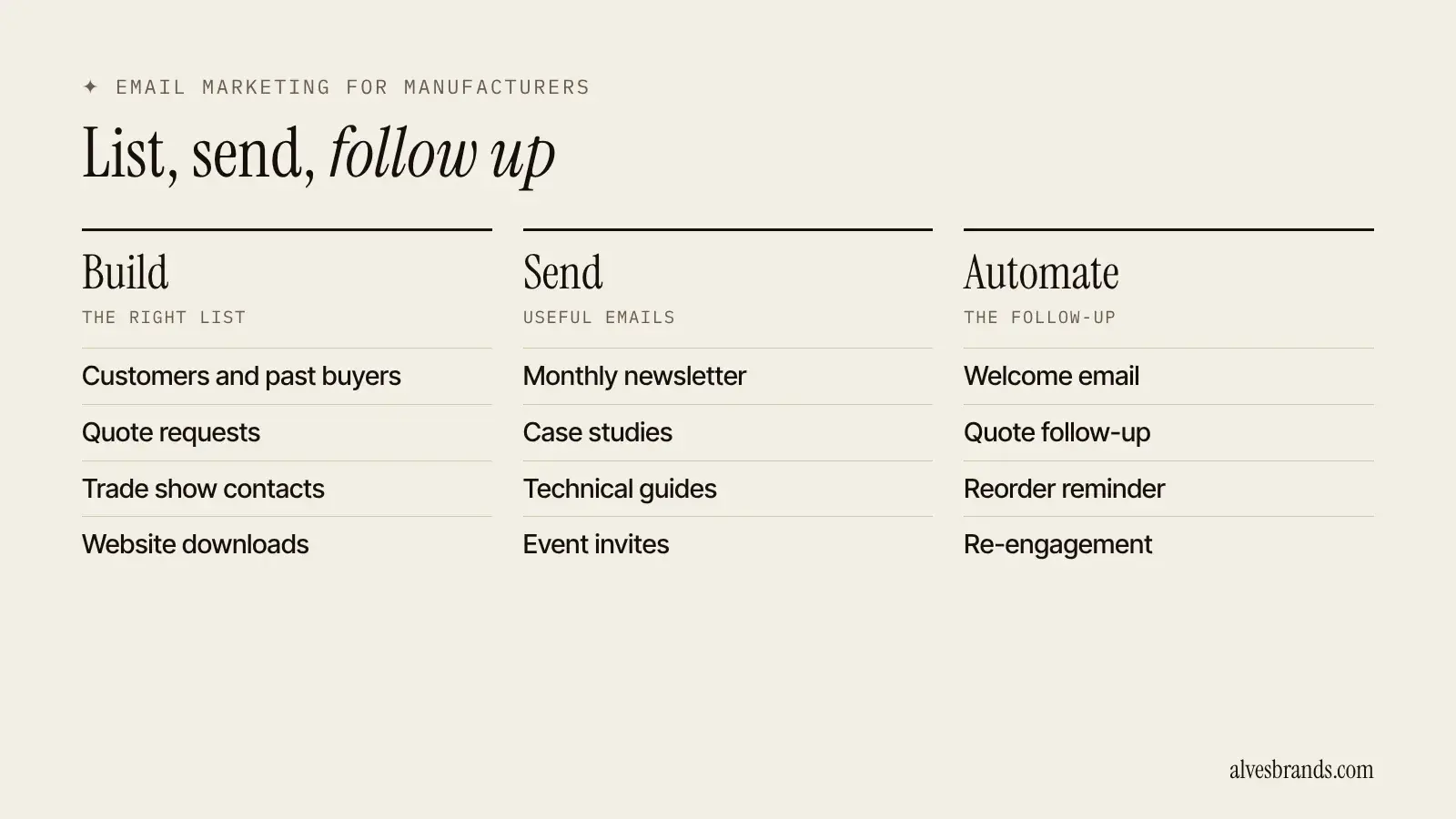
Not sure where to start? A simple first quarter of email marketing for manufacturers could be: month one, a newsletter with your best case study; month two, a technical guide your engineers already wrote for a customer; month three, an invite to your next trade show or a short webinar. Set up the quote follow-up email in the first week, since it brings results fastest.
Step 4: automate the emails that matter most
Automation means emails that go out on their own when something happens. These four save the most time:
- Welcome email. When someone subscribes, send what you promised and tell them what to expect.
- Quote follow-up. Three to five days after you send a quote, a short check-in from the sales rep. Many quotes are lost because nobody followed up.
- Reorder reminder. For consumables and spare parts, a reminder timed to when the customer usually reorders.
- Re-engagement. For contacts who haven’t opened anything in six months, one email asking if they still want to hear from you. Remove those who don’t reply.
Most email tools handle this: HubSpot, Mailchimp, Brevo or the email features in your CRM. Pick the one that connects to the system your sales team already uses.
Step 5: design for busy people
Engineers and buyers read email on phones, between meetings, on the shop floor. Make it easy:
- Plain, simple layout. A logo, short text, one image and a button.
- A subject line that says what’s inside: “New 316 stainless option, 2-week lead time” beats “Exciting news!”
- Send from a real person’s name, not “noreply”.
- Test on mobile before you send, and send a test to a colleague first.
- Put the most important line in the first two sentences.
Step 6: follow the rules and protect deliverability
This part is boring and it matters. Break the rules and your emails go to spam, or worse.
In the US, the CAN-SPAM Act applies to all commercial email, including B2B. The FTC’s compliance guide requires accurate sender details, honest subject lines, a valid postal address, a clear way to opt out and honoring opt-outs within 10 business days. Penalties can reach $53,088 per email.
In the EU, data protection rules are stricter. The European Commission says you must be able to show any list you got from a third party was collected lawfully, and people can object to direct marketing at any time. If you export to Europe, check the rules in each country before you email.
For inbox delivery, Gmail’s sender guidelines ask senders to set up SPF, DKIM and DMARC for their domain, support one-click unsubscribe and keep spam complaint rates below 0.30%. Ask whoever manages your domain to set these up once. It’s a one-hour job that protects every email you send.
Step 7: measure what matters
Opens and clicks are useful signals, but they aren’t the goal. Track these each month:
- Click rate on each email, to see which topics interest buyers.
- Replies, which in B2B often matter more than clicks.
- Quote requests that came from an email.
- Orders from customers who received your emails.
- Unsubscribes and spam complaints, as a warning sign.
For a benchmark, Mailchimp’s email marketing benchmarks put the average open rate across all users at 35.63% and the average click rate at 2.62%, based on data updated in December 2023. Compare yourself with your own past results more than with any average.
Email marketing for manufacturers who export
If you sell abroad, email needs a few extra steps:
- Write in the buyer’s language. Split your list by language and send each group emails they can read. My multilingual website checklist covers the pages those emails should link to.
- Respect time zones. Schedule sends for the morning in the buyer’s country.
- Check local law. Rules differ by country, especially in the EU.
- Link to local pages. An email in Spanish that sends buyers to an English-only page loses them. I explain how foreign buyers search in how foreign buyers find suppliers online.
How email fits with the rest of your marketing
Email works best as part of a bigger system. SEO and content bring new visitors to your site, forms turn them into contacts, and email keeps them warm until they’re ready to buy. For your biggest target accounts, personal emails are one part of account-based marketing for manufacturers. If you’re starting from zero, read my guide to marketing for manufacturers to see where email fits in your first year.
Email is one of eight channels in my guide to manufacturing lead generation.
Frequently asked questions
Does email marketing work for B2B manufacturers?
Yes. It’s low cost, you own the list and it keeps you in touch with buyers through long sales cycles. Most manufacturers see the best results from newsletters, case studies and quote follow-ups.
How often should a manufacturer send marketing emails?
Once or twice a month is a good start for newsletters. Send product news and event invites when you have them, and let automated emails like quote follow-ups run on their own.
Can I buy an email list of manufacturers?
You shouldn’t. Bought lists bring spam complaints, hurt your sender reputation and can break privacy laws. Build your list from customers, quote requests, trade shows and website downloads.
What should a manufacturing newsletter include?
One useful tip, one customer story or case study and one short company update, with a single clear call to action. Keep it short enough to read in two minutes.
Want more quote requests from your website and emails? Ask me for a free website check. I’ll show you how buyers find you on Google and in AI answers, and what to fix first.