A manufacturing marketing plan is a written document that says who you sell to, what you want marketing to achieve, which channels you’ll use, how much you’ll spend, who does what, and how you’ll measure it. It turns “we should do more marketing” into a list of tasks with owners, dates and numbers.
Picking outside help? How to choose a manufacturing marketing agency gives you ten questions to ask and a scorecard.
Most manufacturers don’t have one. They have a website, a booth at one or two trade fairs a year, a sales team and maybe a LinkedIn page. Each piece runs on its own, nobody knows which one brings orders, and the budget gets decided by habit.
This guide walks you through building a marketing plan for a manufacturing company in 11 steps, plus a template you can copy.
Why a manufacturing company needs a marketing plan
In a 2026 Gartner survey of 646 B2B buyers, 67% said they prefer to buy without talking to a sales rep. The 6sense 2024 Buyer Experience Report found buyers are nearly 70% through their process before they contact a seller.
So most of the decision happens online, before your sales team gets a chance. A plan puts you there on purpose, and it gives you five wins:
- Alignment. Every marketing task connects to a business goal, like entering a new industry or a new country.
- Less waste. Money and time go to the channels that bring inquiries, not to the ones you’ve always used.
- A clear difference. Writing the plan forces you to say why a buyer should choose you over the next supplier.
- One message. Your website, catalog, sales team and trade fair booth say the same thing.
- Long-term growth. Search rankings, content and relationships keep working after the campaign ends.
If you want the bigger picture first, read my complete guide to marketing for manufacturers. This guide focuses on turning that into a plan.
Marketing plan vs marketing strategy
Your strategy is the big decision: which buyers, which markets and why they should pick you. Your plan is how you carry it out: channels, budget, calendar, owners and numbers for the next 12 months. The steps below cover both. If you need to write the strategy first, build it with my industrial marketing strategy guide.
What goes into a manufacturing marketing plan
A complete plan has ten sections. You’ll fill each one as you go through the steps.
| Section | What it answers |
|---|---|
| 1. Summary | What the plan wants to achieve, for whom, in one page |
| 2. Business and market analysis | Where you stand, what’s changing, who you compete with |
| 3. Target buyers | Which industries, company sizes, countries and job roles |
| 4. Positioning and message | Why a buyer should choose you, with proof |
| 5. Goals | What you’ll achieve, in numbers, by when |
| 6. Budget | How much you’ll spend and where |
| 7. Channels | Where you’ll reach buyers at each stage |
| 8. Content plan | What you’ll publish and when |
| 9. Action plan | Who does what, by when |
| 10. Measurement and review | Which numbers you track and when you adjust |
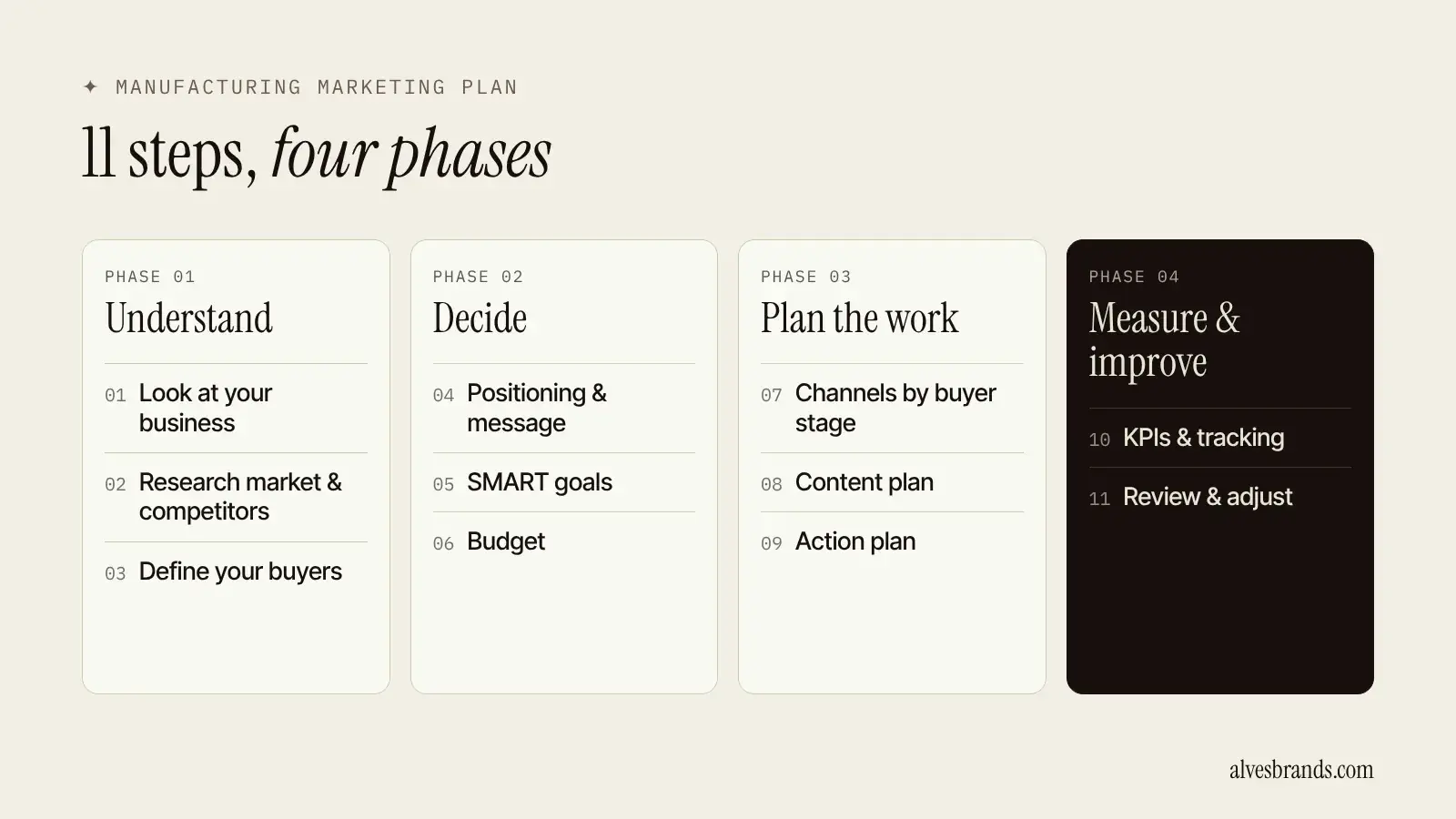
How to build your manufacturing marketing plan in 11 steps
Step 1: Take an honest look at your business
Start with a SWOT analysis: strengths, weaknesses, opportunities and threats. Keep it short and specific. “Good quality” is not a strength. “ISO 9001 certified, 0.3% defect rate, 3-week lead time on custom parts” is.
Questions that help:
- Which products or services bring the best margins?
- Which customers order again, and why?
- Where do you lose deals: price, lead time, minimum order, trust?
- What capacity do you have for new orders? Marketing that brings orders you can’t deliver hurts you.
The US Small Business Administration’s guide to planning your business covers market analysis and sales sections in plain language if you want a structure to follow.
Step 2: Research your market and competitors
Look outside your company. Which industries are buying more of what you make? Are buyers asking about sustainability, local supply or shorter lead times? Does demand rise and fall with seasons or budget cycles?
Then study three to five competitors, the ones buyers actually compare you with. For each one, write down:
- What they sell, at what price level and with which lead times
- Their main message: what do they promise on their homepage?
- Where they show up: Google, directories, trade fairs, LinkedIn, AI answers
- What content they publish and how often
Where to find market data without paying for reports:
- Your own sales data. Which industries and countries grew in the last two years? Which products get the most quote requests?
- Customer conversations. Call five good customers and ask why they chose you and what almost made them choose someone else.
- Industry associations and trade media. Most publish free outlooks and member surveys. My guide to manufacturing industry marketing shows what buyers in six sectors look for.
- Government statistics. Statistics offices publish production and export data by sector. In the US, for example, NIST reports manufacturing made up 10.2% of US GDP in 2023, broken down by industry.
A simple way to start on competitors is to search on Google for the products you sell, the way a buyer would, and note who shows up. Do the same in ChatGPT or Perplexity. In the US, the NIST Manufacturing Extension Partnership also helps manufacturers with market and competitor research. For a fuller method, see my guide to manufacturing market research.
Step 3: Define exactly who buys from you
Don’t plan for “manufacturing companies”. Plan for specific segments, for example “food processing plants in Mexico and Colombia with 50 to 500 employees that need stainless steel tanks”.
For each segment, write down industry, company size, country and the trigger that makes them buy (new line, expansion, a supplier problem, a regulation).
Then map the buying group. Industrial purchases rarely depend on one person:
| Role | What they care about | What they need from you |
|---|---|---|
| Engineer | Specs, tolerances, materials, compatibility | Data sheets, CAD files, technical answers |
| Procurement | Price, payment terms, lead time, risk | Clear quotes, certifications, references |
| Operations / plant manager | Reliability, downtime, support | Case studies, service details, warranties |
| Finance | Total cost, ROI | Cost comparisons, payback examples |
| Management | Strategy, supplier stability | Company facts, track record, capacity |
Last, sketch the buyer’s journey: how they discover a problem, how they research options, how they shortlist and how they decide. You’ll use this in steps 7 and 8.
Step 4: Decide your positioning and message
Positioning is the one sentence that tells a buyer why you. It should be specific and provable. Compare:
- Weak: “High-quality industrial solutions with excellent service.”
- Strong: “Custom aluminum castings in 3 weeks, from 50 pieces, for automotive and agricultural machinery makers in Europe.”
Back the message with proof: certifications, years supplying a known industry, test results, capacity, delivery record, case studies. Then use the same message everywhere: website, catalog, LinkedIn, booth, email signatures and sales decks.
Test it with three customers. If they describe you differently, use their words: buyers search with their language, not your brochure’s.
Step 5: Set SMART goals
Goals should be specific, measurable, achievable, relevant and time-bound (SMART). Tie them to sales, not to activity. “Post on LinkedIn three times a week” is a task. “Get 25 qualified quote requests per month from Germany by June” is a goal.
Good examples for a manufacturer:
- Increase qualified quote requests from the website by 30% in 12 months.
- Sign 3 new distributors in Latin America by the end of the year.
- Reach first page on Google for 10 main product searches in Spain within 9 months.
Pick three to five goals at most. More than that and nothing gets enough attention.
Step 6: Set your budget
There’s no single right number, but benchmarks help. The Gartner 2026 CMO Spend Survey found marketing budgets average 7.8% of company revenue. The 2025 CMO Survey found B2B product companies spend about 6.4% of revenue on marketing. Many smaller manufacturers spend far less, and that’s fine if the money goes to the right places. My manufacturing marketing budget guide shows more benchmarks with dates and a 5-step way to set your number.
A practical way to split it:
- About 70% on channels you know work for you (your website, SEO, the trade fair that brings orders).
- About 20% on growing channels you’re building (content, LinkedIn, a new country).
- About 10% on tests. Try something, measure it, keep or cut it.
Remember people and time, not just money. If nobody in your company has four hours a week for marketing, the plan needs outside help or fewer tasks.
Step 7: Choose your channels by buyer stage
Match channels to the journey from step 3. Buyers need different things at each stage:
| Stage | What the buyer does | Channels that fit |
|---|---|---|
| Discover | Searches a problem or product, asks AI, browses directories | SEO, AI search, industry directories, LinkedIn, trade media |
| Compare | Reads specs, case studies, checks certifications | Product pages, case studies, technical guides, video |
| Decide | Asks for quotes and samples, checks references | Quote form, fast follow-up, references, sample process |
| Stay | Reorders, expands, refers others | Email, account visits, customer support content |
The channels most manufacturers should consider:
- Website. One page per product family, full specs, certifications and an easy quote form.
- SEO. Ranking for the searches your buyers type. Slow to start, strong over time; technical SEO is the base.
- Content and video. Guides, case studies, YouTube videos. In the Content Marketing Institute’s research, 74% of manufacturing marketers rated video as their most effective content type.
- Email. Fast follow-ups and a newsletter for long sales cycles.
- Paid search and LinkedIn ads. Faster results while SEO grows. Compare costs in SEO vs Google Ads.
- LinkedIn. The same CMI study found 85% of manufacturing marketers say LinkedIn gives them the most value.
- Trade fairs and events. Still strong in industry: 51% of manufacturing marketers in the CMI study rated in-person events their most effective channel.
- Directories, associations and trade media. Visibility and trust for Google and AI, the focus of my link building work.
- Distributors and partners. Reach in markets where you have no sales team.
Three channels done well beat eight done badly.
Step 8: Plan your content
Start with the questions buyers ask your sales team; each one can become a page, a video or an email. By stage:
- Discover: guides on choosing a material or process, industry trend articles, “how to” content.
- Compare: case studies with real numbers, comparison pages, spec sheets, application notes, factory videos.
- Decide: pricing factors, lead time explanations, quality process pages, FAQ about samples and minimum orders.
Put it in a calendar. For a small team, one solid piece every week or two is realistic, reused as LinkedIn posts, a short video and an email.
Step 9: Turn it into an action plan
This is where most plans die. Every task needs an owner, a deadline and a place in the calendar. A simple 12-month roadmap:
| Quarter | Focus | Example tasks |
|---|---|---|
| Q1 | Fix the base | Product pages with specs, quote form, tracking set up, directory listings |
| Q2 | Get found | SEO for main product searches, first case studies, LinkedIn routine |
| Q3 | Grow | Paid search tests, a new market or language, trade fair follow-up campaign |
| Q4 | Review and scale | Cut what didn’t work, double what did, plan next year |
Agree with sales on what a “qualified lead” is, how fast they follow up and how they report back. When marketing and sales use the same definitions, the numbers mean something.
Step 10: Choose your KPIs and tracking
Measure what connects to revenue. Set it up before you start, not after.
| KPI | Why it matters | Where to find it |
|---|---|---|
| Qualified inquiries and quote requests | Closest number to sales | Website forms, CRM |
| Source of each inquiry | Shows which channel works | Analytics, CRM, “How did you find us?” |
| Search clicks and impressions | Shows if more buyers find you | Google Search Console |
| Website conversion rate | Shows if the site turns visits into inquiries | Google Analytics |
| Cost per qualified lead | Compares channels fairly | Budget ÷ qualified leads |
| Quote-to-order rate | Shows lead quality | CRM, sales reports |
| Revenue from new customers and markets | The real result | Sales reports |
The free tools cover most of this: Google Search Console for search, Google Analytics for the website and a simple CRM for leads and deals. Don’t skip the CRM. CMI found 64% of manufacturing marketers struggle to tie their content to revenue, and the usual reason is that leads aren’t tracked from first contact to order.
Step 11: Review and adjust
A marketing plan for manufacturing is a working document. Set a rhythm:
- Monthly: check the KPIs, the tasks done and the inquiries received.
- Quarterly: compare results with goals, move budget from weak channels to strong ones, update the next quarter’s tasks.
- Yearly: rewrite the plan with what you learned.
If a channel hasn’t brought a single qualified inquiry in six months, fix it or drop it. Write down every change and why, so next year’s plan starts from facts.
How the plan changes by type of manufacturer
Contract manufacturers sell capacity, not a product. Focus on capabilities pages (processes, materials, tolerances, volumes), certifications and case studies, and SEO for process searches like “CNC machining services”.
OEMs and product manufacturers often sell through distributors. A manufacturer marketing plan for them needs product pages that rank plus support for distributors: product data, photos and training.
Component suppliers sell to engineers who want specs fast: searchable product data, CAD files, data sheets and the directories engineers use.
Exporters need a section per target country: language, search terms, directories, trade fairs and distributors. Start with two or three countries.
Small manufacturers should keep the marketing plan for the manufacturing company short: a strong website, SEO for main products, one or two trade fairs and a follow-up routine.
Tools that make the plan easier to run
You don’t need expensive software. A small set covers most manufacturers:
- A spreadsheet or document for the plan, with goals and KPIs on the first page.
- A CRM to track every lead from first contact to order, with automatic follow-up reminders. Many have free versions.
- Google Search Console and Google Analytics to see how buyers find and use your site.
- A shared task board or calendar with every action, owner and deadline from step 9.
- An email tool for follow-ups and newsletters.
What matters is that everyone uses the same tools and looks at the same numbers. A simple setup the whole team uses beats an advanced one only one person understands.
Things manufacturers need to plan for that other businesses don’t
Long sales cycles. Plan follow-ups and useful content so you’re remembered when the buyer is ready, even a year later.
Complex products. Plan spec sheets, application examples and product videos, easy to find on your site.
Trust. Industrial buyers fear supplier failure. Plan proof: certifications, case studies, references, factory photos and clear company facts.
Industry channels. Plan trade fairs, associations and engineering publications alongside digital.
Key accounts. If a few large customers drive revenue, plan account-based marketing for a short target list.
Production capacity. Coordinate with operations; orders you can’t deliver hurt your reputation.
What most manufacturing marketing plans leave out
Export markets
Many manufacturers grow fastest abroad, yet plan only for home. Buyers search in their own language, so an English-only site misses most of them, and each language version needs the correct setup so Google shows it in the right country, which Google explains in its guide to localized versions of pages. My guide on how foreign buyers find suppliers online and the multilingual website checklist cover this, and it’s the core of my SEO for exporters and international SEO services.
AI search
Buyers now ask ChatGPT, Gemini and Perplexity to recommend suppliers. In the Gartner buyer survey, 45% had already used AI during a recent purchase. If AI assistants can’t find clear, consistent information about your company across the web, they won’t name you.
Add a quarterly check of what AI assistants say about you and your competitors, and state your products, capacity, certifications and export countries clearly everywhere. I explain how this works in how to get recommended by ChatGPT, and it’s what my AI search optimization service does. Want to see how you show up today? Run the free AI visibility check.
Free manufacturing marketing plan template
Copy this into a document and fill in each part. For most small and mid-size manufacturers, 5 to 10 pages is enough.
1. Summary
- Main goal for the next 12 months:
- Target buyers and markets:
- Budget:
2. Business and market analysis
- Strengths / weaknesses / opportunities / threats:
- Market trends affecting demand:
- Top 3 to 5 competitors, their message and where they show up:
3. Target buyers
- Segments (industry, company size, country, buying trigger):
- Buying group roles and what each needs:
- Buyer’s journey (discover, compare, decide):
4. Positioning and message
- One-sentence positioning:
- Proof points (certifications, numbers, case studies):
5. Goals (3 to 5, SMART)
- Goal / number / deadline / owner:
6. Budget
- Total:
- Split (proven ~70% / growing ~20% / tests ~10%):
- People and time available:
7. Channels by stage
- Discover / compare / decide / stay:
8. Content plan
- Top 10 buyer questions to answer:
- Content calendar (monthly):
9. Action plan
- Q1 / Q2 / Q3 / Q4 tasks, owners, deadlines:
- Lead definition and follow-up rules agreed with sales:
10. Measurement and review
- KPIs and targets:
- Monthly and quarterly review dates:
Common mistakes in manufacturing marketing plans
These are the ones I see most often when I review manufacturers’ websites and marketing:
- Goals without numbers. “Grow brand awareness” can’t be measured or managed.
- Planning channels before buyers. Decide who you’re reaching first; the channels follow.
- No owner for tasks. “Marketing will do it” means nobody will.
- Measuring activity instead of results. Posts published and booths visited don’t pay salaries. Track inquiries, quotes and orders.
- Ignoring sales. If sales doesn’t follow up fast, more leads won’t bring more orders.
- Writing it once and forgetting it. A plan nobody opens after January is a wish list.
For what to publish each month, read content marketing for manufacturers.
If your plan includes exhibiting, trade show marketing for manufacturers shows how to plan the meetings and the follow-up.
Need a plan for any B2B company? Use the B2B marketing plan guide.
Frequently asked questions
What are the key parts of a manufacturing marketing plan?
A summary, business and market analysis, target buyers, positioning, goals, budget, channels, content plan, action plan, and KPIs with a review schedule.
How much should a manufacturer spend on marketing?
Benchmarks range from about 6% to 8% of revenue for B2B and larger companies, based on the Gartner and CMO Survey figures above. Smaller manufacturers often spend less. Start with what you can sustain, track results and grow the channels that bring orders.
How often should I update the plan?
Review numbers monthly, adjust budget and tasks quarterly, and rewrite the plan once a year.
What’s the difference between a marketing plan and a sales plan?
The marketing plan covers how buyers find you, learn about you and decide to contact you. The sales plan covers what happens after: quotes, negotiations, account management and sales targets. They should share the same goals, buyer definitions and lead rules, so many manufacturers keep them in one document.
Who should write the plan?
The owner or general manager, with input from sales, marketing and operations. Sales knows the buyers’ questions, operations knows capacity, and the owner sets the goals. An outside specialist can help with research and channels.
How do I start if I’ve never had a marketing plan?
Do steps 1 to 5 first: look at your business, your competitors and your buyers, then set three goals. Even a two-page plan is better than none. If you want a quick start, use the 90-day starter plan for manufacturers.
If you’d like help with the parts of the plan about being found online, in your country or abroad, ask me for a free website check. I’ll show you where you appear on Google and in AI answers in your most important markets.