Marketing for manufacturing companies works when it matches how your buyers buy. A job shop that makes parts to a customer’s drawing needs different marketing. So does a company that sells its own product through distributors. Most advice gives every factory the same list: a website, LinkedIn, a trade show, a newsletter.
This guide starts with the type of company you are. Then it shows which channels fit, what to do first and how to know it works. It’s for owners, sales managers and the one marketing person many plants have. For the wider overview read my complete guide to marketing for manufacturers, and for a template use the manufacturing marketing plan.
What makes marketing for manufacturing companies different
Long, careful buying. A buyer checks quality, capacity, price and risk before switching supplier. Gartner research on the B2B buying journey says a buying group for a complex purchase has 6 to 10 decision makers.
Research before contact. Gartner found that 67% of B2B buyers prefer a rep-free buying experience. 6sense found buyers are nearly 70% through the process before they contact a seller. Your site and profiles do the first round of selling.
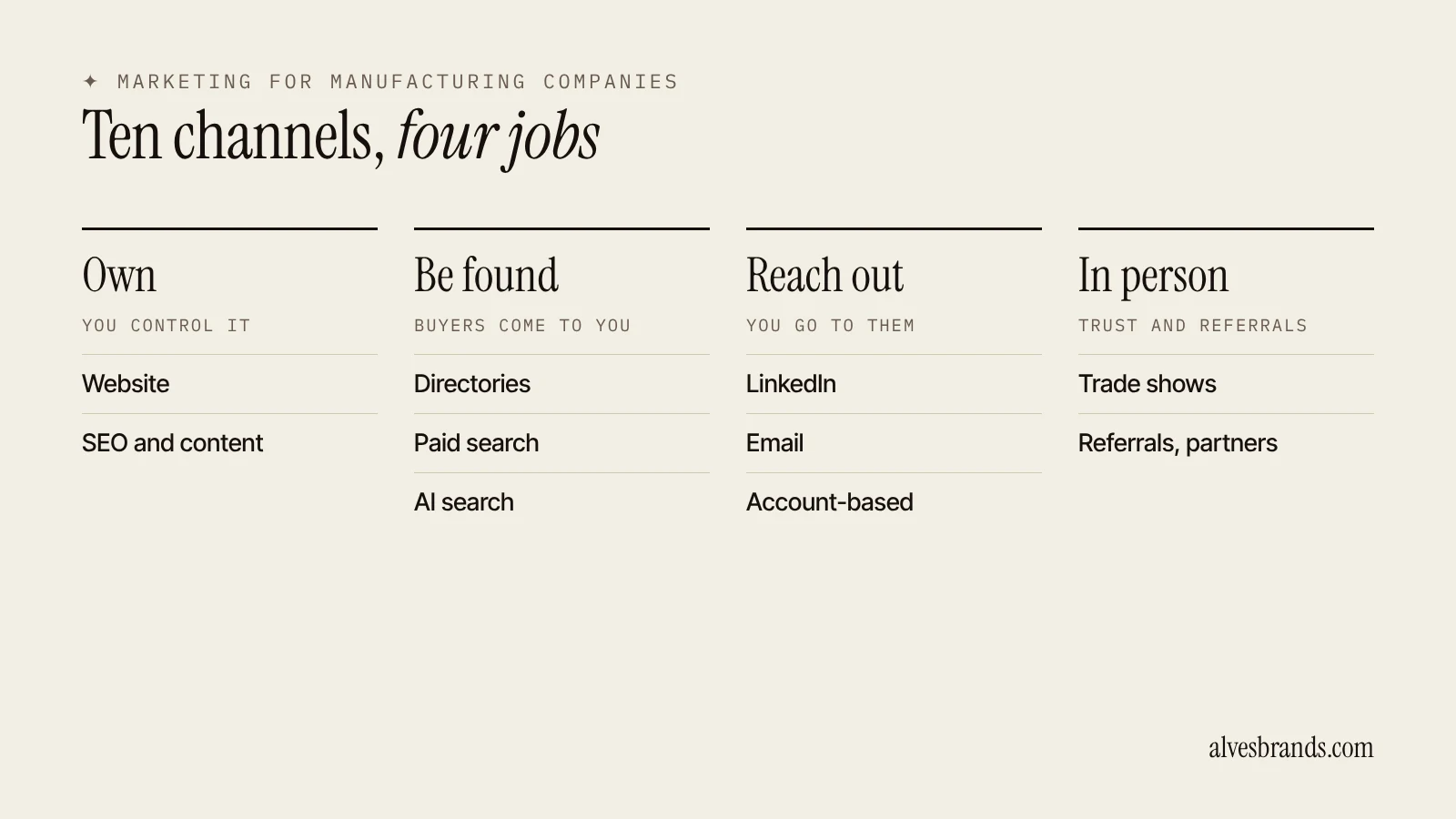
Many channels. McKinsey’s 2024 B2B Pulse survey found buyers use about 10 channels on average, up from about 5 in 2016. Be present and consistent in the three or four your buyers use.
Technical proof. Buyers want specs, certificates and references. Precise facts beat slogans.
Is marketing worth it for a manufacturer?
Yes, if you can trace it to quotes and orders. Many plants say their work comes from referrals, so marketing looks like a cost with no proof. Add a "How did you find us?" field to your quote form and log the source of each RFQ. You don’t need a big budget to start. Fix your website basics, complete your directory profiles and email past customers. Then spend more on channels that bring RFQs. You can test your own site with the free website enquiry check.
Benefits of marketing for manufacturing companies
Good marketing for manufacturing companies does three things. It widens your customer base, so a few big accounts stop carrying the plant. It keeps you in sight while competitors chase the same buyers. And it opens new markets, such as other regions or countries, without a sales team on the ground.
It also differs from consumer marketing. You sell to a few informed buyers, not to millions of shoppers. So marketing for manufacturing companies leans on proof, specs and personal contact more than on reach and branding.
Set your goals, audience and budget first
Before you pick channels, write down three things. Who are your best customers, and what do they ask before they buy? What do you want in 12 months: more RFQs, a new market, a better mix of customers? What can you spend? Look at two or three competitors’ websites and note what they show and what they leave out. Then choose KPIs you can count, such as RFQs, quote-to-order rate and cost per RFQ.
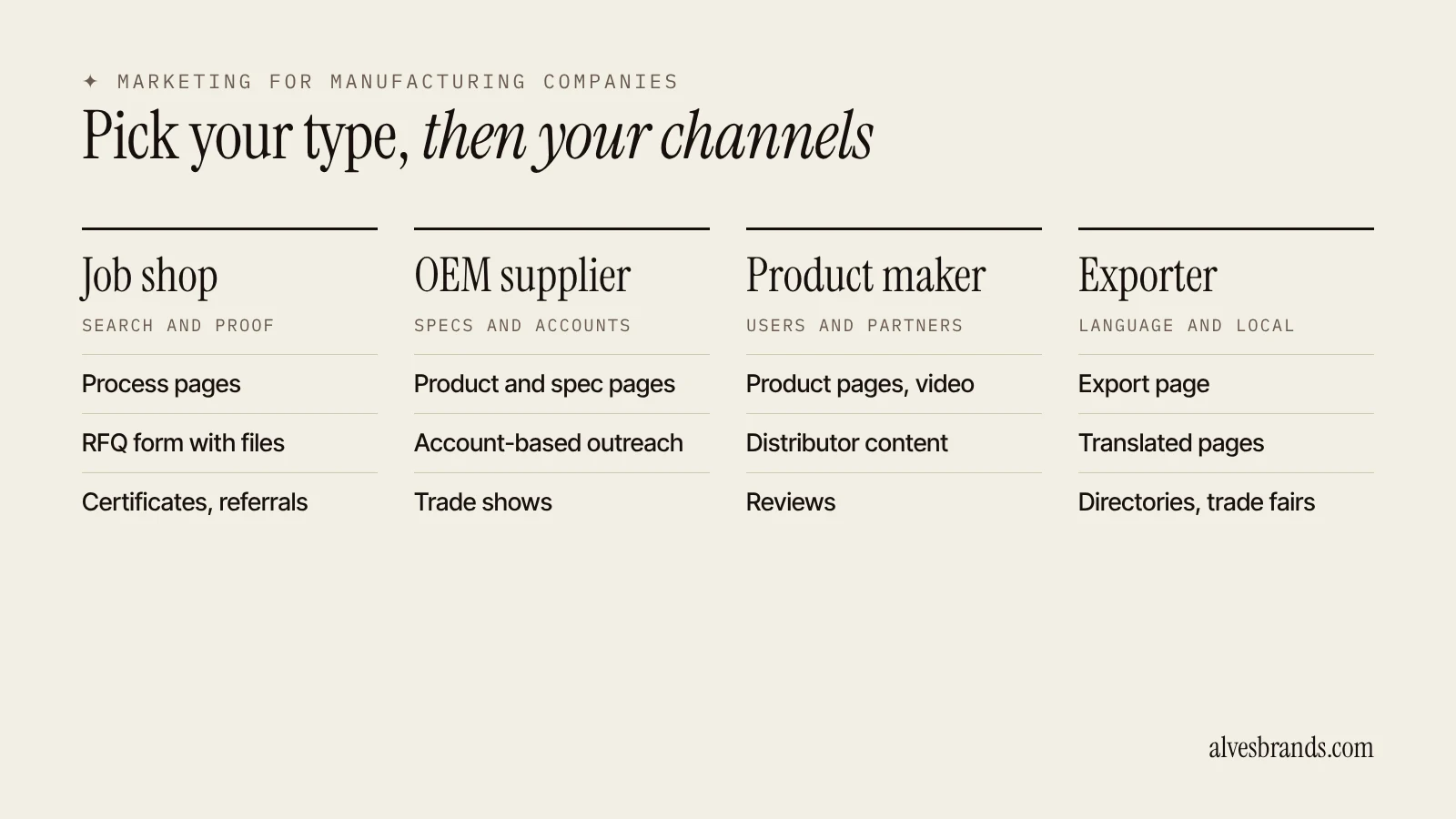
Start with your business type
| Business type | How buyers find you | Marketing that fits best |
|---|---|---|
| Job shop or contract manufacturer | Search for a process, material or certificate; referrals | Process pages, RFQ form with file upload, certificates, directories |
| OEM component supplier | Engineers find parts for a design | Product and spec pages, datasheets, account-based outreach, trade shows |
| Product maker selling through distributors | End users search for the product | Product pages, distributor content, reviews, video |
| Exporter | Foreign buyers search in their language and use directories | Export page, translated pages, directories, trade fairs |
| Engineered-to-order maker | Long, project-led searches and referrals | Case studies, engineering guides, LinkedIn, ABM |
Pick the row closest to you. The channels below go in the order I’d use them.
Channel 1: Your website, built for buyers
A Thomas survey of 266 industrial buyers found 73% focus on the company website when judging a supplier, against 10% for social media. It dates from 2019, so read it as a direction. Buyers still check your site before they call.
Show what you make and for which industries on the first screen. Add real numbers for machines, tolerances and materials. Add certificates, photos of your own plant, clear contact details and a short form. Orbit Media’s study of the 100 top manufacturing websites shows the best ones make the next step obvious. See website design for manufacturers.
Channel 2: SEO and content for manufacturing companies
SEO puts your pages in front of buyers when they search. Aim at searches close to a sale: a process, a material, a standard or a product plus a place. Build one page for each, with real specs and a short quote form. Then add guides that answer engineers’ questions, in line with Google’s advice to write helpful, people-first content. New pages often take two to four months to reach a good position, so start early. Learn more in my guides on SEO for manufacturers, industrial SEO and content marketing for manufacturers.
Channel 3: Directories and marketplaces
Buyers still use supplier directories. Fill in your profile on Thomasnet or a national industry directory. The people there already want to buy. Complete every field, add photos and certificates, and choose the right categories. A thin profile gets skipped. Check the cost against the leads and drop what doesn’t pay.
Channel 4: LinkedIn
LinkedIn says it has more than 1 billion members, so your buyers are probably there. Share what your engineers know, such as a tolerance lesson or a before-and-after. Show your plant and your process. Post from named people, not only the company page. My guide on social media marketing for manufacturers has a one-hour weekly routine.
Channel 5: Email to people who already know you
Email to past customers, open quotes and trade show contacts is cheap. It’s often the fastest way to an order. Send one short, useful message every month or two, and always give an easy way to unsubscribe. See email marketing for manufacturers.
Channel 6: Trade shows and events
Shows still matter in many fields because buyers meet suppliers and see samples. Pick shows where your buyers go, book meetings before the show and follow up within a week. Most of the value is in the follow-up. See trade show marketing for manufacturers.
Channel 7: Account-based marketing
If you sell to a short list of big customers, pick 20 to 50 target companies. Find the people in each buying group. Send them specific content. It suits OEM suppliers and engineered-to-order makers. See account-based marketing for manufacturers.
Channel 8: Paid search
Paid search is the fastest test. Pick terms close to a sale, such as "[process] supplier". Send clicks to a specific page. Track cost per RFQ, not clicks. Use it for new products and to fill gaps while SEO grows.
Channel 9: Referrals and partners
Referrals are often the warmest leads. Ask your best customers who else could use you. Build links with designers, distributors and partner suppliers. Ask for reviews and case studies.
Use simple tools: CRM and automation
A free or cheap CRM keeps every inquiry, quote and follow-up in one place. Nothing gets lost when a salesperson is away. Add simple automation. Send an instant "we got your drawing" email. Set a reminder to follow up after a quote. Email past customers once a month. Tools save time, but they don’t replace a quick, human reply.
Channel 10: AI search
Buyers ask ChatGPT, Gemini and Perplexity for supplier ideas. Ahrefs found that AI Overviews cut the click-through rate of the top page by 58%. Being named in the answer counts. Google says there are no extra requirements for AI features beyond helpful, indexable pages. Write clear pages with precise facts and keep company details the same everywhere. See how to get recommended by ChatGPT.
Marketing for UK manufacturers
Many industrial buyers search with a place, such as "sheet metal fabrication Midlands". If you serve a region, set up a Google Business Profile. UK buyers often check certificates and sustainability policies, so give them a clear page. A good careers page helps with hiring too.
What to say to technical buyers
Say what you make, for whom, in one line: "We machine stainless and titanium parts for medical device makers, in batches of 500 to 20,000, ISO 13485 certified." Use numbers. Name the problem you fix, such as fewer rejects or shorter lead times. Put proof next to each claim. Use plain words, and speak the way your buyers speak, not the way your brochure does. Keep old pages fresh: update specs, photos and dates at least once a year. Make the next step small: "Send us your drawing and we’ll reply within one working day."
Launching a new product or capability
New machines, materials and products need their own small plan. Write a one-page summary of who it’s for and why it’s better. Update your website, directory profiles and LinkedIn on the same day, and email past customers who would care. Tell your sales team what to say. After a month, check which pages got visits, which emails got replies and which questions buyers asked. Use them to write your next page. That is marketing for manufacturing companies at its simplest: one clear message, in the places buyers look.
A simple plan: your first 90 days
| Weeks | Do this | Result |
|---|---|---|
| 1 to 2 | Pick your business type and top three customer types | A clear target |
| 3 to 4 | Fix website basics: key pages, proof, form | A site that can convert |
| 5 to 6 | Complete directory profiles and your LinkedIn page | Presence where buyers look |
| 7 to 10 | Build your first three to five search pages | Pages that can rank |
| 11 to 12 | Email past customers and quotes; review results | Quick orders and lessons |
Keep a simple sheet with one row per RFQ: date, source, product, value and outcome. After three months it shows which channels pay and which only feel busy. Move time from the weak ones to the strong ones. Then repeat each month. My article on the manufacturing marketing budget helps you size the spend.
Who does marketing for manufacturing companies: in-house or agency?
Do in-house what only you know: photos, engineering content, customer stories. Use a consultant for the plan and SEO, and an agency when you need many people or markets. Ask who will do the work and how they measure RFQs. See how to choose a manufacturing marketing agency.
How to measure marketing for manufacturing companies
Watch RFQs and where each came from. Watch quote-to-order rate, organic visits to main pages, directory and LinkedIn leads, and cost per RFQ for paid channels. Ask "How did you find us?" on every call.
Common mistakes in marketing for manufacturing companies
- Copying a big competitor’s mix.
- Doing every channel badly. Pick three.
- Talking about "solutions" and showing no specs.
- Slow follow-up. Reply within a day.
- Ignoring existing customers.
- Buying lead lists.
- Hiding lead times, which builds distrust.
- No tracking of where RFQs come from.
Frequently asked questions
What is the best marketing for manufacturing companies?
It depends on your business type. For most, the base is a site with real specs and proof, pages for what buyers search for and a short quote form. Directories, LinkedIn and email add leads cheaply.
How do small manufacturers market themselves?
Start with a clear website, a complete directory profile, a LinkedIn page and an email to past customers. Add search pages for your best processes. Reply to every inquiry within a day.
What marketing channels work for manufacturers?
SEO, directories, LinkedIn, email, trade shows, account-based marketing, paid search and referrals. Pick by business type and add one at a time.
How much should marketing for manufacturing companies cost?
There’s no single number. Start with what you can track to RFQs. My manufacturing marketing budget guide shows ranges and how to split the money.
How long does marketing for manufacturing companies take to work?
Email can bring orders in weeks. Search pages usually need three to six months. Directories and referrals sit in between.
Is digital marketing better than traditional marketing for manufacturers?
Neither wins alone. Use digital to be found and prove yourself, and use personal contact to close.
Do manufacturing companies need social media?
LinkedIn is worth a few hours a month. Other platforms matter only if your buyers use them.
How do I market a manufacturing company abroad?
Add an export page, translate your top pages, join directories in the target country and use trade fairs. See how foreign buyers find suppliers.
Want help choosing where to start? Ask me for a free website check. I’ll show you what buyers see and what to fix first.