Account-based marketing for manufacturers means picking a short list of companies you really want as customers and marketing to each one as if it were a market of its own. Instead of chasing hundreds of leads and hoping a few are good, you choose the 10, 30 or 100 accounts that fit you best, learn who decides inside each one, and send them the proof they need.
Contract shops sell capability, not a catalog. See contract manufacturing marketing for how to show proof under NDA and win RFQs.
It fits factories well. Your deals are big, slow and decided by groups of people, not one person clicking “buy”. This guide shows how to choose accounts, map the buying group, build the right content, run a 90-day pilot with a small team and measure it without fooling yourself.
If you’re just getting started with marketing in general, read my guide to marketing for manufacturers first. ABM works best on top of a decent website and basic search presence.
What is account-based marketing?
Account-based marketing (ABM) turns the usual funnel upside down. Normal lead generation casts a wide net: ads, content and forms bring in whoever shows up, and sales sorts out the good ones later. ABM starts at the other end. Sales and marketing agree on the companies they want first, and every campaign is built for those companies.
Here’s the difference in practice:
| Lead generation | Account-based marketing | |
|---|---|---|
| Starting point | Anyone who fills a form | A named list of target companies |
| Main goal | Lead volume | Pipeline and revenue from chosen accounts |
| Message | One message for everyone | Tailored by account and by role |
| Who it speaks to | One contact | The whole buying group |
| Success metric | Leads, cost per lead | Engaged accounts, deals, win rate |
| Sales involvement | Takes leads after marketing | Plans and runs it with marketing |
Neither one is “better” in every case. Lead generation is good for finding buyers you didn’t know existed. ABM is good when you already know who your best customers could be and need to get inside those companies.
Why account-based marketing for manufacturers works
Three things make account-based marketing for manufacturers a natural fit.
The buying group is big. According to Gartner research on the B2B buying journey, a typical buying group for a complex B2B solution has 6 to 10 decision makers. In a plant, that can mean a design engineer, a process engineer, the plant manager, quality, procurement and a finance or operations director. Each one has different worries. A single email to one contact won’t move all of them.
Buyers research alone before they call you. A 2026 Gartner survey found that 67% of B2B buyers prefer a rep-free buying experience. The 6sense 2024 Buyer Experience Report found buyers are close to 70% through their process before they contact a seller. ABM puts your proof in front of the right people during that quiet phase.
A few accounts are worth a lot. One OEM contract or one new distributor can be worth years of revenue. When the prize is that big, it makes sense to spend real time on each target instead of spreading a thin budget across everyone.
The results people report are strong, though they come from surveys, not audits. In the 2018 ABM Benchmark Study by ITSMA and the ABM Leadership Alliance, 77% of B2B marketers said ABM drove greater success with their target accounts, and teams with three or more years of ABM were far more likely to report at least double the ROI. Treat those numbers as a sign of what’s possible, not a promise.
Is your company ready for ABM?
Account-based marketing for manufacturers isn’t for every factory. Before you start, check these points honestly:
- You can name your ideal customer. If you can’t describe the type of company that buys the most, pays well and stays for years, start there.
- Deals are worth the effort. If an average order is small and buyers decide alone in a day, plain search marketing will pay better.
- Sales will take part. ABM fails when marketing runs it alone. Someone in sales has to own each account.
- You have proof. Case studies, test data, certifications and references. Without them, a tailored message has nothing to show.
- Your website can back you up. Buyers will check you. Product pages need specs, applications and a clear way to ask for a quote. My digital marketing guide for manufacturers covers what those pages need.
If you tick at least four, you’re ready for a pilot.
The three levels of ABM
You don’t have to go all-in. Most manufacturers mix three levels:
- One-to-one. A full custom program for a handful of very large accounts, often 3 to 10. Custom content, plant visits, executive meetings.
- One-to-few. Groups of 10 to 50 similar accounts, such as “Tier 1 automotive suppliers in Mexico” or “food plants using stainless conveyors”. One campaign per group, adjusted by industry.
- One-to-many. Light personalization for a few hundred accounts, mostly with targeted ads and email by industry.
For a first project, one-to-few is usually the sweet spot. It’s personal enough to stand out and cheap enough to run with a small team.
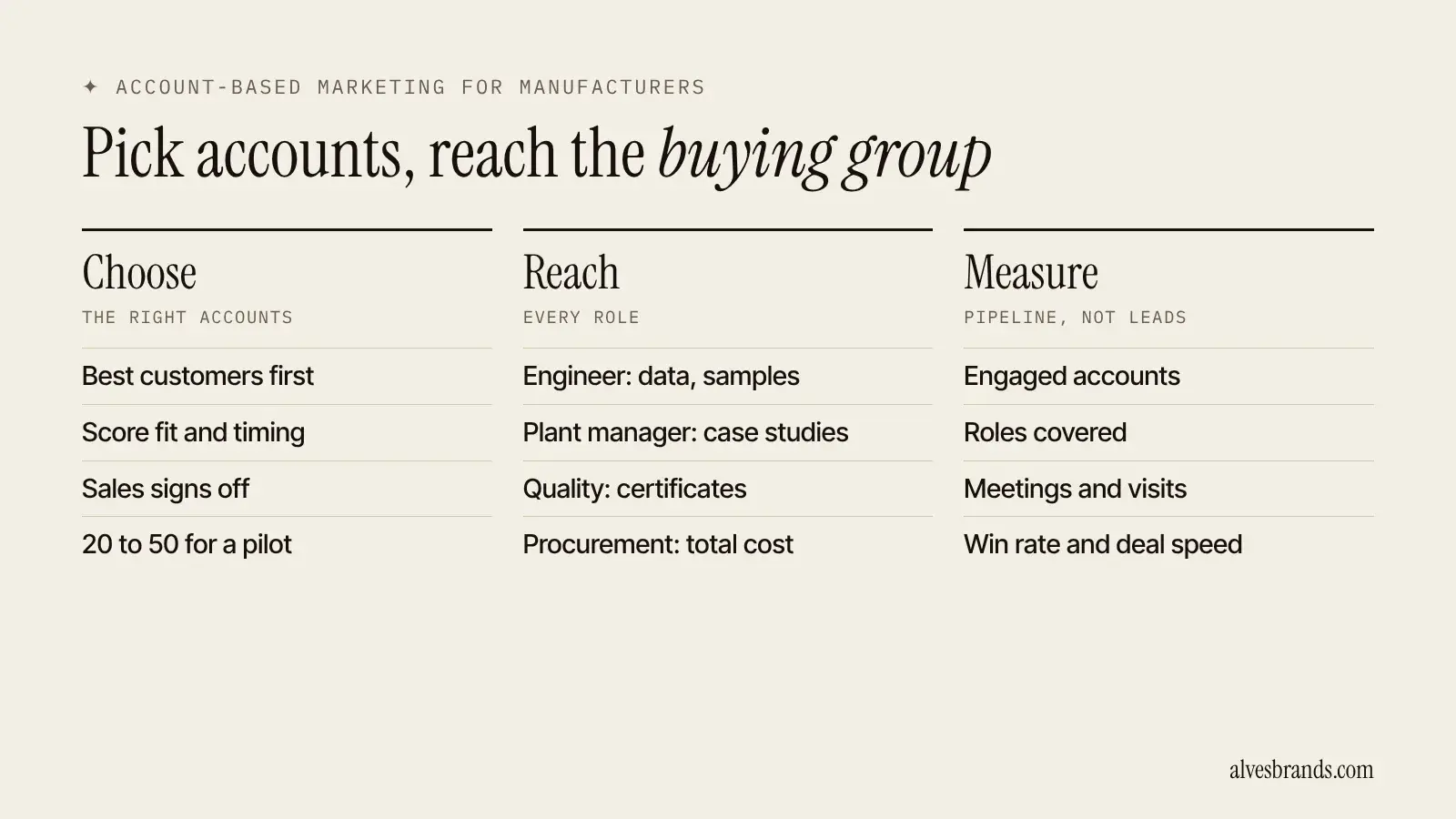
Where ABM fits with the rest of your marketing
ABM doesn’t replace your other marketing. It sits on top of it. Your website, product pages, search presence and trade shows still bring in buyers you’ve never heard of. Account-based marketing for manufacturers takes the accounts you most want and gives them extra attention.
Think of it as two lanes. In the first lane, search, content and directories keep the phone ringing with new names. In the second lane, ABM works a fixed list of big targets that probably won’t find you on their own, or that already know you but buy from a competitor. Each lane feeds the other: a target account that searches for your product should find a strong page, and an inbound lead that fits your profile can move onto the ABM list.
Step 1: choose the right accounts
The account list is the strategy. Get it wrong and nothing else saves the program.
Start with your best current customers. Look at the last three years and ask which accounts bring the most margin, reorder, pay on time and are easy to work with. Write down what they have in common: industry, plant size, products they make, machines they run, location, certifications they require.
That becomes your ideal customer profile. Then find other companies that match it, using your CRM, trade show lists, industry directories, LinkedIn and supplier databases like Thomasnet.
Score each account on four simple points, from 1 to 5:
| Criterion | What to check | Why it matters |
|---|---|---|
| Fit | Industry, plant size, product match, location | Will they actually need what you make? |
| Timing | New lines, expansions, contract renewals, supplier problems | Are they likely to buy soon? |
| Interest | Visits to your site, email clicks, booth visits, downloads | Are they already looking? |
| Access | Contacts you know in engineering, operations, procurement | Can sales actually reach them? |
Add the scores and keep the top 20 to 50 for the pilot. Sales should sign off on the final list. If a rep says “we’ll never win that one”, ask why before you drop it, but don’t force accounts on a rep who won’t work them.
Review the list every month. Remove accounts that show no signal after 90 days and bring in new ones when something changes, like a new plant announcement.
Step 2: map the buying group
For each account, list the roles that matter in a deal like yours. Then find the actual people, which LinkedIn makes much easier.
Most manufacturing deals involve some mix of these:
| Role | What they care about | Proof that moves them | Best channel |
|---|---|---|---|
| Design or process engineer | Will it work? Specs, tolerances, materials | Data sheets, CAD files, test results, samples | Website, email, technical calls |
| Plant or operations manager | Uptime, throughput, easy changeover | Case studies, references, line trials | Plant visits, LinkedIn, events |
| Quality manager | Consistency, certifications, traceability | ISO and industry certificates, PPAP, audit results | Documents, audits |
| Procurement | Price, lead time, supply risk | Total cost comparison, capacity, backup plans | Email, RFQ portals |
| Executive sponsor | Risk, growth, ROI | Business case, references at their level | Meetings, events |
Keep this simple. A one-page sheet per account with names, roles, what each person cares about and what you’ve sent them is enough.
Step 3: build content each role will use
This is where most ABM programs stall. Writing fully custom material for every account is slow. The fix is to build reusable blocks once and adjust them per account.
Good blocks for manufacturers:
- Application notes for each industry you target. One page each, with the problem, the solution and the result.
- Case studies with numbers: scrap reduced, cycle time cut, lead time improved. Even two or three good ones go a long way.
- A total cost of ownership sheet that procurement can use to compare you with a cheaper supplier.
- A technical pack with specs, drawings, CAD files and certificates in one place.
- A short video of the product running on a real line.
- Samples for engineers. A physical part on someone’s desk is hard to ignore.
Then personalize the edges. Change the cover to the account’s industry, add their likely use case in the first paragraph, and pick the case study closest to their situation. That’s often enough for a one-to-few campaign.
Your public website matters here too. ABM ads and emails send people to your pages, and if those pages are vague, you lose them. A clear page per industry or application, with the proof above, works as a landing page for every account in that group. For more ideas on what content works, see these industrial marketing examples.
Step 4: reach them on several channels
One email won’t do it. ABM works by showing up in a few places at once, in the right order, so the account sees a consistent story.
Channels that work well for manufacturers:
- LinkedIn ads targeted by company. The company targeting in LinkedIn Matched Audiences lets you show ads only to people at the companies you chose, and you can narrow it by job function.
- Personal email from the account owner. Short, specific, with one useful thing attached. I cover the basics in my guide to email marketing for manufacturers.
- Direct mail and samples. A package with a sample part and a one-page note gets opened.
- Trade shows. Invite target accounts to your booth before the show and book meetings in advance.
- Plant visits and line trials. For one-to-one accounts, the strongest step of all.
- Phone calls from sales after the account has seen a few touches.
A simple sequence for one account group could look like this:
- Week 1: LinkedIn ads with an application note for their industry.
- Week 2: personal email from the rep with the same note and one question about their line.
- Week 3: sample package to the engineer, with a short letter.
- Week 4: call to follow up on the sample, offer a technical review.
- Week 6: case study email to the plant manager and procurement.
- Week 8: invite to a plant visit, webinar or trade show meeting.
Step 5: get sales and marketing working as one team
ABM is a team sport. Set a 30-minute meeting every week with marketing and the reps who own target accounts. Go through the list and decide, account by account:
- What has happened since last week?
- Who in the buying group is engaged, and who’s missing?
- What’s the next step, and who owns it?
- Should this account move up, stay or drop off the list?
This meeting matters more than any tool. Most failed ABM programs I’ve seen didn’t fail on strategy. They failed because marketing ran campaigns and sales never followed up.
A 90-day ABM pilot plan
Start small. A 90-day pilot with 20 to 30 accounts in one industry is enough to learn if ABM works for you.
| Phase | Days | Marketing does | Sales does |
|---|---|---|---|
| Set up | 1 to 30 | Build the list, score accounts, map buying groups, make content blocks and landing page | Confirm the list, add contacts, share what they know about each account |
| Outreach | 31 to 60 | Run LinkedIn ads, send emails, ship samples, invite to events | Personal emails, calls, discovery meetings, site visits |
| Review | 61 to 90 | Check engagement by account, fix what isn’t working, update the list | Push active accounts forward, drop dead ones, report blockers |
At day 90, compare the pilot accounts with a similar group you didn’t target. If the targeted group has more meetings, more opportunities or faster deals, expand. If not, look at the list and the content before you blame the method.
This pilot fits nicely inside a yearly manufacturing marketing plan. Put ABM next to your search and content work, not instead of it.
Tools you need (and don’t need yet)
You can run a first pilot with tools most factories already have.
Must have:
- A CRM where the company, not the contact, is the main record. HubSpot, Salesforce, Zoho or Pipedrive all work.
- LinkedIn Campaign Manager for company-targeted ads.
- Website analytics, such as Google Analytics, so you can see visits to key pages.
- A shared sheet or CRM view with the account list and scores.
Nice to have later:
- Intent data tools that show which companies are researching your topics.
- Tools that reveal which companies visit your site.
- Website personalization that changes headlines by visitor industry.
- Dedicated ABM platforms. These can cost tens of thousands per year, so wait until the pilot proves the method.
Budget for a small pilot is mostly people’s time plus LinkedIn ads and samples. Many manufacturers run a first pilot for a few thousand dollars in direct spend.
Using AI in ABM without making a mess
AI helps with the slow parts:
- Summarizing an account’s news, annual reports and job posts into a one-page brief.
- Drafting first versions of emails and application notes for each industry.
- Spotting patterns in your CRM, like which accounts started engaging this month.
- Translating content for accounts in other countries.
Keep a human on every message that goes out. AI-written emails that get a plant’s process wrong do more harm than no email. Check facts, numbers and technical claims yourself.
ABM for export and international buyers
This is where many guides stop, and it’s where ABM gets interesting for manufacturers that sell abroad.
If you target accounts in other countries, a few extra things matter:
- Language. Buyers trust suppliers who speak their language. At minimum, have the landing page and key documents translated by someone who knows the industry terms. My multilingual website checklist covers how to set this up properly.
- Local search. Engineers in Germany or Brazil search on Google in their own language before they reply to a foreign email. If you don’t show up there, your outreach looks less credible. That’s the job of international SEO.
- Distributors as accounts. In many markets, the best “account” is a distributor or agent who already sells to your target plants. Treat them as ABM targets too.
- Time zones and trade shows. Plan calls in their working hours and use the big regional shows to meet in person.
- AI search. Buyers abroad increasingly ask ChatGPT or Google’s AI answers for supplier shortlists. Clear pages with specs and proof help you get mentioned.
I explain how buyers in other countries actually look for suppliers in how foreign buyers find suppliers online.
How to measure account-based marketing for manufacturers
Don’t judge ABM by lead counts or email open rates. You chose fewer accounts on purpose, so those numbers will look small. Track account-level progress instead:
| Metric | What it tells you |
|---|---|
| Engaged accounts | How many target accounts interacted with you this month |
| Buying group coverage | How many roles you’re talking to in each account |
| Meetings and site visits | Whether interest is turning into conversations |
| Pipeline from target accounts | Value of open opportunities from the list |
| Win rate on target accounts | Compared with your usual win rate |
| Deal speed | Days from first meeting to order |
| Deal size | Average order value from target accounts |
Check engagement monthly and pipeline quarterly. ABM deals in manufacturing can take six months or more, so give it time before you call the result.
A simple example
Here’s an illustrative case, not a real client. A 60-person machine shop makes precision parts for medical device makers. The owner picks 25 target accounts: device makers in two states with growing production and known supplier issues.
Marketing builds one application note on tight-tolerance parts for surgical tools, a case study from an existing medical customer and a page about their ISO 13485 certification. Sales finds the engineering manager, quality lead and buyer at each account.
Over 90 days they run LinkedIn ads to those 25 companies, send sample parts to 12 engineers, email the case study to quality leads and invite everyone to their booth at a regional medical manufacturing show. They track every touch in a shared CRM view and meet every Monday.
The goal isn’t hundreds of leads. It’s five or six serious conversations and one or two qualification orders. For a shop that size, that can be a very good year.
Common mistakes to avoid
These are the mistakes that sink account-based marketing for manufacturers most often:
- Picking accounts marketing likes but sales won’t work. Agree on the list together.
- Too many accounts. Starting with 300 accounts turns ABM back into mass marketing.
- Personalizing the logo, not the message. Putting their name in the subject line isn’t personalization. Talking about their process is.
- Talking to one contact. If only the buyer knows you, the engineers will pick someone else.
- Quitting after six weeks. Manufacturing decisions are slow. Give the pilot its full 90 days, and deals longer.
- Weak website pages. Ads and emails send people to your site. If they find nothing useful, the campaign was wasted.
Trade shows are a good place to start conversations with target accounts. See trade show marketing for manufacturers for the before, during and after plan.
Frequently asked questions
What is account-based marketing for manufacturers?
It’s a B2B approach where a manufacturer picks a list of target companies and markets to each one with tailored content, ads, email, samples and sales outreach. It replaces chasing lead volume with winning specific accounts.
How many accounts should a manufacturer target with ABM?
Start with 20 to 50 for a pilot. A one-to-one program for very large accounts can be just 3 to 10. Grow the list only after the pilot shows results.
How much does ABM cost for a small manufacturer?
A first pilot can run on existing tools plus LinkedIn ads and samples, often a few thousand dollars in direct spend. The bigger cost is the time sales and marketing put in each week.
Is ABM better than SEO for manufacturers?
They do different jobs. SEO brings buyers you don’t know yet. ABM wins buyers you’ve already chosen. Most manufacturers need both, and ABM works better when your site already ranks for your main products. My manufacturing marketing strategies guide shows how they fit together.
How long does account-based marketing take to work?
Expect engagement within the first 60 days and real pipeline in three to six months. Closed deals can take longer, depending on your sales cycle.
Want to know if your website is ready to support an ABM campaign at home and abroad? Ask me for a free website check. I’ll show you how your target buyers see you on Google and in AI answers, and what to fix first.