Manufacturing lead generation is the work of getting the right buyers to ask you for a quote. Not clicks, not likes, not names on a list. A request for quote (RFQ) from a company that fits what you make, can pay and has a real project.
Most factories get this wrong in one of two ways. They chase volume and drown the sales team in junk. Or they wait for referrals and trade shows and hope the phone rings. Both leave money on the table.
This guide shows eight ways to bring in leads, how to tell good ones from bad ones and what to do in the first hour after a request lands. If you don’t have a plan yet, read the manufacturing marketing plan first and come back here for the lead part.
What a lead is, and what it isn’t
A lot of talk about leads mixes up very different things. Here’s a simple way to sort them.
| Type | What happened | What you do |
|---|---|---|
| Visitor | Someone read a page | Nothing yet. Make the page useful. |
| Contact | Someone downloaded a guide or joined your list | Send helpful emails. Don’t call. |
| Inquiry | Someone asked a question or for a catalog | Reply within a day. Ask what they need. |
| RFQ | Someone sent drawings, quantities and a date | Drop everything. Quote fast. |
| Customer | Someone placed an order | Ask for a referral and a review. |
Only the last three move revenue. If your report says “400 leads” and 395 of them are contacts who grabbed a PDF, you have a list, not a pipeline. Count RFQs and inquiries separately from everything else.
Why leads are harder to get in manufacturing
Four things make your job different from selling shoes online.
Buying takes months. A buyer has to check quality, capacity, price and risk before they switch a supplier. Few orders close in a week.
Many people decide. According to Gartner research on the B2B buying journey, a typical buying group for a complex B2B purchase includes 6 to 10 decision makers. An engineer checks the specs, procurement checks the price, quality checks your certificates and the plant manager worries about delivery.
Buyers research alone first. A 6sense study found buyers are nearly 70% through the process before they contact a seller. Gartner found that 67% prefer a buying experience without a sales rep. If your site can’t answer their questions, you never hear from them.
Your best leads are small in number. One good RFQ can be worth more than a thousand downloads. So you want fewer, better leads, not more.
Decide who a good lead is before you chase one
Spend an hour on this first. It saves weeks. Write down five facts about your best last five customers:
- What they bought, and in what quantity.
- Their industry and country.
- Who sent the first message (title, not name).
- How they found you.
- How long it took from first message to order.
Now write a one-line profile: “Procurement or engineering managers at medical device makers in Germany and the Netherlands who need 5,000 to 50,000 machined parts a year with ISO 13485.” That line decides which pages you write, which directories you join and which people you talk to. A vague profile gives you vague leads.
Mark three things as a hard no as well. For example: orders under 500 units, countries you can’t ship to, materials you don’t work with. Put those limits on your quote form so people screen themselves out.
The 8 ways to do manufacturing lead generation
1. Pages built around what buyers search
This is the steadiest source of leads I know, and it keeps working while you sleep. A buyer types “CNC machining of titanium parts, ISO 13485” or “custom aluminum extrusion supplier Turkey.” If you have a page for exactly that, you show up. If you only have a page called “Capabilities,” you don’t.
Build one page per process, material or industry you want to win. Each page needs the machines, tolerances, materials, certificates, lead times, a photo of real work and a button to send an RFQ. My guide to manufacturing marketing strategies shows how to pick the first ten pages.
Google’s own advice is to make content that is helpful and made for people first. A specific page that answers a buyer’s question beats a clever slogan every time.
2. A quote form that works for engineers
Your form decides if a visit becomes a lead. Make it short but make it useful:
- Name, company, work email, country.
- Upload for drawings or STEP files.
- Material, quantity, target date.
- One free-text box for anything else.
Skip the 15-field form. Skip the “download our brochure” gate before showing prices or specs. Engineers hate it and leave. Add a phone number and an email next to the form for people who’d rather talk.
3. Directories and marketplaces buyers already use
Buyers in industrial markets still use supplier directories, and some of them are the first stop. Thomasnet is the best known in North America. Others matter more in Europe, Turkey, India or China. Ask your last ten customers which sites they used when they looked for you, then claim a complete profile on the top two or three.
A complete profile means every product, every certificate, real photos and a link back to your own pages. A half-empty listing hurts you.
4. LinkedIn, used for engineers, not for ads
The Content Marketing Institute found that 85% of manufacturing marketers say LinkedIn gives them the most value. It works when your engineers and owners share what they know: a failure analysis, a tolerance lesson, a short video of a part coming off the machine.
Pick a target list of 50 to 100 buyers or engineers at companies that fit your profile. Follow them, comment on their posts, then send a short, honest message when you have something that helps them. No pitch in the first line.
5. Email to the people who already know you
Your cheapest leads are the ones you’ve already met. Old quotes that never closed. Trade show contacts. Customers who bought once and stopped. Send them a short note every month or two with one useful thing: a new capability, a lead time change, a case study.
I cover the setup in my email marketing for manufacturers guide. Check the rules for your target countries first. The FTC’s CAN-SPAM guide is a good start for US recipients, and the EU has stricter ones.
6. Trade shows, with a follow-up plan
A show gives you faces and business cards. It doesn’t give you leads until you follow up. Before you go, set up a simple sheet: name, company, what they need, next step, date. Within three days after the show, send every contact a short, personal email that mentions what you talked about. Most of your competitors won’t.
7. Referrals and partners
Distributors, agents, engineering firms and complementary suppliers all meet your future buyers before you do. Offer them something clear: a commission, a joint case study, a shared lead. Ask each happy customer one question after delivery: “Who else do you know who needs this?” Write down the answer.
8. Paid search for high-intent terms
The CMI manufacturing study found that 68% of manufacturing marketers said search and pay-per-click gave them the best paid results. Run ads only on terms that show buying intent, such as “custom [part] manufacturer” or “[process] supplier.” Send each ad to the matching page, never to your homepage. Set a small daily budget, check the search terms report every week and block junk searches.
Reply fast, or the rest doesn’t matter
Speed is the one part of manufacturing lead generation you control completely. Set a rule: every RFQ gets a human reply within one working day, and the first reply asks the right questions instead of just saying “thanks.”
A good first reply:
- Confirms you got the drawings.
- Asks two or three things you need to quote (material, tolerance, volume per year).
- Says when they’ll hear from you with a price.
- Is signed by a real person with a phone number.
For overseas buyers, a short reply that shows you understand their market goes a long way. My guide on how foreign buyers find suppliers online shows what they check before they write.
Score leads in five minutes
You don’t need software. Give each new lead a score from 0 to 2 on four questions:
| Question | 0 | 1 | 2 |
|---|---|---|---|
| Does it fit what we make? | No | Maybe with changes | Yes |
| Is there a real project? | Just browsing | Planning | Drawings and a date |
| Can they buy? | Unknown | Likely | Confirmed budget or buyer title |
| Is the size right? | Too small | Borderline | Good |
Add the scores. Seven or eight is a hot lead: call today. Four to six is a warm lead: reply by email and follow up in a week. Three or less goes on the monthly email list. This takes five minutes per lead and keeps your team on the right ones.
A follow-up routine that doesn’t annoy people
Most quotes die in silence. The buyer got three prices, picked one and never told the others. A simple routine fixes the gap:
- Day 0: send the quote with a short note on what’s included.
- Day 3: ask if they have questions about the specs or the lead time.
- Day 10: send one useful thing, like a sample photo or a similar job.
- Day 21: ask directly: “Did you decide? Even a no helps me.”
- Day 60: move them to your monthly list.
Log each step in a shared sheet. Whoever picks up the phone should see the history in ten seconds.
Track what matters
Track five numbers every month. Keep them in a simple table.
| Number | Why it matters |
|---|---|
| Visits to money pages | Shows if people find you |
| RFQs and inquiries | The real count of leads |
| RFQs by source | Tells you which channel pays |
| Quote-to-order rate | Shows lead quality and price fit |
| Hours to first reply | Shows how fast you are |
Here’s the math that makes manufacturing lead generation real. If 2,000 visitors a month produce 20 RFQs, that’s 1%. If you quote 15 and win 3 at an average order of $12,000, you earned $36,000 from the channel. Now you can see what an extra page, a better form or a faster reply is worth. Tools like Google Analytics and Search Console are free and enough to start.
A 30-day plan for manufacturing lead generation
Week 1: Write the ideal-lead profile and the hard-no list. Fix the quote form. Add a phone number and email to every page.
Week 2: Build or improve three pages that match real searches. Claim your profiles in the two directories your customers use.
Week 3: Write down every old quote and contact. Send a short, useful email to the whole list. Set up the lead score sheet.
Week 4: Start the follow-up routine. Check where your first new RFQs came from. Choose one channel to grow next month.
If you’d like a second pair of eyes on what’s missing, an SEO audit gives you a ranked fix list in five working days, and the services and prices page shows my monthly options.
Where AI search fits in
More buyers now ask ChatGPT, Gemini or Perplexity for supplier ideas before they open Google. Those tools quote pages that state facts clearly: what you make, where, with which certificates. Google explains how it treats AI features in search too. If your pages are clear and specific, you help both. I wrote more in my guide on getting recommended by ChatGPT, and the AI visibility check shows what these tools say about you today.
Common manufacturing lead generation mistakes
- Chasing downloads. A gated PDF brings contacts, not buyers.
- Slow replies. An RFQ that sits two days goes to someone else.
- No hard-no list. You waste hours quoting orders you can’t win or don’t want.
- Sending every ad to the homepage. Buyers want the page that matches their search.
- One channel only. If every lead comes from one trade show or one directory, you’re one change away from an empty pipeline.
For more ideas, see these industrial marketing examples and the B2B manufacturing marketing guide.
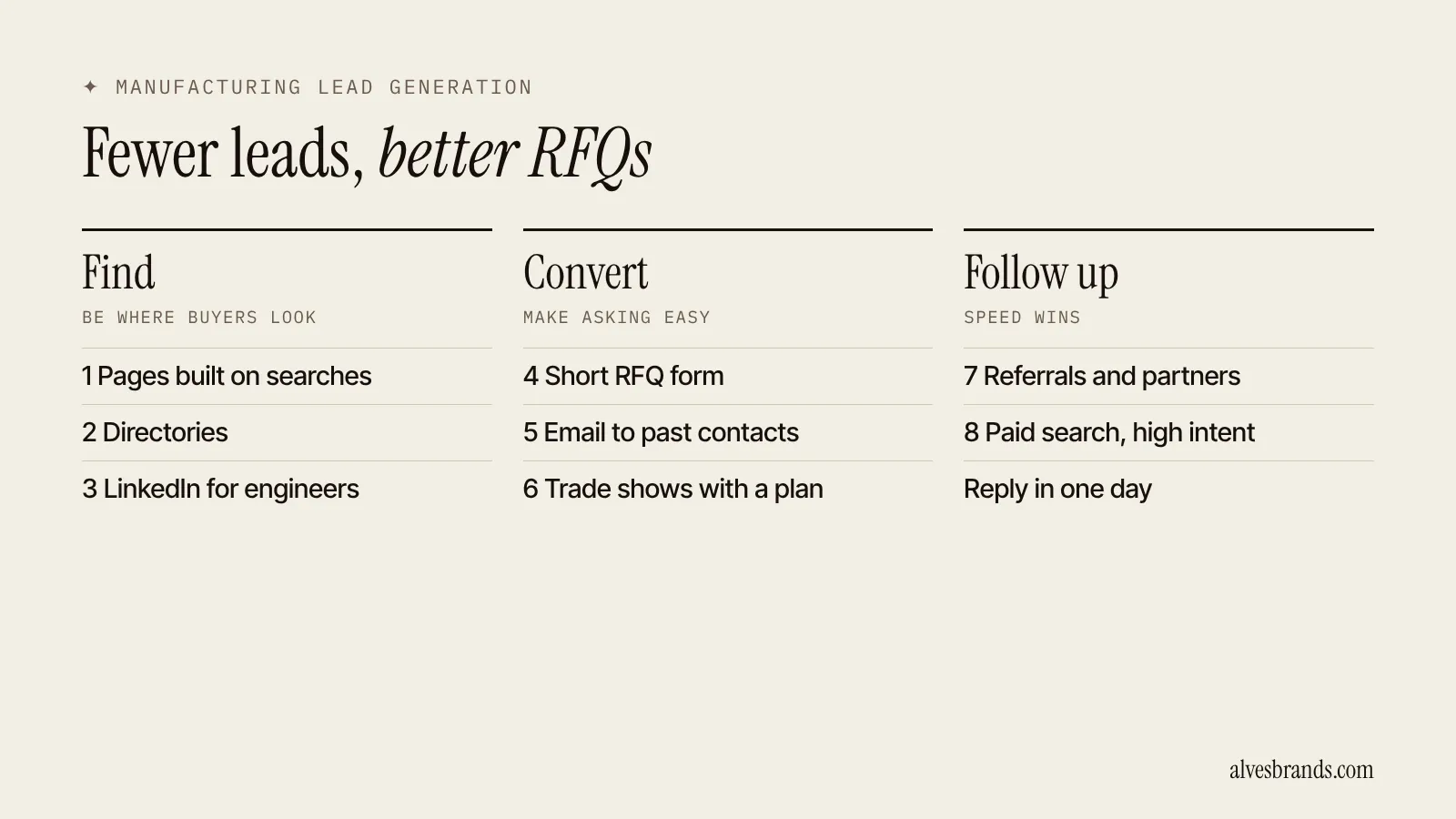
Two more sources worth planning: LinkedIn and shows. Read social media marketing for manufacturers and trade show marketing for manufacturers for the routines.
Related reading: the search side of lead generation is covered in SEO for B2B companies and industrial SEO.
Buyers work out their landed cost before they send an RFQ, so show your terms clearly.
Frequently asked questions
What is manufacturing lead generation?
It’s the process of getting qualified buyers to contact you for a quote or a conversation. It covers your website, directories, LinkedIn, email, trade shows, referrals and ads, plus the way you reply and follow up.
What’s the best way to get leads for a manufacturing company?
For most factories, specific pages that match what buyers search for, plus a short RFQ form, give the steadiest stream of leads. Referrals and email to past contacts add the cheapest extra ones.
How many leads should a manufacturer expect?
Fewer than you think. A site with 1,000 to 3,000 visits a month often gets 10 to 30 real inquiries when the pages and form are clear. Judge by RFQs and orders, not by total leads.
How do I get leads from other countries?
Make sure the site itself converts, using my website design for manufacturers guide. Add a clear export page with shipping terms, languages, certificates and a contact form. Join the directories buyers use in each country and translate your top pages. My multilingual website checklist covers the setup.
How much does lead generation cost?
Start with free work: fix your pages, form and replies. Then add one paid channel at a time, such as a directory profile or a small search ad budget. Track cost per RFQ so you know when to stop or grow.
How long does it take to see results?
Email to past contacts and a better follow-up routine can bring RFQs in weeks. Search pages usually take three to six months to build steady traffic.
Not sure why your site isn’t bringing RFQs? Ask me for a free website check. I’ll show you what buyers see and what to fix first.