A B2B marketing plan is a short document that says who you want to win, what you’ll tell them, where you’ll reach them, what it costs and how you’ll know it worked. If it runs past ten pages, nobody will use it.
This guide gives you ten steps, a one-page template you can copy and a worked example for a small exporter. It’s written for owners, sales managers and the one marketing person many companies have. If you sell to manufacturers or industrial buyers, pair it with my manufacturing marketing plan and B2B manufacturing marketing guides.
What is a B2B marketing plan?
A B2B marketing plan turns your business goal into marketing work. It lists your target accounts, your message, your channels, your budget, your calendar and your numbers for the next 12 months, or the next 90 days if you’re starting out.
Plan or strategy? A strategy is the big choice: who you serve and why you win. A plan is the list of actions that follow from it. LinkedIn’s guide to B2B marketing plans makes the same split. Write the strategy in a few lines, then build the plan from it.
Why B2B plans differ from B2C plans
- Fewer buyers, bigger deals. You could sell to a few hundred companies, not millions of people.
- Groups decide. Gartner research on the B2B buying journey says a buying group for a complex purchase has 6 to 10 decision makers.
- Long cycles. Weeks or months pass between the first visit and the order.
- Research comes first. Gartner found that 67% of B2B buyers prefer a rep-free buying experience, and 6sense found buyers are nearly 70% through the process before they contact a seller.
- Many channels. McKinsey’s 2024 B2B Pulse survey found buyers use about 10 channels on average, up from about 5 in 2016.
So a B2B plan has to reach several people at one company, over time, with proof at every step.
The 10 steps of a B2B marketing plan
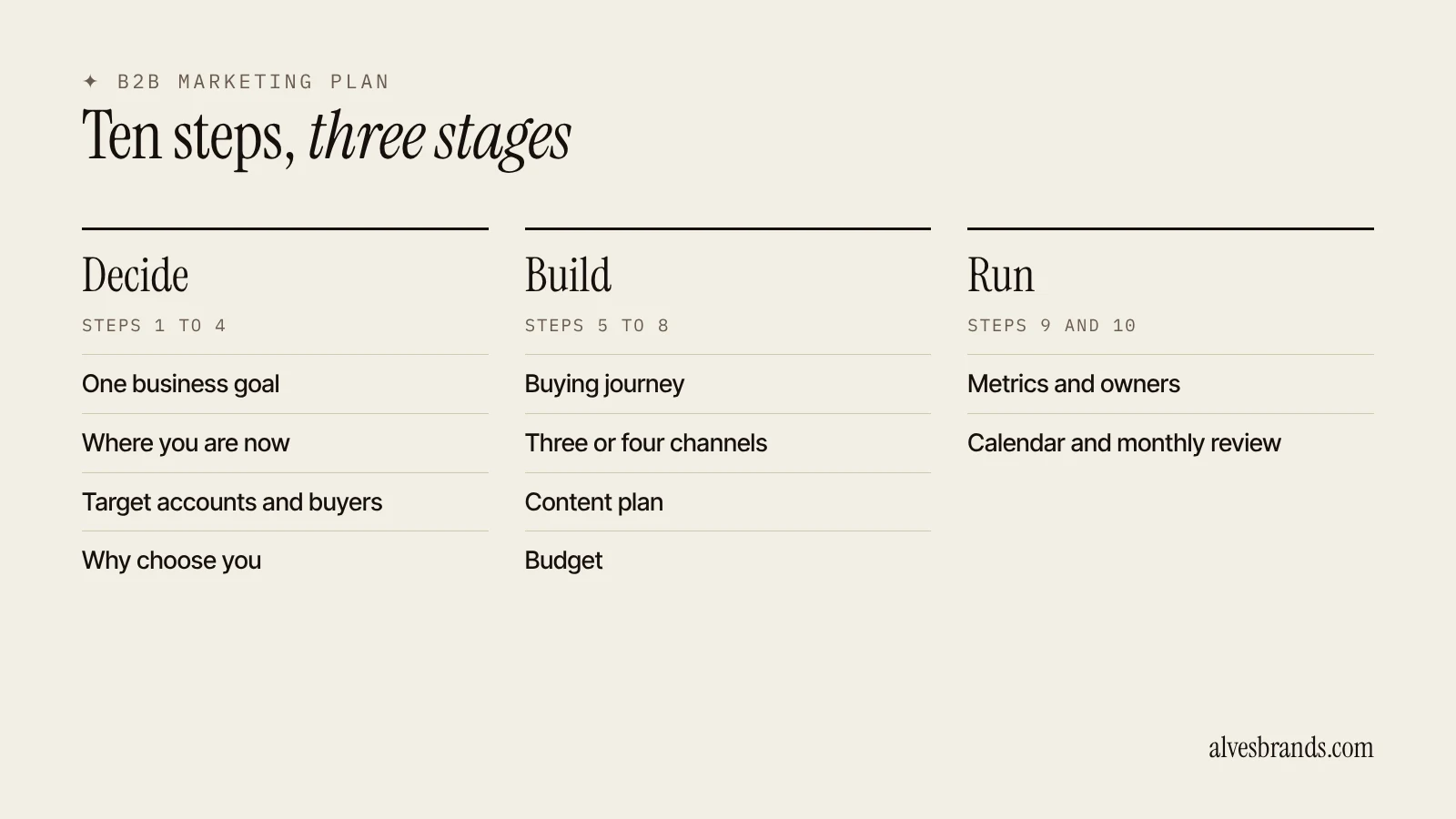
Step 1: Set one business goal
Start with a number the company cares about, not a marketing number. Examples: win 12 new accounts this year, add £400,000 of new sales, or raise the share of sales from export from 20% to 30%. Then split it into marketing goals, such as qualified enquiries per month.
Keep it to one to three goals. If everything is a priority, nothing is.
Step 2: Look at where you are now
Gather what you already know:
- Sales by customer type, product and country.
- Where your best customers came from.
- Your website’s top pages and enquiry sources.
- Win and loss notes from the last 10 deals.
A short SWOT (strengths, weaknesses, opportunities, threats) helps if you keep it honest and under one page.
Step 3: Choose your target accounts and buyers
Write your ideal customer profile (ICP) in plain words: industry, company size, country, problem and buying trigger. Then list the roles at those companies: the person who uses your product, the person who signs, the person who checks risk.
Pick 50 to 200 target accounts if you can. A named list lets you plan emails, ads and sales calls against real companies.
Step 4: Say why they should choose you
Write your positioning in one sentence: "We [do what] for [who] so they [result], unlike [alternative]." Back it with three proof points: numbers, certificates, client names you can use.
Test it on three customers. If they don’t recognise themselves, rewrite it.
A message map keeps everyone saying the same thing. Write one column per buyer role and fill three rows:
| Purchasing manager | Technical lead | Owner or director | |
|---|---|---|---|
| Their worry | Late deliveries and price rises | Quality and certificates | Risk and cash flow |
| Our answer | Fixed lead times and clear terms | Material certificates and test reports | References and a clear contract |
| Proof | On-time record | Certificates page | Client names with permission |
Step 5: Map the buying journey
List what each buyer asks at each stage, and what content answers it.
| Stage | What the buyer asks | What helps |
|---|---|---|
| Problem | Why is this happening? | Guides, checklists |
| Options | What are my choices? | Comparisons, buyer’s guides |
| Vendor | Who can do this? | Service and product pages |
| Proof | Can I trust them? | Case studies, certificates, reviews |
| Decision | How do I start? | Quote form, contact, samples |
Step 6: Pick your channels
Choose three or four channels, not twelve. Match them to where your buyers look and what you can run well.
| Channel | Best for | Time to results |
|---|---|---|
| Website and SEO | Being found when buyers search | 3 to 6 months |
| Email to customers and prospects | Reorders, introductions, follow-up | Weeks |
| Reaching named roles at target accounts | 1 to 3 months | |
| Paid search | Fast tests on high-intent terms | Days to weeks |
| Trade shows and events | Meeting buyers face to face | Around the event |
| Referrals and partners | Warm introductions | 1 to 3 months |
| Directories and marketplaces | Buyers who already want to source | 1 to 3 months |
| Account-based marketing | A short list of large accounts | 2 to 6 months |
For details on two of them, read account-based marketing for manufacturers and email marketing for manufacturers.
Step 7: Plan your content
Content feeds every channel. Plan one main piece a month and use it in several places:
- A guide or case study on your website.
- A short email to your list.
- Two LinkedIn posts that teach one point from it.
- A line your sales team can use in calls.
Google says it ranks helpful, people-first content, so write for a buyer’s question, not for a keyword. My content marketing for manufacturers guide shows what to publish.
Step 8: Set the budget
Start with what you can track to results. A simple split for a small company:
| Item | Share of budget | Examples |
|---|---|---|
| Website and content | 35% to 45% | Page fixes, case studies, guides |
| Demand generation | 25% to 35% | Search ads, LinkedIn, email tools |
| Events and outreach | 10% to 20% | A show, a webinar, sample kits |
| Tools and measurement | 5% to 10% | CRM, analytics, email software |
| Test fund | 5% to 10% | Anything new you want to try |
These are starting ranges, not rules. Move money towards the channels that bring qualified enquiries. See my manufacturing marketing budget guide for a worked split.
Here is the split on a made-up £30,000 yearly budget:
| Item | Share | Amount |
|---|---|---|
| Website and content | 40% | £12,000 |
| Demand generation | 30% | £9,000 |
| Events and outreach | 15% | £4,500 |
| Tools and measurement | 8% | £2,400 |
| Test fund | 7% | £2,100 |
Review the split every quarter. If one channel brings most qualified leads, move money there.
Step 9: Set metrics and owners
Choose numbers at each stage and name one owner for each.
| Stage | Metric | Owner |
|---|---|---|
| Reach | Visits to key pages, email opens, impressions | Marketing |
| Interest | Enquiries, downloads, replies | Marketing |
| Sales conversation | Qualified leads, meetings booked | Sales and marketing |
| Win | Proposals, orders, average order value | Sales |
| Return | Cost per qualified lead, marketing-sourced sales | Owner or finance |
Add a "How did you find us?" field to your forms, and log the source of every enquiry in a CRM or a simple sheet.
Step 10: Build the calendar and review it
Put actions on a 12-month calendar with a monthly 30-minute review. Ask three questions: What worked? What didn’t? What do we change next month? A plan that never changes was never used.
Use a CRM to run the plan
A CRM is a tool that stores every contact, enquiry and follow-up in one place. A free or cheap one is enough to start. Record the source of each lead, the stage it reached and the date of the next step. Then your monthly review is a five-minute look at real numbers instead of a debate based on memory.
One-page B2B marketing plan template
Copy this into a document and fill it in.
| Section | Your answer |
|---|---|
| Business goal | |
| Marketing goals | |
| Target accounts (ICP) and buyer roles | |
| Positioning in one sentence | |
| Three proof points | |
| Buying journey: top question at each stage | |
| Channels (three or four) | |
| Content plan (one main piece a month) | |
| Budget and split | |
| Metrics and owners | |
| First 90 days: actions and dates |
Example: a small exporter’s B2B marketing plan
This is a made-up example to show the shape. The numbers are illustrations, not benchmarks.
Company: a 40-person maker of stainless steel fittings in Turkey that sells to distributors in the UK and Germany.
Business goal: win 10 new distributors in 12 months.
Target accounts: 120 industrial distributors with a stainless range, 30 to 200 staff, in the UK and Germany. Buyer roles: purchasing manager and technical sales lead.
Positioning: "We make food-grade stainless fittings in batches of 500 to 20,000 with a 3-week lead time and full material certificates."
Channels: website pages in English and German, LinkedIn to named buyers, email to past enquiries, one trade show and a distributor directory profile.
Content: a catalogue page for each fitting family, two case notes, a certificates page and a monthly email with one technical tip.
Metrics: qualified enquiries per month, samples sent, quotes and orders, cost per qualified lead.
Two more examples, to show how plans differ
These are made-up examples. The numbers are illustrations, not benchmarks.
A UK engineering consultancy with 25 staff. Goal: win four new framework places and six direct clients in a year. Target accounts: 80 local authorities, utilities and main contractors. Channels: service and sector pages, case studies, LinkedIn from named engineers, one CPD talk a quarter. Metrics: tender invitations, proposals sent and wins.
A B2B software firm selling to logistics managers. Goal: 300 qualified demo requests in a year. Target accounts: 500 mid-size logistics firms in the UK. Channels: comparison and how-to pages, paid search on high-intent terms, webinars and email. Metrics: demo requests, demo-to-trial rate, cost per qualified demo.
Notice what stays the same: one goal, a named list of accounts, three or four channels and a few numbers.
Make marketing and sales agree on what a lead is
Many plans fail because marketing counts a download as a lead and sales doesn’t. Agree on three levels in writing:
- Enquiry. Someone asked a question or requested a quote.
- Qualified lead. The company and the buyer match your ICP, and there’s a real need and a rough timeline.
- Opportunity. A proposal or sample is on the table.
Count and report each level. Hold a short sales and marketing meeting every two weeks to review the list and decide who follows up on what.
A 12-month calendar in one table
| Months | Focus | Main actions |
|---|---|---|
| 1 to 3 | Base | Positioning, key pages, tracking, first case study, email to customers |
| 4 to 6 | Reach | Content each month, LinkedIn outreach, first search ads, one event |
| 7 to 9 | Convert | Improve the best pages, add comparison pages, follow up every lead |
| 10 to 12 | Scale what works | Move budget to the best two channels, plan next year |
Add dates and owners to each action. A task with no name beside it won’t get done.
Choose metrics that match your goal
If your goal is new accounts, track meetings and proposals with target accounts. If it’s more sales from existing accounts, track repeat orders and email replies. If it’s a new market, track enquiries and samples from that country. Pick the metric that moves with the goal, and ignore the rest.
A simple 90-day B2B marketing plan
Weeks 1 to 2: Decide.
- Pick the goal and target accounts.
- Write the positioning and proof points.
Weeks 3 to 6: Build.
- Fix the key website pages and the quote form.
- Add tracking and a "How did you find us?" field.
- Write the first case study.
Weeks 7 to 10: Launch.
- Email past customers and warm contacts.
- Start LinkedIn posts and outreach to target accounts.
- Run a small search ad test.
Weeks 11 to 13: Review.
- Count enquiries by source.
- Keep what works, drop what doesn’t and plan the next quarter.
B2B marketing and AI search
Buyers also ask ChatGPT, Gemini and Perplexity for supplier ideas. Ahrefs found that AI Overviews cut the click-through rate of the top page by 58%. Being named in the answer counts. Google says there are no extra requirements for AI features beyond helpful, indexable pages. Add this to your plan: clear pages with exact facts, and the same company details everywhere. See how to get recommended by ChatGPT.
In-house or agency?
A small team can run a plan like this alone. Consider an agency for a site rebuild, paid ads at scale or a large content plan. Ask for B2B examples in your industry, who does the work and how they report. My guide on how to choose a manufacturing marketing agency has ten questions you can reuse.
Common B2B marketing plan mistakes
- Too many goals and too many channels.
- No named target accounts.
- A message about "us" instead of the buyer’s problem.
- Content with no link to a sales step.
- No owner for each number.
- No monthly review.
- Counting visits and likes instead of qualified leads.
Fit SEO into the plan with the B2B SEO strategy, and get links with B2B link building.
Frequently asked questions
What should a B2B marketing plan include?
Goals, target accounts, positioning, the buying journey, channels, content, budget, metrics, owners and a calendar. LinkedIn’s guide lists similar parts.
How do you write a B2B marketing plan?
Follow the ten steps above: goal, current state, accounts, positioning, journey, channels, content, budget, metrics and calendar. Keep it short enough to use.
How long should a B2B marketing plan be?
One page for the summary and a few more for the calendar and budget. A long document is rarely read.
How much should a B2B company spend on marketing?
There’s no single number. Start with what you can track to qualified leads, then move money towards what works. Use the split in step 8 as a starting range.
What is the difference between a marketing plan and a marketing strategy?
The strategy says who you serve and why you win. The plan lists the actions, budget and dates that follow from it.
How often should I update my B2B marketing plan?
Review it monthly and rewrite it each quarter or year. Change the plan when the numbers show something isn’t working.
What are good B2B marketing metrics?
Qualified leads, meetings booked, proposals, orders, cost per qualified lead and marketing-sourced sales. Track visits too, but don’t judge by visits alone.
Do I need a marketing plan if most of my work comes from referrals?
Yes. A plan makes referrals easier to win and gives you a second source of work if one key client leaves. Start with a one-page plan and a source field on your forms.
Where does account-based marketing fit in a plan?
It fits in the channel step. Use it when you have a short list of large target accounts, and plan emails, ads and sales calls against that list. See my guide on account-based marketing for manufacturers.
Can a small business have a B2B marketing plan?
Yes. A one-page plan with three goals, three channels and a monthly review is enough to start.
Want help with your plan? Ask me for a free website check. I’ll show you what buyers see and what to fix first.