Contract manufacturing marketing is the work of getting OEMs, brands and startups to send you RFQs for parts or products they’ll design themselves. You don’t sell a catalog item. You sell your plant, your people and your track record, and the buyer is picking a partner who’ll hold their reputation for years.
That changes almost everything about how you market. Your clients’ names are under NDA, so you can’t post case studies the usual way. Your buyers are engineers and sourcing managers who check certificates before they read your homepage. And the sale takes months, since a supplier switch means new tooling, new samples and new risk.
This guide covers what’s different, what to put on your site, how to show proof when you can’t name names, and which channels fill an RFQ inbox.
What makes contract manufacturing marketing different
A normal manufacturer says “here’s our product.” A contract manufacturer says “give us your drawing and we’ll build it.” Three things follow from that.
The product is capability. Buyers compare processes, materials, tolerances, volumes, certificates and lead times. They want to know if you can make their part, not whether you make good parts.
Trust is the whole sale. The buyer hands you their design, their schedule and their brand. A bad batch lands on their name. So they look for signs you’re stable, careful and honest.
You’re often invisible. Your work ends up inside someone else’s product with someone else’s logo. That’s why you can’t point at a famous client and why your marketing has to prove skill in other ways.
The Content Marketing Institute’s manufacturing research found that 57% of manufacturing marketers say lack of resources is their biggest challenge, and 64% struggle to tie content to revenue. Contract shops feel both harder than most, since they’re usually small and the sales cycle is long. If that’s you, keep the plan small and tie every piece to an RFQ.
Who buys, and how they look for you
Your buyers fall into three groups:
| Buyer | What they care about | Where they look |
|---|---|---|
| Engineer | Can you hold the tolerance, handle the material, scale from prototype | Google, technical pages, drawings, supplier sites |
| Sourcing or procurement manager | Price, lead time, quality system, risk | Directories, RFQ platforms, referrals, Google |
| Founder or product lead (startups) | Speed, small runs, clear communication | Google, LinkedIn, marketplaces, other founders |
Gartner found that 67% of B2B buyers prefer a rep-free buying experience. For a contract manufacturer, that means the engineer reads your site, compares you with four others and only then asks for a quote. If your site can’t answer their questions, you never hear about the job.
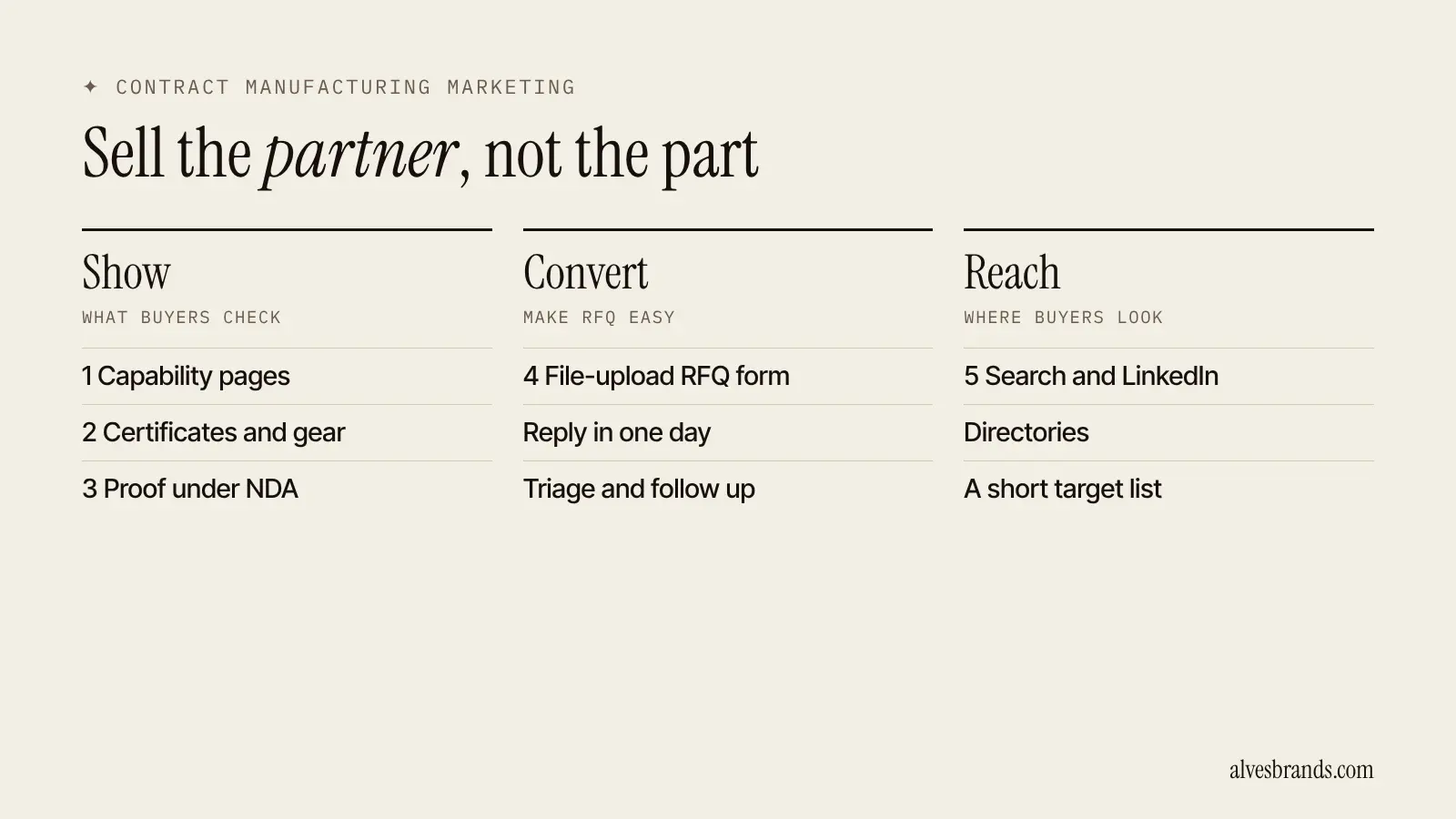
Step 1: Build capability pages that answer engineers
Most contract manufacturing sites have one “Capabilities” page with a bulleted list. That list does nothing in search and tells the buyer nothing. Build one page per process or material you want work for.
A CNC shop could have pages for “5-axis CNC machining,” “titanium machining,” “CNC machining for medical devices” and “low-volume CNC production.” Each page should show:
- What you make, with real photos of parts from your own floor.
- The numbers: tolerances, max part size, materials, finishes, typical volumes.
- The equipment list with machine makes and models.
- Industries served and the standards you work to.
- Lead times for prototype and production.
- How to send a drawing, with a form that takes a file.
Write each page for the search a buyer would type: “contract injection molding for medical devices,” “sheet metal fabrication low volume,” “PCB assembly prototype.” Look at what your buyers actually search with the method in my manufacturing market research guide and in how foreign buyers find suppliers.
Step 2: Put your quality proof where buyers can see it
Certificates close deals in this niche. They also filter you out of deals if they’re missing. Put these on the homepage, the capability pages and the contact page:
- ISO 9001 and any industry add-ons you hold. Link to the ISO 9001 standard so a new buyer knows what the certificate covers.
- Industry certificates like IATF 16949 for automotive, AS9100 for aerospace, ISO 13485 for medical, if you have them.
- Registrations such as the US State Department’s DDTC registration for firms making defense items.
- Inspection gear: CMM, optical scanners, test labs.
- Sample documents: a redacted first-article report, a control plan, a certificate of conformance.
Never claim a certificate you don’t hold. Buyers check, and one false line ends the relationship.
Step 3: Show proof when you’re under NDA
This is the problem every contract manufacturer asks about. You can’t name the client, so how do you show results? Use these:
Anonymous case studies. “A Tier 1 automotive supplier needed a bracket with a 0.02 mm tolerance in 5,000 units a month. Here’s how we got scrap from 6% to under 1%.” No name, but real numbers and real process. Ask the client for permission to describe the project without naming them. Many agree.
Process stories. Walk through how you solved a hard problem: a fixture you designed, a material you switched, an inspection step you added. Engineers love this. It shows how you think.
Part galleries. Photos of finished parts, with material, process and tolerance in the caption. If the part is covered by an NDA, shoot a similar one made in-house or use a generic part.
Numbers. On-time delivery rate, defect rate in parts per million, years of customer relationships, repeat order share. Say what the number covers and the period. A made-up figure is worse than none.
Testimonials without logos. “Head of Sourcing, European medical device maker” with a real quote is better than nothing. Get written approval first.
Awards and audits. Customer audit results, supplier-of-the-year awards, third-party reviews.
Step 4: Make RFQ the easy next step
The point of the site is a quote request. Check your own process:
- Is there an RFQ button on every page, not just the contact page?
- Does the form take CAD files and drawings (STEP, PDF, DXF)?
- Does it ask for quantity, material and target date? Those fields cut the back-and-forth.
- Do you tell the buyer when to expect a reply? “Within one business day” works well.
- Does an NDA option exist? Offer a mutual NDA on request so buyers with sensitive designs feel safe.
Then measure the form. Count visits, submissions and how many turn into quotes. If you have a Search Console account, you’ll also see which searches bring people to which capability pages.
Step 5: Pick the channels that fit contract work
Here’s how the main channels rate for contract manufacturers:
| Channel | Fit | Why |
|---|---|---|
| Google search (SEO) | Very high | Engineers search by process and material; leads come with intent |
| Directories and RFQ platforms | High | Buyers already in sourcing mode, though fees and price pressure apply |
| High | Reaches sourcing managers and engineers; good for proof and process posts | |
| Trade shows | High | Face time with OEMs, costly and slow |
| Paid search | Medium | Fast and measurable, can be pricey per click |
| Email to a targeted list | Medium | Works for known accounts, weak as cold outreach |
| Social media beyond LinkedIn | Low | Little buyer intent |
Directories are worth a closer look. A profile on Thomasnet or a regional directory puts you where sourcing managers already search. Treat it as one source, not the whole plan. You pay for visibility, and you compete on price with every other listing. Your own site should carry the load over time.
Search: the channel that pays longest
Search suits contract work for a simple reason. A buyer with a drawing in hand types exactly what they need: “contract manufacturer plastic injection molding Mexico.” That’s a high-intent search, and few shops show up with a page that answers it.
Start with 10 to 20 pages, each aimed at one process, material or industry. Add a location if you want local buyers, like “CNC machining in Ohio.” Use plain, technical language, not slogans. For the technical side, my SEO audit checks the things that block capability pages from ranking, and the digital marketing for manufacturers guide covers the wider picture.
AI answers now matter too. Buyers ask ChatGPT and Gemini “who makes X” before they search. The same capability pages with clear facts give those tools something to quote. See my guide on getting recommended by ChatGPT and the AI visibility check to see how you show up today.
LinkedIn for contract manufacturers
LinkedIn works for you because your buyers are on it and your proof is visual. Post:
- A photo of a finished part with the process and tolerance in the caption.
- A short video of a machine cutting something hard.
- A note on how you solved a problem, in plain words.
- A shop-floor shot with your team.
Share two or three posts a week and have a real engineer, not only the marketing person, post some of them. Engineers trust engineers. Also connect with the sourcing managers and product leads at the companies you want to win. You aren’t selling in the first message. You’re getting seen.
Account-based thinking for a short target list
Contract manufacturing is often a numbers game of 30 to 100 ideal accounts, not thousands of leads. If you can name them, treat each one like a project: learn their products, find the right engineer and buyer, send something useful (a design-for-manufacturing note on their product, say) and follow up. My guide on account-based marketing for manufacturers shows the method step by step.
Handle RFQs like a sales process
Marketing brings the inquiry. What happens next decides the job. A lot of contract shops spend months on contract manufacturing marketing and then lose the quote in the inbox. Set up a simple routine:
- Reply within one business day, even if only to say the engineer is reviewing the drawing.
- Triage fast. Score each RFQ on fit (can we make it?), size (is it worth it?) and timing (can we hit the date?). Say no early to bad fits. It builds a reputation for honesty.
- Ask smart questions. Annual volume, material, target price, end use. Buyers notice when you’ve read the drawing.
- Send a clear quote. List what’s included, lead time, tooling, minimums and how long the price holds.
- Follow up twice. One call three days later and one email a week after. Most lost quotes are lost to silence, not price.
- Log the result. Win, loss and the reason. After 20 quotes you’ll see which pages and channels bring the jobs you actually want.
This also gives your marketing a real number: quotes per month by source, and the share you win.
Price and positioning
Price talk comes early in contract work, so decide your position before you advertise. Three common ones:
| Position | What you say | Who it attracts |
|---|---|---|
| Lowest cost | “Competitive pricing, fast quotes” | Price shoppers, thin margins |
| Specialist | “We only do medical-grade titanium parts” | Buyers with hard requirements who pay for skill |
| Partner | “We design for manufacturing, then build” | OEMs that want help earlier in the project |
Specialist and partner positions are easier to defend and easier to rank for, since the searches are narrower. A shop that says “we make everything” competes with everyone. A shop that says “low-volume aluminum enclosures for electronics startups” is the obvious pick for that buyer. Pick a lane, then say it in your headline, your page titles and your LinkedIn bio.
A 90-day plan for contract manufacturing marketing
You don’t need a big budget to start. Here’s a plan one person can run part-time.
Days 1 to 30: fix the base.
- List your five best-fit processes, materials and industries.
- Gather certificates, equipment lists and 20 good photos of your own parts.
- Add an RFQ button and a file-upload form on every page.
- Set up Search Console and a way to track form fills.
Days 31 to 60: build the pages.
- Write four capability pages, one for each of your best-fit searches.
- Publish two anonymous case studies.
- Add your certificates and a sample quality document to the site.
- Update your LinkedIn company page.
Days 61 to 90: get seen.
- Post on LinkedIn twice a week with part photos and process notes.
- Claim or update your directory profiles.
- Send a short, useful email to your 30 best-fit accounts.
- Review RFQs by source and double down on what works.
After 90 days, you’ll know which pages bring quotes. Add more pages in the same pattern. If you want to see how the strategy fits together, the industrial marketing strategy guide lays out the steps in order.
What a strong capability page looks like
Here’s a quick test. Take your best page and ask whether an engineer could answer these from it alone:
- Can this shop make my part, in my material, at my tolerance?
- What volume do they handle, from one prototype to a full run?
- Which quality system covers the work, and is there proof?
- Who have they built this kind of part for, even without names?
- How do I send a drawing and how fast will I hear back?
If any answer is missing, the engineer opens another tab. Fix the page until all five are clear, then copy the pattern for every other process you offer. It’s slow work, and it’s why a shop with twelve sharp pages beats a shop with a flashy homepage and one list of services.
Also keep the pages current. Add new equipment, new certificates and recent parts as you get them, and update the date. Buyers trust a page that shows someone is paying attention, and search engines favor pages that stay accurate.
Where to start this week
If all of this feels like a lot, do three things this week. Pick your single best-fit process and write the page for it. Add your certificates to the footer of every page. Then reply to your last five RFQs, won or lost, with a short thank-you and a question about what decided it. The answers will tell you what buyers care about more than any survey, and you’ll have the first lines of your next page. Write them down in the buyer’s own words.
Common mistakes
- One generic capabilities page. Search can’t tell what you do best, and neither can the buyer.
- No certificates on the site. Buyers assume you don’t have them.
- Hiding behind NDAs. You can almost always say something, even if you can’t say who.
- Stock photos of someone else’s machines. Engineers spot them.
- A slow RFQ reply. A quote request that waits three days is a lost job.
- Competing only on price. The lowest bidder wins the worst customers.
For ideas from real firms, read these industrial marketing examples, and for the bigger picture on selling to businesses, see B2B manufacturing marketing. If you’re weighing outside help, read how to choose a manufacturing marketing agency.
For more ways to bring in quote requests, see manufacturing lead generation.
Selling engineering services instead? Read marketing for engineering firms.
Frequently asked questions
What is contract manufacturing marketing?
It’s marketing aimed at OEMs, brands and startups that outsource production. You promote your capabilities, quality systems and track record so buyers send you RFQs, rather than promoting a product line.
How do you market contract manufacturing services?
Build one page per process or material, show certificates and equipment, publish anonymous case studies, make RFQ easy, and use search, LinkedIn, directories and a short list of target accounts.
How do I show proof if my clients are under NDA?
Describe projects without names, share process stories, post part photos with specs, publish real numbers like defect rate and on-time delivery, and ask clients for approval to use unnamed testimonials.
Which channel brings the best leads?
Search usually brings the highest-intent leads over time, since buyers type the exact process and material they need. Directories and trade shows work faster but cost more and push price down.
How long does it take to get RFQs from SEO?
Expect 4 to 9 months for the first steady inquiries from new capability pages, sooner for niche terms with little competition.
What should a contract manufacturer’s homepage say?
Say what you make, for whom and to what standard in the first screen: process, industries, key certificates and an RFQ button. A buyer should know in five seconds if you’re a fit.
How much should a small contract shop spend on marketing?
Start with time, not money. Four good capability pages, an RFQ form that takes files and steady LinkedIn posts cost little. Add paid search or a directory listing only after you can track which source brings quotes.
Do I need a separate site for each service?
No. One site with a page per service, material and industry beats several thin sites. It builds authority in one place.
Run a contract shop and not sure what buyers see? Ask me for a free website check. I’ll show you which capability searches you’re missing and what to fix first.