Marketing for engineering firms works when it earns trust before the first call. Your buyers are engineers, project managers and procurement teams. They check your people, your past projects and your accreditations, and many do it online before they write to you.
Most advice for engineering firms is a list of agency services: a new website, some SEO, some ads. This guide is different. It starts with the kind of firm you run, then shows what to do first, which channels pay off and how to tell if it works. For the search side, read my guide to engineering SEO, and for the wider picture see marketing for industrial companies. If you build as well as design, read digital marketing for construction companies.
Why marketing for engineering firms is different
Technical buyers. They want facts: standards, tolerances, software, sign-off, insurance. Slogans don’t move them.
Long, shared decisions. Gartner research on the B2B buying journey says a buying group for a complex purchase has 6 to 10 decision makers. In engineering that can be a client, a main contractor, an architect and a procurement team.
Research before contact. Gartner found that 67% of B2B buyers prefer a rep-free buying experience. 6sense found buyers are nearly 70% through the process before they contact a seller. Your website and profiles do the first round of selling.
Work comes from reputation. Work often comes from referrals and repeat clients, and that is why marketing looks optional. Referrers still check you online before they recommend you.
Tenders and frameworks. Public and utilities work often runs through formal bids. Marketing has to support the bid, not only the website.
Is marketing worth it for an engineering firm?
Yes, if you can trace it to enquiries and wins. Referrals are fragile. One key client leaves, one partner retires, and the pipeline thins out. Marketing gives you a second source of work and makes referrals easier to win.
Start small. Add a "How did you find us?" field to your contact form. Log the source of every enquiry and every win for three months. You’ll see what already works before you spend anything. You can test your own site with the free website enquiry check.
Set your goals, audience and budget first
Write down three things before you pick channels.
- The work you want more of. A discipline, a sector and a size of job. "Mechanical and electrical design for hospitals and labs" is a goal. "More clients" is not.
- The people who decide. Name the roles: client project manager, main contractor, architect, procurement lead.
- What you can spend. Time counts as money. Four hours a week from a senior engineer is a real budget.
My manufacturing marketing budget guide shows how to split a small budget, and the same logic fits engineering firms. For a quick estimate, use the free SEO cost calculator.
Start with your type of firm
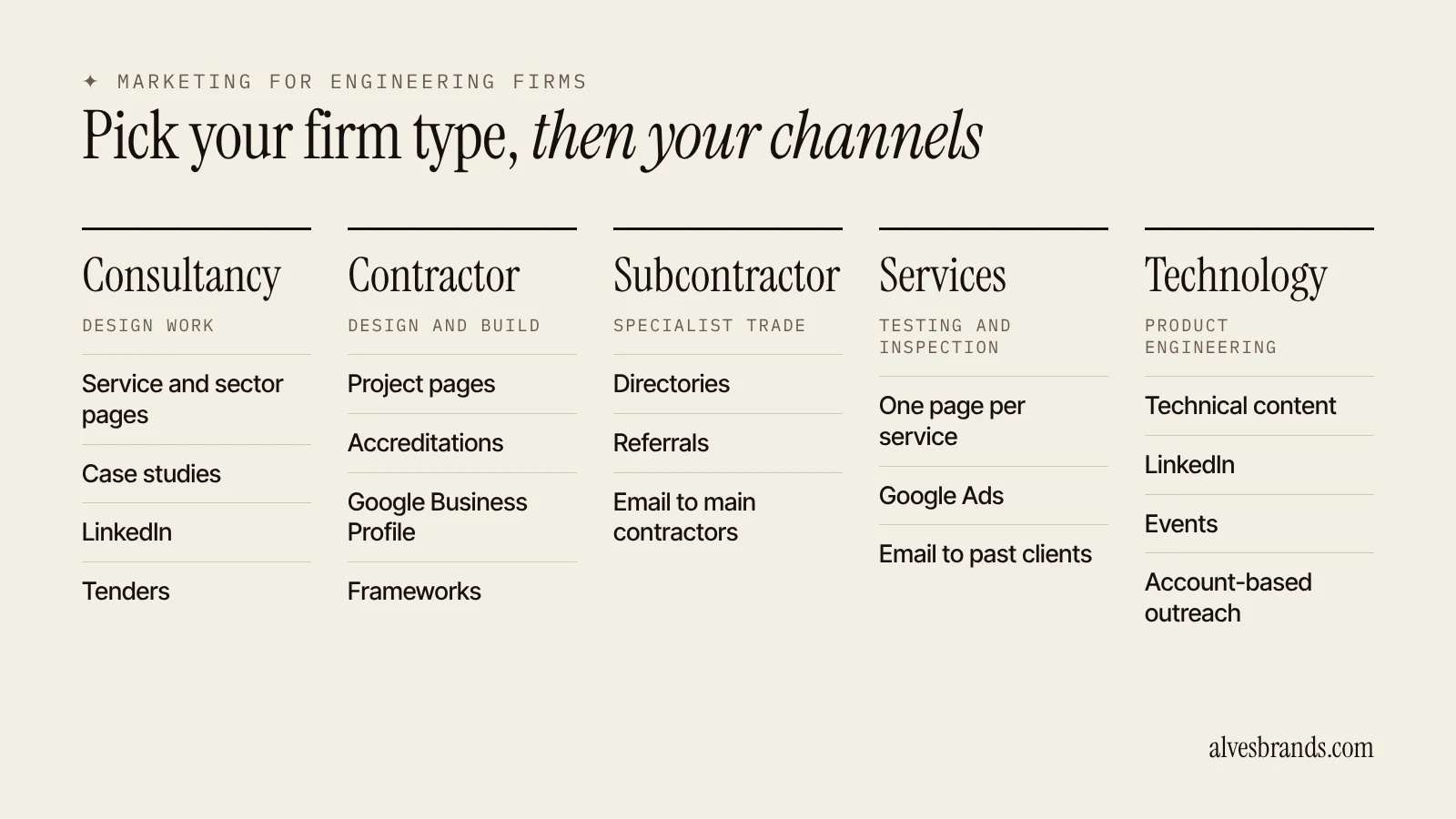
Marketing for engineering firms is not one job. Pick the row that fits you and begin there.
| Firm type | Who buys | What they check | Best first channels |
|---|---|---|---|
| Design consultancy | Clients, architects, main contractors | Chartered engineers, similar projects, software, insurance | Service and sector pages, case studies, LinkedIn, tenders |
| Design and build or contracting firm | Developers, public bodies, owners | Track record, safety record, capacity, references | Project pages, accreditations, Google Business Profile, frameworks |
| Specialist subcontractor | Main contractors, other engineers | Price, programme, certificates, response speed | Directories, referrals, email to main contractors |
| Engineering services and testing | Plant owners, facilities teams | Standards, accreditation, turnaround, reports | Search pages for each service, Google Ads, email to past clients |
| Product or technology engineering firm | Manufacturers, OEMs | Specs, prototypes, IP terms, lead time | Technical content, LinkedIn, trade events, account-based outreach |
Channel 1: Your website, built for technical buyers
In marketing for engineering firms, your website is where the first judgement happens. A Thomas survey of 266 industrial buyers found 73% focus on the company website when judging a supplier. Engineering buyers are no different.
Build these pages first:
- One page per discipline. Structural, mechanical, electrical, civil, process. Say what you do, for whom, and how a job runs.
- One page per sector. Healthcare, energy, rail, data centres, water. Use the words that sector uses.
- Team pages. Names, photos, chartered status, years of experience. Buyers buy people.
- Project pages. Scope, size, role, result. See the next section.
- Accreditations. ISO certificates, safety schemes, insurance, professional body membership. Put them where buyers can find them in one click.
- A short contact form. Name, email, project type, timescale. Reply within a day.
Orbit Media’s study of the 100 top manufacturing websites shows the best ones make the next step obvious. The same holds for engineering sites. Read website design for manufacturers for a page-by-page checklist.
Channel 2: SEO for engineering firms
Buyers search for a service, a sector and a place, such as "structural engineers Manchester" or "process engineering consultants for food plants". Match each search with a page that answers it.
- One page per service, sector and main location.
- A clear title and a short description for each page.
- Technical guides that answer engineers’ questions, in line with Google’s advice to write helpful, people-first content.
- PDFs with real content. Google lists PDF among the file types it can index, so a good technical note can bring visits.
Search is slow. Plan for three to six months before pages rank. My engineering SEO guide goes step by step, and industrial SEO covers the wider topic.
Channel 3: Case studies and project pages
Proof closes deals, and it is the heart of marketing for engineering firms. A good project page has five parts:
- The client’s problem, in one or two sentences.
- Your scope and your role.
- The method, with the standards or software used.
- The result, with numbers you can back up: cost, time, energy, safety, uptime.
- A photo or drawing, and a quote if the client agrees.
Ask for permission before you publish. If a client won’t be named, write "a UK water utility" and keep the facts. Never invent results. If you have no case study yet, write a short note on how you’d approach a typical job.
Channel 4: Tenders and frameworks
Public and utilities contracts above a threshold are published on Find a Tender, the GOV.UK service for high-value public and utilities contracts. GOV.UK says the threshold is usually £139,688 including VAT. Smaller public work sits on other portals, so check the buyer’s own procurement page too.
Marketing helps you win these bids:
- Keep a bid library. Store CVs, project summaries, policies and insurance in one folder, updated each quarter.
- Make your website match your bid. Evaluators look you up.
- Track lost bids. Ask for feedback and note the reasons.
Channel 5: LinkedIn and thought leadership
For marketing for engineering firms, LinkedIn fits well, because your buyers and referrers are there. A few hours a month is enough.
- Post a short project update, a lesson learned or a technical tip. Use real engineers’ names.
- Share one short article a month on a problem your clients face.
- Comment on posts from clients and partners.
- Keep each engineer’s profile current, with the same firm description.
Skip long threads about the firm’s culture. Engineers read posts that teach them something.
Channel 6: Email to people who already know you
Your best list is past clients, current clients, consultants, architects and contractors you’ve worked with. Send one useful email a month: a short case, a code change that affects them, or a new capability. Reply to every response personally. My guide to email marketing for manufacturers has a simple monthly format that works for engineering firms too.
Channel 7: Directories, accreditations and Google Business Profile
Buyers also check industry directories, professional body listings and accreditation schemes. Fill in each profile fully, with the same name, address and description everywhere.
If you have an office clients visit, or you win local work, set up a Google Business Profile. Google says local results are based on relevance, distance and prominence, so a complete profile, a correct category and a few real reviews help.
Channel 8: Events, CPD and partnerships
Marketing for engineering firms works best face to face too. Engineers trust engineers. Offer a lunch-and-learn or a CPD talk to architects and contractors. Present at a professional body meeting. Co-host a short webinar with a partner. Follow up within a week and send the slides to everyone who attended. For bigger shows, see trade show marketing for manufacturers.
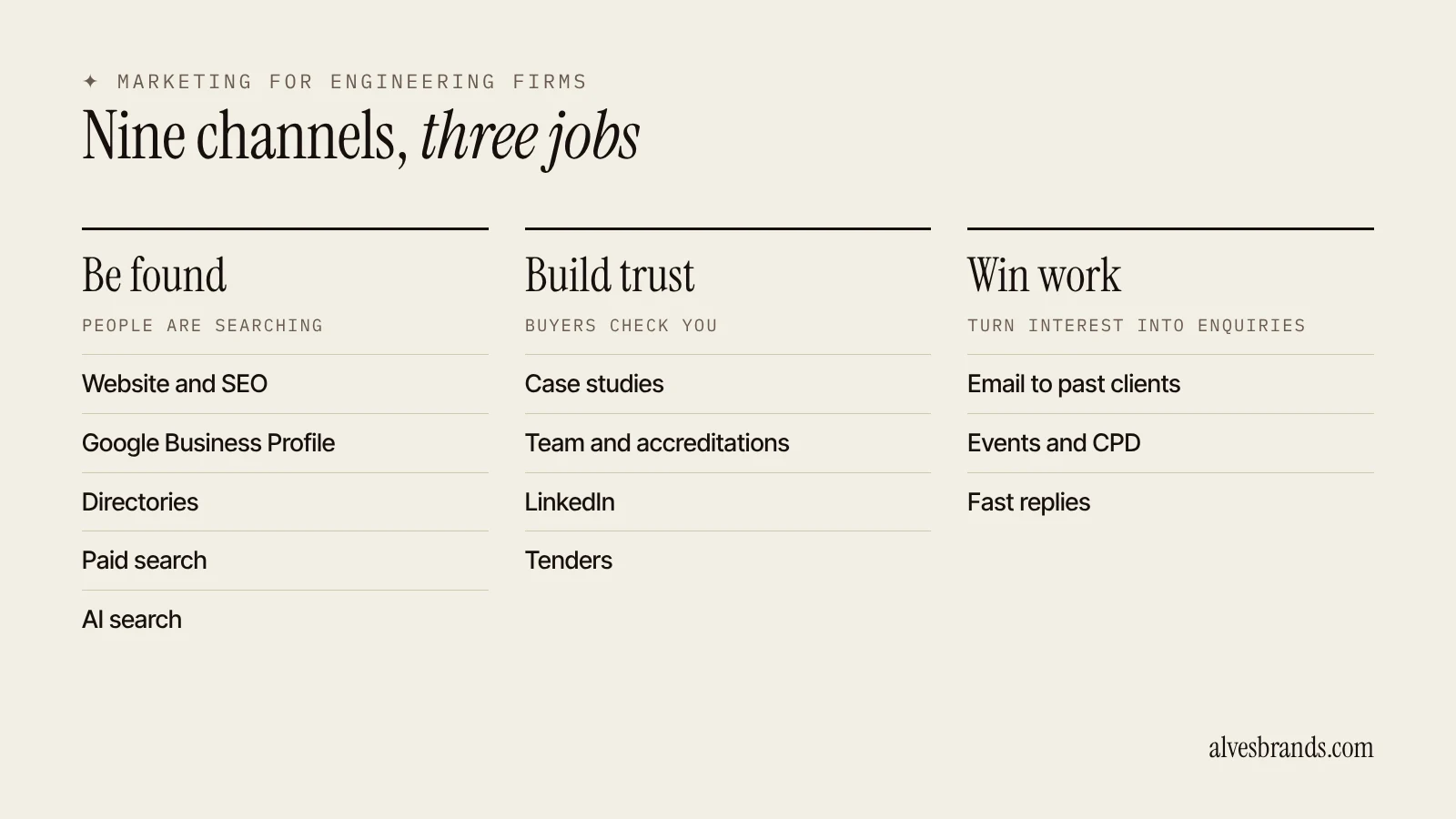
Channel 9: Paid search and paid social
Paid ads in marketing for engineering firms: Google Ads works for services people search for every week, such as testing, surveys and inspection. Pick terms close to a sale, send clicks to a specific page and track cost per enquiry, not clicks. LinkedIn ads work when you have a list of target accounts. Start with a small budget and stop what doesn’t bring enquiries.
Channel 10: AI search
Buyers ask ChatGPT, Gemini and Perplexity for supplier ideas. Ahrefs found that AI Overviews cut the click-through rate of the top page by 58%. Being named in the answer counts. Google says there are no extra requirements for AI features beyond helpful, indexable pages. Write clear pages with exact facts, and keep the firm’s name, address and services the same everywhere. See how to get recommended by ChatGPT.
What to say to technical buyers
Say what you do, for whom, and the proof, in one line. For example, with made-up numbers: "We design the mechanical and electrical services for NHS hospital refurbishments, with 40 completed projects and a 15-person chartered team." Use numbers you can prove.
Then answer the questions a buyer asks in this order: Can you do it? Have you done it before? Who will do the work? What does it cost and how long will it take? What happens if something goes wrong?
A simple plan: your first 90 days
Weeks 1 to 2: Set the base.
- Write your one-line positioning and the work you want.
- Add a "How did you find us?" field to the contact form.
- List your 20 best past clients and referrers.
Weeks 3 to 6: Fix the website.
- Add or improve one page per discipline and sector.
- Add team pages, accreditations and two project pages.
- Make sure the site loads fast on a phone.
Weeks 7 to 10: Start two channels.
- Email your 20 contacts with one useful update.
- Post twice a month on LinkedIn from named engineers.
- Fill in your directory profiles and Google Business Profile.
Weeks 11 to 13: Check and adjust.
- Count enquiries by source. Keep what brings work and drop the rest.
- Write the next case study or technical guide.
In-house or agency?
A small firm can start marketing for engineering firms with one marketing person, or a senior engineer with a few hours a week plus a freelancer for design and writing. Consider an agency when you want faster results, need a new website, or run paid ads at scale. Ask any agency for engineering projects they’ve worked on, who does the work and how they report. My guide on how to choose a manufacturing marketing agency has ten questions you can reuse.
How to measure marketing for engineering firms
Track a few numbers each month:
- Enquiries by source.
- Enquiries that became a proposal, and proposals that became a win.
- Visits to service and sector pages.
- Tender invitations and the number won.
- Cost per enquiry for paid channels.
Don’t judge by visits alone. One enquiry from the right client is worth more than a thousand visits from the wrong people.
Common mistakes in marketing for engineering firms
- Listing every service on one page instead of one page per service.
- Hiding the team and the accreditations.
- Publishing projects with no facts or numbers.
- Posting only on the firm’s page, with no engineer names.
- Waiting for referrals and doing nothing else.
- Switching channels every month, so nothing has time to work.
- Not tracking where enquiries come from.
Frequently asked questions
What is the best marketing for engineering firms?
A clear website with service and sector pages, project proof, LinkedIn and email to past clients. Add SEO and tenders as your next step.
How do small engineering firms get new clients?
Ask your best clients for introductions, make your team and projects easy to find online, and follow up with every enquiry within a day. Then add one channel at a time.
How much should an engineering firm spend on marketing?
There’s no single number. Start with the time you can give and a small budget you can track to enquiries. See my manufacturing marketing budget guide for ways to split it.
Is SEO worth it for engineering firms?
Yes, because buyers search for services and sectors. It takes three to six months to show results, so start early. Read the engineering SEO guide.
Do engineering firms need LinkedIn?
It’s worth a few hours a month, because clients, partners and recruits all look you up there. Use named engineers, not only the firm’s page.
How long does marketing take to work for an engineering firm?
Email and direct contact can bring enquiries in weeks. Search pages usually need three to six months. Tenders and events sit in between.
How do I market an engineering consultancy?
Focus on people and proof: chartered engineers, similar projects, clear scope and fast replies. Use sector pages, case studies, LinkedIn and your tender library.
Should an engineering firm hire a marketing agency?
Consider one when you need a new site, paid ads or more speed than your team can give. Check their engineering experience first.
Want help choosing where to start? Ask me for a free website check. I’ll show you what buyers see and what to fix first.