How to choose a manufacturing marketing agency comes down to one test: can they explain your buyer, your sales cycle and your numbers better than your own sales team does after a 45-minute call? If they can’t, keep looking. Pretty portfolios and big client logos don’t answer that.
A bad pick costs you a year. Most contracts run 6 to 12 months, the first results from search work take months anyway, and by the time you know it isn’t working, the budget is gone. Set the number first with my manufacturing marketing budget guide. This guide gives you a short process, ten questions to ask, the red flags I’d walk away from, and a scorecard to compare your shortlist. For a quick estimate, use the free SEO cost calculator.
One thing up front: I run a one-person SEO practice, not an agency, so I’m not selling you a retainer on this page. I’ll point out where a freelancer or an in-house hire beats an agency, because sometimes it does.
Do you need an agency at all?
Not always. The Content Marketing Institute’s manufacturing research found that 57% of manufacturing marketers name lack of resources as their biggest challenge. That’s the real reason most plants hire outside help: there’s no time and no spare people.
Here’s how the three options stack up.
| Option | Good for | Watch out for |
|---|---|---|
| In-house marketer | Plants with steady work to give one person | One person can’t be a writer, designer, SEO and ad buyer at once |
| Freelancer or consultant | One clear job, like SEO or a new website | Single point of failure if they get busy or leave |
| Agency | Many skills at once, bigger budgets | Junior staff do the work after the sales team wins the deal |
If you only need one thing done well, say search or a website rebuild, a specialist freelancer is usually cheaper and closer to the work. If you need strategy, content, web, ads and email all moving together, an agency makes sense. My guide on manufacturing company marketing goes deeper on the in-house versus outside question.
Step 1: Write your brief before you talk to anyone
Agencies sell what they already have. If you walk in without a brief, you’ll walk out with their standard package. Write one page first:
- The goal, as a number. “20 qualified quotes a quarter from Germany” beats “more leads.”
- Who you sell to. Job titles, industries, countries.
- What you’ve tried and what happened.
- Your sales cycle. Weeks, months or a year.
- A budget range. Hiding it wastes everyone’s time.
- What you can’t give them. Say so if nobody on your side has time to review drafts.
If you don’t have a plan yet, build the manufacturing marketing plan first. It takes a week and makes every agency call sharper.
Step 2: Build a shortlist of three to five
The first rule of how to choose a manufacturing marketing agency is to compare a few, not one.
Don’t send a request to fifteen agencies. You’ll drown in decks. Find three to five from these places:
- Peers. Ask other plant owners who they use and whether they’d rehire them.
- Industry associations. Trade groups often list vendors that serve their members.
- Search results. Look at who ranks for your own buyers’ searches. An agency that can’t rank itself won’t rank you.
- Case studies in your field. A pump maker’s results tell you more than a restaurant’s.
Skip anyone who cold-emailed you a “free audit” generated by a tool. A real audit has a person’s name on it and talks about your specific pages.
How to choose a manufacturing marketing agency: 10 questions to ask
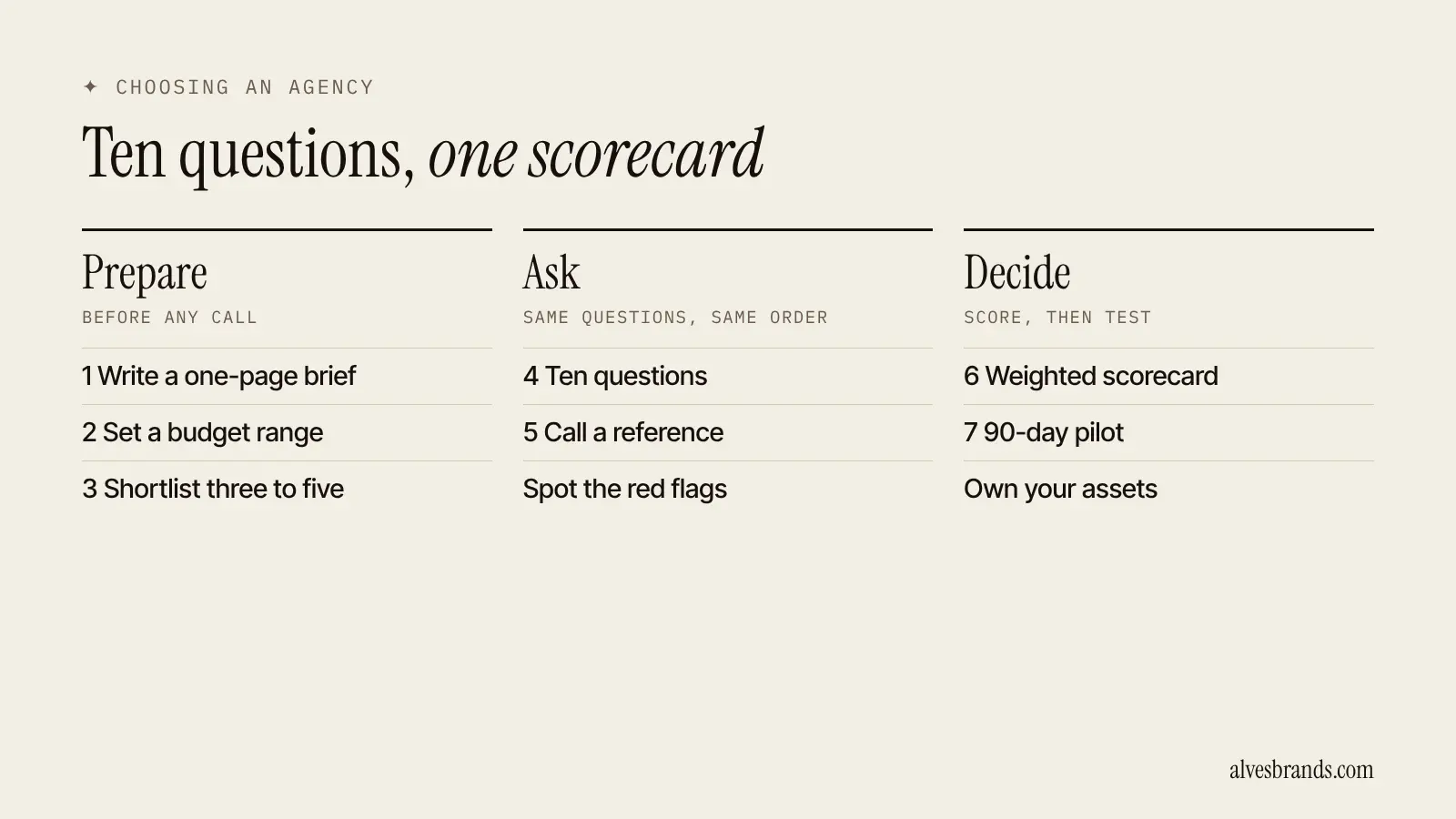
Ask all of them the same questions, in the same order, and write the answers down.
1. Which manufacturers have you worked with, and can I call one?
You want clients with a similar product, buyer and sales cycle. One reference call is worth ten case-study PDFs. Ask the client what went wrong, not just what went right.
2. Who will actually do the work?
Meet the person who’ll write, design or manage your ads, not just the salesperson. Ask how many accounts each person handles. Over 15 or 20 per person is a warning sign.
3. How do you learn a technical product?
Good agencies interview your engineers and your sales team, visit the plant if they can, and read your catalog. Weak ones send you a questionnaire. Technical buyers spot shallow content in two sentences.
4. What will you measure, and how is it tied to revenue?
The CMI study found that 64% of manufacturing marketers struggle to tie their content to revenue. Make the agency show you how they’ll solve that for you: tracked forms, call tracking, CRM fields, quote requests by source.
5. What results can I expect in 3, 6 and 12 months?
Honest answers sound like “month 3 you’ll see the groundwork, month 6 rankings start to move, month 12 you should see quotes.” Anyone promising page one in 30 days is guessing or lying. Google itself warns about SEO providers that guarantee rankings, and it says to treat cold outreach from SEO firms with suspicion.
6. What do I own at the end?
Your website, domain, analytics, ad accounts, content and creative files should be in your name from day one. Get this in writing. Some agencies hold the domain or the ad account hostage when you leave.
7. How do you handle a long B2B sales cycle?
Industrial buyers go through roughly 70% of the process before they talk to a seller, per the 6sense 2024 buyer report. An agency that talks only about leads this month doesn’t understand that.
8. How do you work with our sales team?
Marketing and sales should meet at least monthly. Ask how they’ll learn which leads turned into jobs. If the answer is “we send you a report,” that’s a no.
9. What does the contract look like?
Look at the term, the notice period, what happens to your assets, and what’s included. Month-to-month after a 3-month start is fair. A 12-month lock-in with no exit is a lot to ask from a stranger.
10. What would make you say no to us?
The best agencies turn down bad fits. If they say yes to everything, they want your money more than your results.
How to run the reference call
Most people skip this or ask “were you happy?” and get a polite yes. Ask these instead:
- What was the goal, and did you hit it?
- How long before you saw the first real quote or order from their work?
- Who did the work, and did that change after the first month?
- What annoyed you?
- Would you sign again today, same terms?
Pay attention to pauses. A client who needs a few seconds before saying “yes” is telling you something. Also ask whether the reference pays full price or got a discount for letting the agency use their name. A reference who got free work isn’t a neutral voice.
Three kinds of agency, and who they fit
Agencies group into three types, and each fits a different plant.
Industry specialists. They only work with manufacturers or industrial firms. They know the vocabulary, the trade shows and the buying committees. The downside is price and the risk that they’ve signed your direct competitor. Ask who they already work for.
Channel specialists. An SEO shop, a LinkedIn ads shop, a video studio. They’re deep in one skill. If your problem is “we don’t rank for our main products,” a search specialist is a sharper pick than a full-service firm.
Full-service generalists. Branding, web, ads, email, PR under one roof. Handy if you want a single contact. The weak spot is that they know a little of everything and a lot of nothing, and manufacturing is often a side vertical for them.
Pick by your problem, not by the pitch. A plant with a decent website and no traffic needs search and content. A plant with traffic and no quotes needs a better website and sales follow-up. A plant with neither needs the plan first.
Mistakes buyers make
- Choosing on price alone. The cheapest proposal usually leaves out the hard parts, like technical fixes and reporting.
- Hiring before the website is ready. Ads sent to a slow, vague site burn money. Fix the basics first.
- Expecting the agency to know your product. They’ll learn it only if your engineers give them time. Block that time before you sign.
- No internal owner. Someone on your side must approve drafts within a few days. Without that, work stalls and you blame the agency.
- Judging by traffic. More visits don’t mean more quotes. Ask for numbers that sit near revenue.
Red flags that should end the call
- Guaranteed rankings. Nobody can promise that. See Google’s own advice above.
- No manufacturing clients. Learning on your budget is expensive.
- A package before a conversation. They quoted before they asked about your buyers.
- Vanity numbers. Impressions, followers and “reach” in every slide, quotes and revenue in none.
- Secrecy about methods. You should be able to understand what they do each month.
- Pressure to sign today. A 20% “this week only” discount is a sales trick.
- Links bought in bulk. Google’s spam policies list buying or selling links for ranking purposes as link spam, and the penalty lands on your site, not theirs.
What manufacturing marketing agencies cost
Prices vary a lot by country and size, so treat these as rough ranges, not quotes. They come from what agencies publish and what I see in proposals, not from a survey.
| Service | Typical shape | What to expect |
|---|---|---|
| SEO and content | Monthly retainer | A few thousand dollars a month for a serious program |
| Website build | One-off project | Anywhere from a few thousand to tens of thousands |
| Paid search or LinkedIn ads | Management fee plus ad spend | Fee is often 10 to 20% of spend or a flat monthly amount |
| Full-service marketing | Monthly retainer | The top of the range, often with a long contract |
Always ask what’s included. A cheap retainer that covers two blog posts a month is not the same as one that includes technical fixes, reporting and calls.
Score your shortlist
This is the step that turns how to choose a manufacturing marketing agency from a gut call into a decision you can defend to your partners.
Put your agencies in rows and score each from 1 to 5 on these columns. Weight the first three double.
| Criteria | Weight |
|---|---|
| Real manufacturing experience and references | x2 |
| Clear link between work and revenue | x2 |
| Senior people on your account | x2 |
| Understands your buyer’s long cycle | x1 |
| You own your assets | x1 |
| Fair contract and exit terms | x1 |
| Fit with your team and style | x1 |
Anyone scoring under 70% of the maximum is out. If two agencies tie, pick the one whose reference client spoke most warmly.
Start with a small pilot
A pilot is the safest way to choose a manufacturing marketing agency when two finalists look equal on paper.
Contract shops should also read contract manufacturing marketing, and firms that sell or service equipment can use marketing for industrial companies to write a sharper brief.
Don’t sign the big retainer on day one. Ask for a 90-day pilot with a clear target: an audit and fix list, five pages rewritten, or a single ad campaign. You’ll see how they communicate, how fast they deliver and whether the work reads right to your engineers. If it goes well, extend it.
What a good first call sounds like
You can learn a lot in the first 45 minutes. A good agency spends most of that time asking questions: who buys from you, how long a deal takes, which jobs make you the most money, where your last leads came from. They’ll ask to see your analytics and your sales process. They’ll tell you what they’d fix first and what they’d leave alone, and they’ll say what they don’t know yet.
A weak first call is mostly a pitch. You hear about awards, team size and a long list of services, but few questions about your business. Then a proposal arrives two days later with a price and a scope that could belong to any company. If that’s what you got, ask yourself how they’ll treat your account once you’ve signed.
Take notes on three things: did they understand your buyer, did they give a straight answer on timing and cost, and did they push back on anything you said. An agency that never disagrees with you isn’t thinking hard about your problem.
What to do in the first 90 days
Once you’ve picked someone, set the rules early:
- Week 1. Hand over access: analytics, Search Console, ad accounts, CMS. Keep admin rights yourself.
- Week 2. Agree the three numbers you’ll track and where you’ll see them.
- Month 1. Put a 30-minute call on the calendar every two weeks, with someone from sales in the room.
- Month 3. Review against the goal in your brief. Cut what isn’t moving.
A good starting point for your own review is the industrial marketing strategy guide, which lists the checks I’d run on any plan. If the agency’s work touches search, run a quick SEO audit on your site before they start so you have a clean baseline to compare against.
For export-focused plants, add one more question: can they do this in your buyers’ languages? Translating isn’t enough. My guide on how foreign buyers find suppliers shows what local search looks like.
Compare my B2B SEO agency and SEO consultant offers against the questions above.
Before you hire, see the B2B SEO strategy steps so you know what to ask for.
If SEO is the gap, see my manufacturing marketing agency page and the manufacturing SEO cost guide.
Frequently asked questions
How do I choose a manufacturing marketing agency?
The short version of how to choose a manufacturing marketing agency: write a one-page brief with a numeric goal, shortlist three to five agencies with manufacturing clients, ask each the same ten questions, call a reference, score them in a table and start with a 90-day pilot.
How much should I pay a manufacturing marketing agency?
It varies by service and country. A serious SEO and content program usually runs a few thousand dollars a month, and a website build costs from a few thousand to tens of thousands. Get written quotes from three and compare what each includes.
What should a manufacturing marketing agency include in the contract?
The term and notice period, the deliverables, who owns the website, domain, analytics and ad accounts, the reporting schedule and what happens to your assets if you leave.
Is a freelancer better than an agency?
For one clear job, often yes. A freelancer costs less and you work with the person doing the job. An agency fits when you need strategy, content, web and ads moving together.
How long before an agency shows results?
Paid ads can bring quotes in weeks. Search and content take 6 to 12 months to build. Ask for leading signs at 90 days, like rankings, traffic and quote-form fills.
What are the biggest red flags?
Guaranteed rankings, no manufacturing clients, a package quoted before they asked about your buyers, reports full of vanity numbers and a lock-in contract with no exit.
Want a second opinion on a proposal? Ask me for a free website check. I’ll tell you what the agency should be fixing first and what you can skip.