Content marketing for manufacturers means publishing useful pages, guides, videos and posts that answer what buyers ask before they pick a supplier. You teach, you show proof and the buyer remembers you when it’s time to ask for a quote.
It sounds soft, but it’s the opposite. Your buyers are engineers and purchasing managers with a problem to solve. They don’t want a slogan. They want a tolerance, a lead time, a failure story they can trust. The company that publishes those answers gets the call.
This guide covers what to publish, how to get the knowledge out of your engineers’ heads, a simple monthly routine and the numbers to watch. If you need the bigger plan, read the manufacturing marketing plan alongside it.
Why content marketing for manufacturers works
Buyers do most of their homework alone. A 6sense report found they’re nearly 70% through the process before they contact a seller, and Gartner found that 67% prefer a buying experience without a sales rep. Your content is your sales rep during that time. It answers questions at 2 a.m. in a time zone you’ve never visited.
The Content Marketing Institute’s manufacturing study backs this up. In it, 74% of manufacturing marketers rated video the content type that works best, and 85% said LinkedIn gives them the most value. The same study found that 68% said search and pay-per-click gave them the best paid results. Buyers use search and video to learn, and professionals use LinkedIn to share what they find.
And your knowledge is already good. You have engineers who know why a part fails and what fixes it. Most competitors never put that on paper.
What content brings buyers
Not all content earns its keep. Here’s how the main types compare for a factory.
| Content | What it does | Effort | Best for |
|---|---|---|---|
| Capability and product pages | Catches buyers who search for what you make | Medium | Every factory |
| Case studies | Proves you solve real problems | Medium | Winning bids |
| How-to and spec guides | Catches early searches, builds trust | Medium | Search traffic |
| Comparison articles | Helps buyers choose a material or process | Medium | Engineers |
| Short videos of the shop floor | Shows the work and the people | Low to medium | LinkedIn, product pages |
| Downloads (CAD, data sheets, checklists) | Trades value for contact details | Medium | Engineers |
| FAQs | Answers repeat questions | Low | Every page |
| Email updates | Keeps you in front of past contacts | Low | Existing leads |
Start at the top of the table. Pages and case studies bring the fastest results. The rest builds on them.
Where ideas come from
You don’t need a brainstorm. You need to listen. Your best topics sit in places you already have:
- Sales emails and calls. Every question a buyer asks twice is a topic. Make a sheet and log them.
- Your engineers. Ask what customers get wrong, what fails in the field and what they’d change in a design.
- Quality and support. Returns, complaints and rework tell you what buyers worry about.
- Search results. Type your product into Google and read the “People also ask” box. Those are real questions.
- Competitor pages. See what they cover. Then cover it better, or cover what they skip.
A tip that saves hours: write the question as the title. “How tight a tolerance can you hold on aluminum extrusions?” is a better title than “Precision capabilities.” Buyers search in questions, and so do AI assistants.
How to get the knowledge out of your engineers
This is where most factory content dies. The people who know the answers are busy, and they hate writing. So don’t ask them to write.
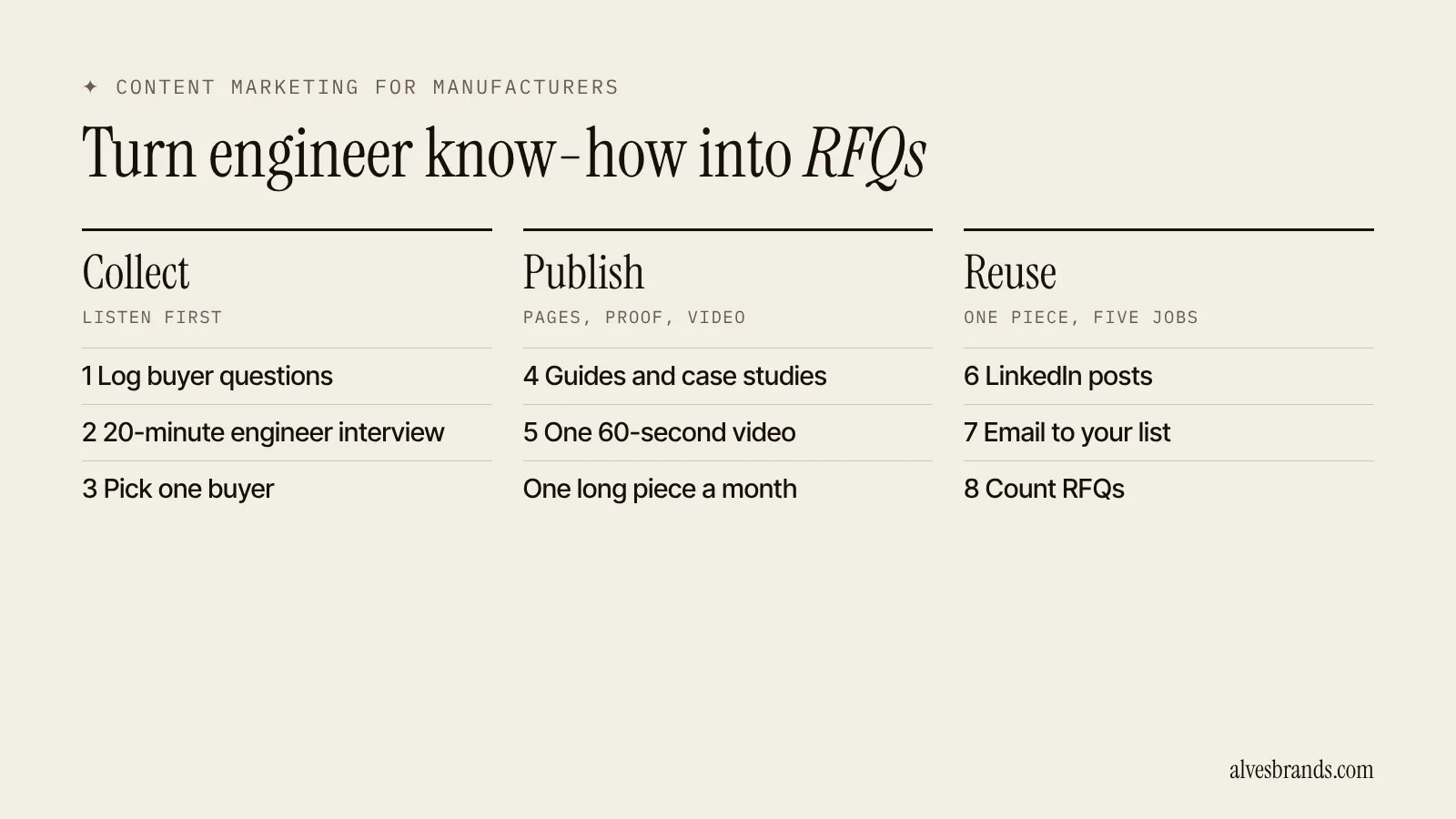
Use a 20-minute interview:
- Pick one question from your sheet.
- Book 20 minutes with the engineer. Record the call, with permission.
- Ask: “What do customers usually get wrong here? What would you tell a new buyer? Can you give a real example?”
- Turn the recording into a draft. A writer, a marketer or an assistant can do the first pass.
- Send the draft back. The engineer checks every number and fixes what’s wrong. That’s five minutes, not an afternoon.
One interview can feed a guide, a LinkedIn post, a short video and three email tips. And the article carries the engineer’s name, which Google and buyers both like. Google’s guidance on helpful content asks for real experience and a reason to trust the author. A named engineer gives you both.
A simple strategy in five steps
1. Choose one buyer. Don’t write for “the industry.” Write for one person: a procurement manager at a medical device company, say, or a plant engineer at a food packer.
2. Choose one goal. For most factories it’s RFQs. Not likes, not followers.
3. Pick three topic groups. For example: choosing a material, avoiding defects, comparing processes. Every piece you publish belongs to one of these groups. That keeps you focused and helps Google see what you know.
4. Pick two formats you can keep up. One long, such as a guide or case study, and one short, such as a LinkedIn post or video. Skip the rest until these are steady.
5. Pick a rhythm. One long piece a month and one short piece a week is better than ten pieces in January and nothing after.
Content for each stage of the buying process
Buyers move through stages, and each needs something different.
Early: “I have a problem.” They search for causes, options and basics. Offer guides and explainers. Example: “Why do plastic parts warp after molding?”
Middle: “Which option fits?” They compare materials, processes and suppliers. Offer comparison articles, spec tables and calculators. Example: “Aluminum or steel for brackets: how to choose.”
Late: “Who should I trust?” They check proof. Offer case studies, certificates, customer names, plant tours and sample requests. Example: a case study with before-and-after numbers.
If you only have time for one stage, pick the late one first. Case studies close deals. Then add middle content, then early.
What a good piece of content looks like
Whatever the format, a strong piece does five things:
- Answers the question in the first 100 words. Don’t make buyers dig.
- Uses specifics. Numbers, materials, standards, dates, photos of your own work.
- Names a source for every outside fact. Link to the standard, the study or the regulator.
- Shows who wrote it. An engineer’s name and role.
- Ends with a next step. A quote form, a sample request or a related guide.
A case study needs a clear shape: the customer’s problem, what you tried, what worked, the result in numbers and a quote from the customer. If you can’t name the customer, describe the industry and size.
Video and LinkedIn: the two channels that matter most
Video of a machine making a part is proof a paragraph can’t give. You don’t need a studio. A phone, good light and a clean shop floor work. Keep it to 60 to 90 seconds. Show the process, say what’s special and add captions, because many people watch without sound.
LinkedIn works because your buyers and their bosses are on it. Post what your engineers know: a failure analysis, a lesson on tolerances, a before-and-after photo. The CMI B2B trends research found that LinkedIn is the top channel for sharing thought leadership (76%). Post from the engineer’s account as well as the company page. People trust people more than logos.
Make one piece do five jobs
A single guide can become:
- A page on your website that ranks in search (see my website design for manufacturers guide for how to lay those pages out).
- Three short LinkedIn posts, each with one tip.
- A 60-second video where the engineer explains the main point.
- An email to your list with a link.
- A section in your sales deck or an answer in your quote email.
That’s one interview and one day of work, spread over a month. It’s how a small team keeps pace.
Ten topic ideas you can use this month
If you’re staring at a blank page, start with these shapes and fill in your own product:
- “How to choose between [material A] and [material B] for [part type]”
- “[Process] tolerances: what’s realistic and what costs extra”
- “5 reasons [part type] fail in the field, and how to stop them”
- “What to put in a drawing so you get an accurate quote the first time”
- “[Standard or certificate] explained for buyers”
- “How we cut lead time on [product] from 8 weeks to 4” (only if it’s true)
- “[Product] price drivers: what changes your quote”
- “A buyer’s checklist for visiting a supplier’s factory”
- “Samples, prototypes and first articles: what to expect”
- “Shipping [product] to [country]: papers, packaging and timing”
The fourth and seventh are favorites with buyers, because they save time and cut surprises. They also bring RFQs that are ready to quote, because the buyer already knows what to send you.
Keep a “parking lot” sheet for ideas. Every time a buyer asks something odd, add a line. Within three months you’ll have forty topics and never face a blank page again. Rank them by how often the question comes up and how close the asker is to buying, then write the top one first.
A case study you can copy
Use the same five blocks every time, and the writing gets fast:
- The customer: industry, size, country (name them if you can).
- The problem: what was failing, late or too costly, in one or two sentences.
- What we did: the steps, the material or process change and why.
- The result: hard numbers, such as scrap rate, lead time, cost per part or savings.
- A quote: one or two lines from the customer, with their name and role.
Add two photos of the real part and a link to the matching capability page. Aim for 400 to 600 words. Ask for the customer’s permission before you publish, and keep the email that says yes.
Who does what
A small team can run this with three roles, and one person can hold more than one:
- The owner of the plan picks topics, keeps the calendar and counts RFQs.
- The writer runs the interviews and writes the drafts. This can be you, a freelancer or an agency.
- The expert is an engineer who spends 20 minutes on an interview and 5 minutes checking each draft.
Put the calendar in a shared sheet with four columns: topic, owner, date, status. Review it for ten minutes every week.
Use AI carefully
The Content Marketing Institute’s 2026 B2B research found that 95% of organizations use AI-powered applications. It helps with first drafts, summaries of interview recordings and translation checks. It’s a bad tool for specs, tolerances and certificates. One wrong number on a page can cost you an order and your name.
Content marketing for manufacturers gets better with one rule: AI drafts, an engineer checks every fact before it goes live. And don’t publish text that sounds like everyone else’s. Add your own photos, numbers and stories.
Reach buyers in other countries
If you export, content is one of your best tools. Translate your top pages and guides into the languages of your best markets, using a human reviewer for technical terms. Google explains how to set up localized versions of a page. My multilingual website checklist shows the steps, and my SEO for exporters page explains how I handle it.
Measure what matters
Don’t get lost in vanity numbers. Track these once a month:
| Number | Where | What it tells you |
|---|---|---|
| Visits to your guides and pages | Google Analytics | Are people finding the content? |
| Search impressions and clicks | Search Console | Is Google showing your pages? |
| RFQs and inquiries by source | Form field, inbox | Which content brings buyers |
| Time on page and scroll | Analytics | Do people read it? |
| Replies and shares on LinkedIn | Are engineers engaging? |
A page with many visits and no RFQs needs a clearer next step. A page with few visits but several RFQs deserves more links and promotion. You can test your own site with the free website enquiry check.
A 90-day plan for content marketing for manufacturers
Month 1: Set up.
- Make the question sheet from sales emails and calls.
- Pick your buyer, your goal and your three topic groups.
- Interview two engineers. Write one case study and one guide.
Month 2: Publish and share.
- Publish the guide and the case study.
- Post three LinkedIn updates from the interviews.
- Record one 60-second video.
- Send the first email to your list.
Month 3: Improve and repeat.
- Check Search Console for pages that show up but get few clicks. Fix titles and intros.
- Publish a comparison article.
- Ask two customers for a quote or a case study.
- Count RFQs by source and plan the next quarter.
If you’d like a second opinion on what to publish first, an SEO audit shows what’s missing in five working days.
Common mistakes in content marketing for manufacturers
- Writing about yourself. Buyers care about their problem, not your founding year.
- Publishing without a goal. Every piece needs a next step and a number to check.
- Posting for a month and stopping. Content needs a few months before results show.
- Letting marketing write alone. Without an engineer’s check you’ll publish errors.
- Hiding everything behind a form. Give away the useful part. Ask for contact details only for big extras like CAD files.
- Skipping the follow-up. An RFQ from a guide needs a fast reply. See my guide on manufacturing lead generation.
For more ideas, browse these industrial marketing examples and read how SEO for manufacturers helps your content get found.
Social posts spread what you publish. Read social media marketing for manufacturers for the platforms and a three-hour weekly routine.
Frequently asked questions
What is content marketing for manufacturers?
It’s publishing useful pages, guides, case studies, videos and posts that help buyers solve a problem and trust your company, so they ask you for a quote.
What content works best for manufacturers?
Capability and product pages, case studies and how-to guides bring the most buyers. Short videos and LinkedIn posts help engineers notice you.
How often should a manufacturer publish?
One strong guide or case study a month, plus one short post a week, is enough to start. Keep the rhythm for at least six months.
How long does content marketing take to work?
Email and LinkedIn can bring replies in weeks. Search traffic from new pages usually builds over three to six months.
How much does it cost?
You can start with time from your engineers and a writer for a few hours a week. Costs grow with video, translation and paid promotion. Track cost per RFQ to see what pays.
Do I need a blog?
You need a place to publish helpful content, and a blog section works well. Make sure each post answers a real buyer question and links to a page that sells.
Who should write it?
A writer who can interview your engineers works best. The engineer reviews facts and the name goes on the piece.
How do I know it’s working?
Count RFQs and inquiries by source, and watch visits and impressions to your guides. Rising RFQs matter more than rising traffic.
Not sure what your buyers want to read? Ask me for a free website check. I’ll show you which topics you’re missing and where to start.