SEO for manufacturers means making your website easy for Google, and for AI assistants, to find, understand and show when a buyer searches for what you make. Done well, it brings people who already want a supplier, and they arrive with a part number, a drawing or a deadline.
I do this work for exporters and factories, so I’ll keep this practical. No theory about algorithms. You’ll see how buyers search, which pages to build, what to fix on the technical side, how to earn links without breaking Google’s rules and what a realistic 90-day plan looks like.
If you want the wider picture first, start with marketing for manufacturers. If you want rankings, read on.
Why SEO for manufacturers pays
Industrial buyers research before they talk to anyone. A 6sense study found they’re nearly 70% through the process before they contact a seller, and Gartner found that 67% prefer a buying experience without a sales rep. Where do they research? Search engines first.
The Content Marketing Institute’s manufacturing study found that 68% of manufacturing marketers said search and pay-per-click gave them the best paid results. Paid search stops when the budget stops. A good page keeps working.
Three more reasons SEO suits factories:
- Your buyers search in specifics. “Stainless steel 316L tube supplier,” “injection molding for medical parts,” “powder coating near me.” Few people compete for each phrase.
- One lead is worth a lot. One new account can pay for a year of work.
- Your competitors are often bad at it. Many industrial sites are slow, have a catalog as a PDF and describe products in one line.
Google also says plainly that SEO is about helping search engines understand your content and that it won’t fix a weak business. You still need good products, fair prices and fast replies.
How industrial buyers search
Not every search is the same. Knowing the type tells you which page to build.
| Search type | Example | Page that wins |
|---|---|---|
| Product or part | “M8 stainless hex bolt DIN 933” | Product page with specs |
| Process | “CNC machining titanium aerospace” | Capability page |
| Supplier | “contract manufacturer in Turkey for plastic parts” | Country or industry page |
| Problem | “how to stop burrs on laser cut steel” | Guide or article |
| Comparison | “aluminum vs steel for brackets” | Comparison article |
| Brand | “your company name” | Homepage and about page |
Most factories only have pages for the last row. That’s why they miss almost every search that brings new buyers.
Step 1: Find the words buyers use
Skip the fancy tools at the start. You can learn most of what you need for free.
- Ask your sales team. What do customers say in the first email? Copy their exact words. They almost never use your internal product names.
- Check Search Console. The Search Console report shows the searches that already bring people to your site. You’ll often find pages ranking on page two that need small fixes.
- Type your product into Google. Look at the suggestions, the “People also ask” box and the related searches at the bottom.
- Look at the top three results. What pages do they have? What do they cover that you don’t?
- Use a keyword tool. A free or paid tool shows rough search volume and difficulty. Use it to compare phrases, not to trust the exact numbers.
Put everything into one sheet: the phrase, the type of search, the page that should rank and its status. Group phrases that mean the same thing. They belong on one page, not five.
Step 2: Build the site around what you sell
Google reads structure. So do buyers. A simple, clear layout beats a clever one.
One page per thing you want to rank for. That means one page per product family, one per process, one per industry you serve and one per country if you export. Avoid putting everything on a single “Products” page.
A tidy URL path. Use short, readable addresses like /cnc-machining/titanium/. No random numbers.
Links between the pages. Your capability page links to the matching products, case studies and the quote form. Your guides link back to the pages that sell. That’s how Google learns what matters most on your site.
A menu a buyer can use in five seconds. Products, capabilities, industries, about, contact. Put the phone number and a quote button in the header.
Step 3: Write each page so it ranks and sells
Every important page needs the same parts. Use this list as a template.
- Title tag (about 60 characters). The main phrase first, then your company name. “Titanium CNC Machining for Aerospace | Company”.
- One H1. Say what the page is, in plain words.
- A first paragraph that answers the search. Say what you make, for whom and where. Do it in the first 100 words.
- Specs in a table. Materials, sizes, tolerances, certificates, quantities, lead times. Engineers scan tables first.
- Real photos with descriptive file names and alt text. “Titanium bracket after 5-axis machining” beats “IMG_2044.jpg”.
- Proof. A short case study, a certificate, a customer name you’re allowed to use.
- One clear action. Request a quote, with a form that takes a minute.
- A short FAQ. Real questions buyers ask: minimum order, lead time, samples, export papers.
Write a meta description too, about 150 to 160 characters. It doesn’t change rankings directly, but it’s the line buyers read in the results. Say what the page offers and add a reason to click, such as a certificate, a lead time or a free quote.
Don’t stuff the same phrase over and over. Write for a buyer, mention the phrase where it’s natural and use related words they’d use. If you’re stuck, read your page out loud. Does it sound like a person who knows the job?
Example: one capability page, built from scratch
Say you run a shop that makes aluminum parts for the medical industry. Here’s how one page comes together.
The phrase is “CNC machining for medical device parts.” The search type is process. The title tag reads “CNC Machining for Medical Device Parts | Your Company.” The H1 repeats it in plain words. The first paragraph says you machine aluminum, titanium and stainless parts for medical device makers in Europe, with ISO 13485 certification and tolerances down to 0.01 mm.
Below that sits a table: materials, machines, tolerances, batch sizes, lead times. Then two photos of real parts, a short case study about a bracket you made for a surgical tool, a four-question FAQ and a quote form with a file upload. Links go to your titanium page, your quality page and a guide on choosing a machining supplier.
That page took one afternoon to plan and a day to write. It now speaks to the exact search a buyer types. Repeat that for your next nine phrases and you have a real foundation.
If you have hundreds of products
Distributors and parts makers with thousands of items can’t write a page by hand for each one. Do it in layers:
- Write strong pages for the 20 best sellers, by hand.
- Build category pages for the rest, with filters and clear specs.
- Use a template for the product pages, so each one has a unique title, a short description, a spec table and an image.
- Don’t let filters create thousands of near-duplicate pages. Block or merge the ones that add nothing.
A template doesn’t mean copying the same text. Each page needs its own part number, specs and photo.
Step 4: Fix the technical basics
A slow or broken site loses rankings and leads. You don’t need to be a developer. You need to check six things.
- Mobile. Open your top ten pages on a phone. Can you read specs, tap the phone number and send the form?
- Speed. Google measures Core Web Vitals: how fast the main content loads, how fast the page responds and how much it jumps around. Compress images, remove heavy scripts and use a decent host.
- Indexing. In Search Console, check that your key pages are indexed. If they aren’t, find out why: a “noindex” tag, a blocked folder or a duplicate page.
- Sitemap and robots file. Submit a sitemap. Make sure the robots file doesn’t block pages you want in Google.
- PDF catalogs. A catalog buried in a PDF doesn’t rank well and it can’t be read on a phone. Put the same data on real web pages and keep the PDF as a download.
- Broken links and redirects. If you change a URL, redirect the old one. Check for error pages every month.
Add structured data too. It’s code that tells Google what a page is: your organization, a product, an FAQ. Google explains it in its structured data guide. It doesn’t guarantee fancy results, but it removes guesswork.
Step 5: Publish content that answers real questions
Product pages catch buyers who know what they want. Guides catch buyers who are still working it out, and they build trust before the first call.
Good topics come from your own inbox and calls:
- Questions buyers ask before they quote. “What tolerance can you hold on aluminum?” “How long does powder coating last outdoors?”
- Comparisons. Material A against material B. Process A against process B. Say which you’d pick and why.
- How-to-choose pages. What to check before picking a supplier in your category.
- Case studies. A problem, what you did, the result, with numbers.
- Standards and certificates explained. What ISO 9001 or a food-grade rating means for a buyer.
Google’s guidance on helpful content says to write for people, show real experience and give a reason to trust you. Put an engineer’s name on the article. Add photos of your own parts. Give real numbers and say when they were true. Avoid thin pages written only to catch a phrase.
Don’t publish ten weak posts when four good ones will do. One strong page that covers a topic better than the top results beats a stack of short ones.
Step 6: Earn links without trouble
Links from other sites still help. Google treats them as votes, but not all votes count the same. A link from an industry association is worth more than fifty from random blogs.
Places that give real links:
- Supplier and industry directories. Claim profiles on Thomasnet and the directories your buyers use in each country.
- Trade associations and chambers of commerce. Member pages often link to your site.
- Your customers and suppliers. Ask for a link on their “partners” or “suppliers” page.
- Trade press. Offer an engineer’s quote or a data point for an article.
- Your own useful content. A strong guide or a free calculator earns links over time.
Never buy links in bulk and never join link swaps. Google’s spam policies name link spam as something that can push your pages down. Ten good links beat a thousand bad ones.
Step 7: Local and international SEO
Local. If you serve a region, like a machine shop or a distributor, set up your Google Business Profile with the right categories, photos, hours and a phone number. Ask happy customers for reviews and reply to each one.
Design. Search works best on a site buyers can use. My website design for manufacturers guide covers the layout, speed and mobile basics.
International. If you export, build pages for each market and language. Google explains how in its guide to localized versions of a page. Use proper language tags and don’t auto-translate everything with a plugin. I cover the details in my multilingual website checklist and my SEO for exporters page.
Step 8: Get ready for AI search
Buyers now ask ChatGPT, Gemini and Perplexity for supplier ideas. Google shows AI summaries on some searches too, and it explains how that works in its page on AI features and your website. The same basics help in both worlds: clear pages, plain facts, specs in tables, named authors, structured data and mentions on trusted sites.
An AI assistant can’t recommend what it can’t read. Check that your key pages load without logins or heavy scripts, and state your location, certificates and capabilities in text. My guide to getting recommended by ChatGPT goes deeper, and the AI visibility check shows what these tools say about you today.
Measure what counts
Look at these numbers once a month:
| Number | Where to find it | What it tells you |
|---|---|---|
| Impressions and clicks | Search Console | Are more people seeing and visiting your pages? |
| Rankings for 10 to 20 key phrases | Search Console or a rank tool | Are the right pages moving up? |
| Visits to money pages | Analytics | Is traffic going where it should? |
| RFQs and inquiries | Your form and inbox | The only number that pays |
| RFQs by source | Form field or analytics | How much comes from search |
Traffic that doesn’t bring RFQs is a warning sign. Maybe the page ranks for the wrong phrase, or the form is hard to use. Google Analytics and Search Console are free and enough for this.
A monthly routine that takes two hours
Once the base is built, SEO turns into a habit. Block two hours each month:
- Open Search Console and note the top ten pages by clicks and any page that dropped.
- Check indexing errors and fix them.
- Pick one page ranking between positions 8 and 20. Add a missing spec, a photo, an FAQ or a better title.
- Publish or update one guide.
- Count RFQs and write down where they came from.
Small, regular work beats a big rebuild every two years.
How long it takes
Be honest with yourself about time. A new page usually takes a few weeks to get indexed and three to six months to build steady rankings. Hard phrases take longer. Easy, specific phrases can move in weeks.
Anyone who promises a first-page ranking in 30 days for a competitive phrase is guessing, or selling something. What you can promise is steady work and a report that shows progress.
A 90-day plan for SEO for manufacturers
Days 1 to 30: Fix and map.
- Run through the technical checklist above and fix the worst problems.
- Build your keyword sheet and choose the 10 pages that matter most.
- Add a short RFQ form and a phone number to every page.
Days 31 to 60: Build.
- Write or rewrite five of the key pages using the page template.
- Claim your profiles in two or three directories.
- Add structured data and submit the sitemap.
Days 61 to 90: Grow.
- Publish two helpful guides based on real buyer questions.
- Ask three customers for links or testimonials.
- Review Search Console. Improve pages that sit on page two.
- Count the RFQs by source and pick the next five pages.
DIY or hire help?
Do SEO for manufacturers yourself if you have time, someone who writes well and an engineer who can review facts. Hire help if you export to several countries, run on a custom platform or don’t have the hours. If you hire, ask for a keyword map, a list of pages they’ll build and a monthly report with RFQs, not just rankings. My guide on how to choose a manufacturing marketing agency gives you ten questions to ask.
Not sure where to start? An SEO audit gives you a ranked list of what to fix in five working days, and the services and prices page shows how I work month to month.
Common mistakes in SEO for manufacturers
- One page for everything. A single “Products” page can’t rank for twenty phrases.
- Catalog in a PDF only. Google and buyers can’t use it well.
- Copying the manufacturer’s data sheet. Duplicate text adds nothing. Write your own and add your own photos.
- Ignoring Search Console. It’s free and shows what’s wrong.
- Buying links. It can cost you rankings you took months to earn.
- No quote form. A page that ranks but has no clear next step wastes the visit.
- Giving up at month two. SEO needs a few months before the numbers move.
For more on the bigger plan, read the digital marketing for manufacturers guide and the manufacturing lead generation guide.
Related reading: for the wider B2B view see SEO for B2B companies, and for catalogs, PDFs and technical buyers see my guide to industrial SEO.
If you run an engineering firm, see the engineering SEO guide.
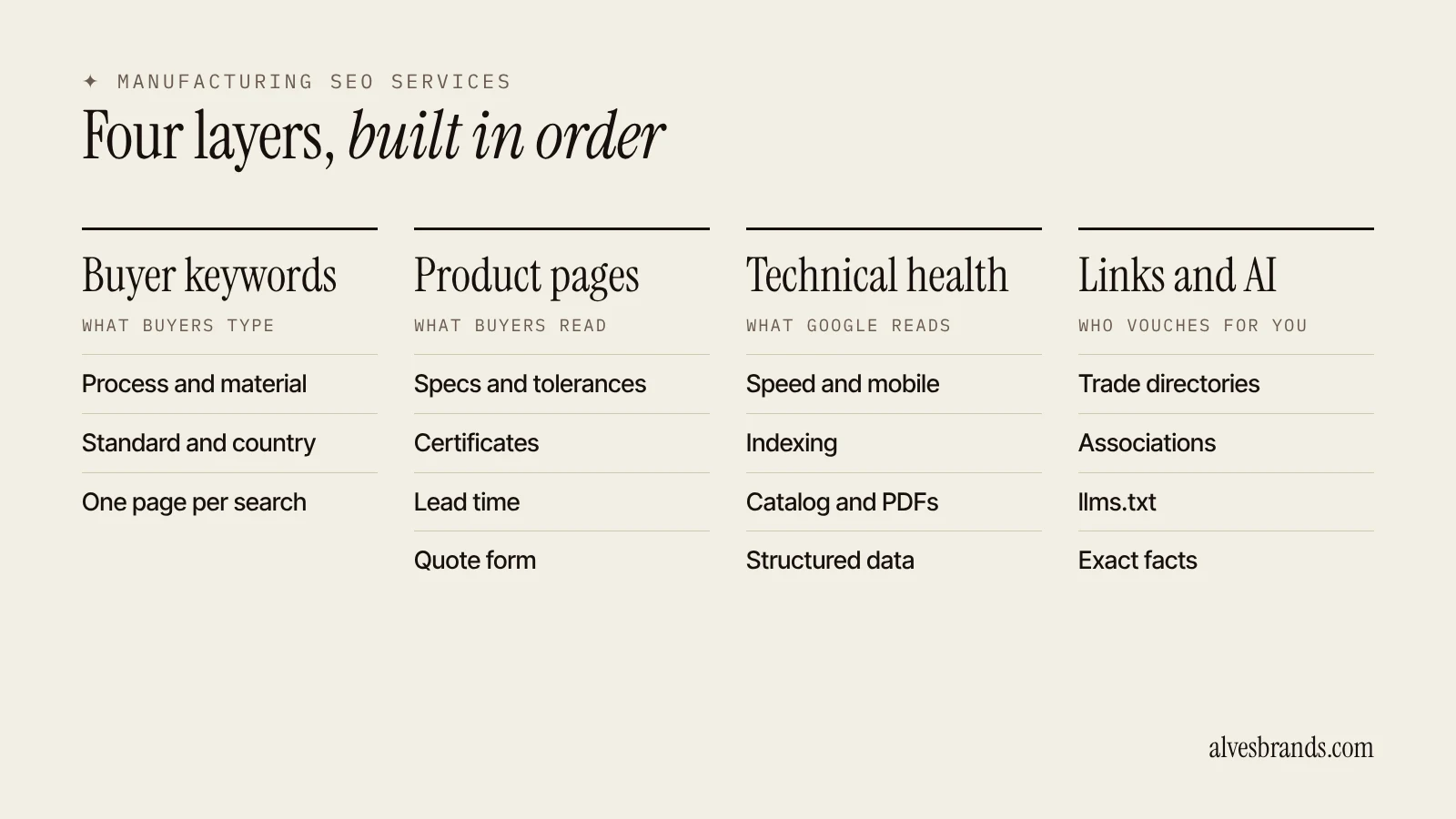
Want it done for you? See my manufacturing SEO services. To build better product pages, read SEO for product pages.
Run the manufacturing SEO checklist on your site, and read how to earn B2B links.
To see what your buyers type, use the free buyer search generator.
Frequently asked questions
What is SEO for manufacturers?
It’s the work of improving your website so buyers find you on Google and in AI assistants when they search for what you make. It covers your pages, your site’s technical health, your content and the links pointing to you.
Does SEO work for manufacturing companies?
Yes. Industrial buyers research online before they call, and they search for specific products, processes and suppliers. A company with clear pages for those searches gets found.
How much does SEO for a manufacturer cost?
It runs from a one-off audit for a few hundred euros to monthly work of a few thousand. Cost depends on how many pages and languages you need. Ask any provider what you get each month, in pages and reports.
How long does SEO take to work?
Plan for three to six months before steady traffic builds. Some easy phrases move in weeks. Hard ones take longer.
Do I need a blog?
You need helpful content, and a blog is one place to put it. Start with four to six strong guides that answer the questions buyers ask before they quote.
Is SEO better than Google Ads for a manufacturer?
They do different jobs. Ads bring traffic while you pay. SEO builds traffic that keeps coming after the work is done. Many companies run both, with SEO as the base.
What should I fix first?
Start with your quote form, your mobile speed and one page for your best-selling product or process. Those three changes show results the fastest.
Can I do SEO for my factory myself?
Yes, if you have time and someone who can write clearly. The steps in this guide cover the core of it. An audit can save time by pointing out the biggest gaps first.
Want to know what’s holding your site back? Ask me for a free website check. I’ll show you which searches you’re missing and what to fix first.