Marketing for manufacturers is everything a factory or industrial company does to get found, trusted and chosen by the businesses that buy its products. It’s not ads for the general public. It’s helping an engineer, a buyer or a distributor decide that you are the supplier they want to call.
And the way those people decide has changed a lot. Most of the decision now happens online, before anyone talks to you.
This guide covers what manufacturing marketing is, why it’s different from consumer marketing, the channels that work, a simple plan to start, how to measure it, and the part most guides skip: selling to buyers in other countries and showing up in AI answers.
Why marketing for manufacturers matters more now
Sales reps, trade fairs and word of mouth still work. But buyers don’t wait for a rep anymore:
- In a 2026 Gartner survey of 646 B2B buyers, 67% said they prefer a buying experience without a sales rep, and 45% had used AI during a recent purchase.
- The 6sense 2024 Buyer Experience Report found buyers are nearly 70% through their buying process before they contact a seller, and 81% already have a favorite vendor by then.
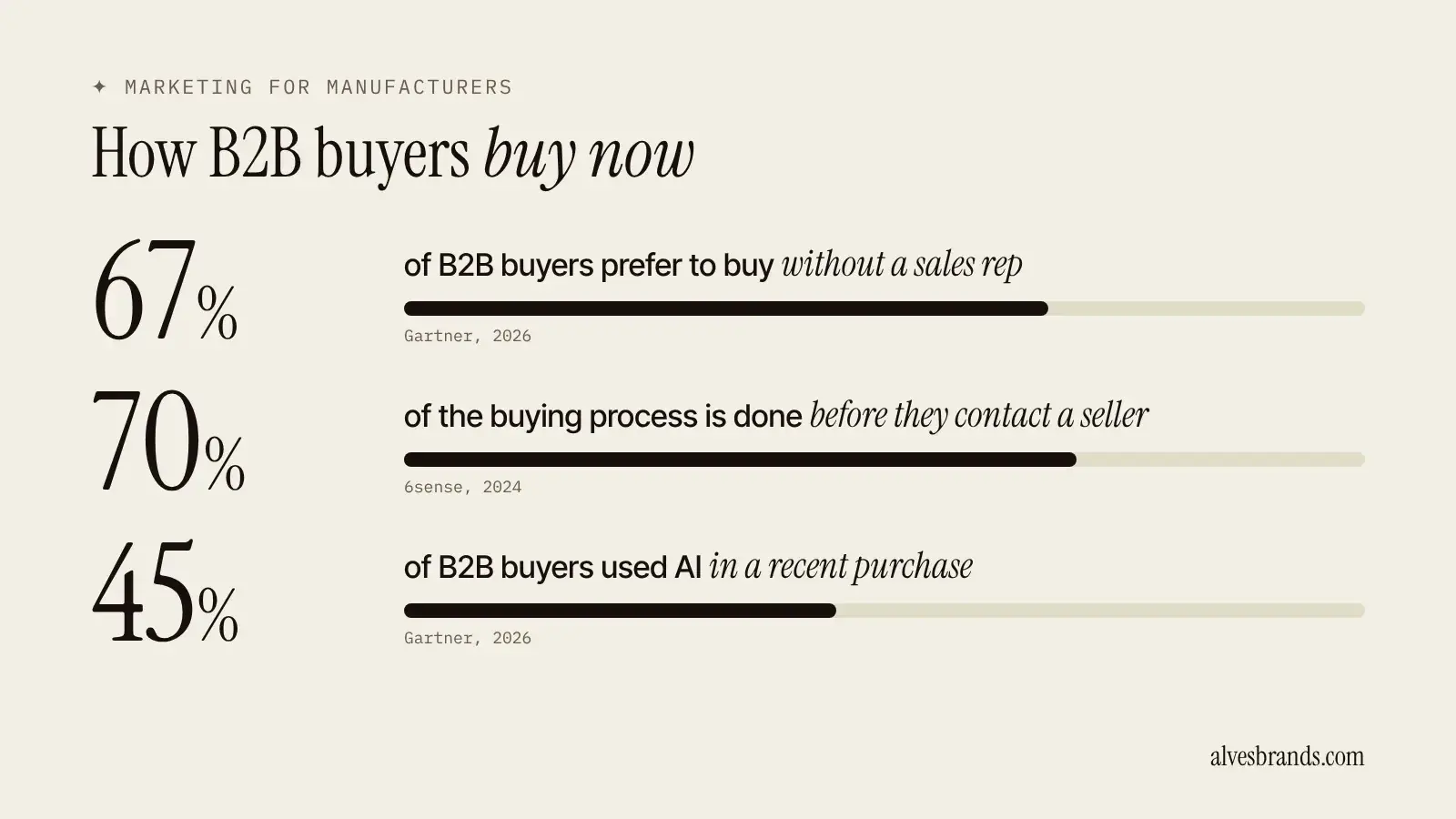
By the time a buyer emails you, they have already searched, compared and made a shortlist. If you weren’t visible during that research, you’re not on it. The buyer-side view is in my B2B manufacturing marketing guide.
How manufacturing marketing is different from consumer marketing
Selling a sofa and selling a hydraulic valve are two different jobs.
| Consumer marketing | Manufacturing marketing | |
|---|---|---|
| Who buys | One person | A group: engineers, procurement, finance, management |
| Why they buy | Feelings, price, convenience | Specs, reliability, total cost, risk |
| Sales cycle | Minutes to days | Weeks to many months |
| Order size | Small, one-off | Large, often repeat for years |
| What convinces them | Reviews, brand, design | Data sheets, certifications, case studies, samples |
| Cost of a bad choice | Low | A stopped production line |
That last row explains most of it. A wrong supplier costs a lot, so industrial buyers read a lot and trust proof more than promises. Your marketing has to give them that proof.
The challenges manufacturers face
Most manufacturing companies run into the same problems when they start marketing:
Complex products. A product with 40 technical specs is hard to explain in a social post. You need pages and content that go deep.
Long sales cycles. A buyer who finds you today might order in nine months. You need a way to stay in their memory during that time, like email and useful content.
Many people to convince. The engineer cares about tolerances. Procurement cares about price and delivery. The plant manager cares about downtime. One message doesn’t reach all of them.
Small teams. Many manufacturers have one marketing person, or none. Research from the Content Marketing Institute found that 57% of manufacturing marketers say lack of resources is their biggest challenge.
Proving it works. In the same research, 64% struggle to tie content to revenue. That’s why measurement gets its own section below.
None of these are reasons to skip marketing. They’re reasons to be focused about it.
Start with a plan: who, what and how much
Good marketing for manufacturers starts with four questions, before you pick any channel. (Full version: my manufacturing marketing plan.)
1. Who exactly buys from you?
Be specific. Not “companies in the automotive sector”, but “procurement managers at tier-2 auto parts suppliers in Germany and Mexico who need custom aluminum castings”. Then list everyone else in the decision and what each one worries about. Ask yourself:
- Is your product a commodity (buyers compare on price) or custom (buyers compare on capability)?
- Does one person decide, or a committee?
- Which countries do your best customers come from?
- What do they search for, and in which language?
2. Who are you up against?
Look at who shows up when a buyer searches for your product. Check their websites, what content they publish and where they are listed. If you want outside help with this, the NIST Manufacturing Extension Partnership helps US manufacturers with market and competitor research.
3. What does success look like?
Pick goals you can count: qualified inquiries per month, quote requests, new distributors signed, revenue from new markets. “More brand awareness” is not a goal you can manage.
4. What’s the budget?
Put most of it into the channels that match how your buyers search, and keep 10 to 20% for testing. Three channels done well beat eight done badly.
The marketing channels that work for manufacturers
Your website: the base of everything
Every other channel sends people to your website, so it has to do its job. For a manufacturer, that means:
- One page per product or product family, with full specs, materials, tolerances, certifications, photos and downloadable data sheets. Engineers want details, not slogans.
- Clear capabilities: what you make, in what volumes, with what equipment, to which standards.
- Proof: certifications (ISO and others), industries you serve, case studies with real numbers, logos of clients who allow it.
- An easy way to ask for a quote: a short RFQ form, an email and a phone or WhatsApp number on every page.
- Fast and mobile-friendly: buyers check suppliers from their phones too.
If your site is slow or broken underneath, fix that first. My technical SEO service covers speed, mobile and the structure search engines need.
SEO: get found when buyers search
SEO (search engine optimization) is how you show up on Google when a buyer searches for what you make. For manufacturers it’s often the best long-term channel, because the searches are specific and the people searching are ready to buy. In practice:
- Find the exact words buyers use, like “custom aluminum die casting manufacturer” or “food grade stainless steel tanks supplier”.
- Give each important search its own page that answers it fully.
- Write for people first. Google’s own guide says it rewards helpful, reliable content made for people, not pages stuffed with keywords.
- Get mentioned and linked by industry directories, associations and trade media.
- Track your results for free in Google Search Console.
Industrial searches don’t have huge volumes. That’s fine. Ten visitors a month from procurement managers can be worth more than 10,000 random visitors.
Content marketing: answer the questions buyers ask
Content shows your expertise before the first call. The formats that work best:
- Technical guides and articles: how to choose a material, how to compare two processes, what affects lead time.
- Case studies: the problem, what you did, the result in numbers.
- Videos: factory tours, a product in action, how something is made. In the CMI research, 74% of manufacturing marketers rated video their most effective content type.
- Spec sheets, CAD files and brochures buyers can download and share with their team.
Email marketing: stay present during long sales cycles
Email keeps you in touch between first visit and first order:
- Follow up every inquiry fast, ideally the same day.
- Send a short newsletter once or twice a month with something useful: a new case study, a product update, an industry change. See email marketing for manufacturers for what to send and how to automate it.
- Split your list (distributors, end users, countries) so each group gets what matters to them.
Paid search and LinkedIn ads: speed while SEO grows
SEO takes months. Google Ads can put you in front of buyers this week, as long as you target narrow, high-intent searches and send people to the right product page, not your homepage. Manufacturing marketers in the CMI study said search and PPC gave them the best paid results.
LinkedIn ads reach specific job titles (procurement, engineering, plant managers) in specific countries. They cost more per click, so use them to promote a case study or buyer’s guide. Not sure where to start? I compared the options in SEO vs Google Ads.
LinkedIn and social media
For manufacturers, LinkedIn is the social network that matters. In the CMI research, 85% of manufacturing marketers said LinkedIn gives them the most value. Post what you’d show a visitor at your factory: new machines, finished projects, your team, short videos from the floor. People buy from people, even in B2B.
Trade shows and events
Half of the manufacturing marketers in the CMI study rated in-person events their most effective channel. Connect them to your online work: publish your booth info before the show, capture contacts with a simple form, and follow up within a week.
B2B directories and marketplaces
Many buyers start on industry directories like Thomasnet in North America, or sector-specific directories in other regions. A complete listing with your capabilities, certifications and a link to your site gives you visibility and a link that helps your SEO. My link building service focuses on exactly these kinds of mentions: directories, chambers of commerce and industry media.
Partnerships and distributors
Partner with companies that sell to the same buyers without competing with you, and with distributors in your target markets. A “Become a distributor” page on your site brings leads on its own.
What most guides on marketing for manufacturers miss
Selling to buyers in other countries
Most guides assume you only sell at home. But many manufacturers grow fastest through exports, and foreign buyers search in their own language. A buyer in Mexico types “fabricante de piezas de aluminio”, one in Germany types “Aluminiumguss Hersteller”. If your site is only in English, they never see you. You need pages in their languages, set up so Google shows the right one in each country. Google explains how in its guide to localized versions of pages (hreflang).
I wrote more about this in how foreign buyers find suppliers online and in the multilingual website checklist. If exports are your growth plan, that’s the core of my SEO for exporters service and international SEO.
Showing up in AI answers
Buyers now ask ChatGPT, Gemini, Claude and Perplexity things like “Who are reliable stainless steel tank manufacturers in Turkey?”, and 45% of B2B buyers in the Gartner survey had already used AI in a purchase. AI assistants name suppliers they find clear, consistent information about across the web. If your company is barely mentioned anywhere, you won’t be named. I explain how this works in how to get recommended by ChatGPT, and it’s what my AI search optimization service is for. Want to see how you show up today? Run the free AI visibility check.
Mistakes to avoid
- Talking about yourself instead of the buyer’s problem. “50 years of excellence” says nothing. “Tolerances of ±0.01 mm, delivered in 3 weeks” says a lot.
- Hiding the specs. If an engineer can’t find the data sheet, they’ll find a supplier who shows it.
- Making the quote request hard. Long forms and no phone number cost you inquiries.
- Trying every channel at once. Pick two or three and do them well.
- Ignoring SEO because it takes months. That’s why to start now.
- Only marketing in one language when you want to sell in several countries.
- Not measuring. If you can’t tell which channel brought a lead, you can’t decide where to spend.
How to measure your marketing
Measuring marketing for manufacturers doesn’t need complex tools. Track these every month:
| What to track | Why it matters |
|---|---|
| Qualified inquiries and quote requests | The closest number to revenue |
| Where each inquiry came from | Tells you which channel to grow |
| Search impressions and clicks (Search Console) | Shows if more buyers are finding you |
| Rankings for your main product searches | Early sign that SEO is working |
| Quote-to-order rate | Shows if you attract the right buyers |
| Revenue from new customers and new countries | The real result |
Also ask every new lead “How did you find us?”. It catches what tools miss.
A simple 90-day plan to start
Days 1 to 30: fix the base. Define your buyers and target countries. Make sure every product has a complete page with specs and a data sheet. Add a short quote form and contact details on every page. Set up Google Search Console and analytics.
Days 31 to 60: get found. Research the searches your buyers use, which differ by manufacturing sector. Improve the pages that match them. Complete your listings on the main directories. Start posting on LinkedIn once or twice a week. The digital side of this work has its own guide, and manufacturing marketing strategies helps you choose.
Days 61 to 90: build trust and follow up. Publish your first case study and your first technical guide. Set up a follow-up email for new inquiries. If you sell abroad, plan the first translated version of your key pages. Review the numbers and decide what to do more of.
After 90 days you won’t be done, but you’ll have a base that keeps bringing buyers in, and real numbers to plan your next step. If you want to rank on Google for what you make, read SEO for manufacturers.
Related reading: marketing for manufacturing companies shows which channels fit a job shop, an OEM supplier, a product maker or an exporter.
Prefer an SEO-led partner? See my manufacturing marketing agency page.
Frequently asked questions
How do you market a small manufacturing business?
Start with a clear website showing what you make, your specs and how to request a quote. Then focus on SEO for your key products, LinkedIn and your industry’s directories.
How do manufacturers get new customers?
Mostly by being visible where buyers research: Google, AI assistants, industry directories, trade fairs and LinkedIn. Then by making it easy to ask for a quote and following up fast.
How much should a manufacturer spend on marketing?
There’s no single right number; it follows your margins, goals and competition. What matters more is spending on channels that match how buyers search, and tracking which ones bring inquiries. See budget benchmarks for manufacturers.
How long does SEO take for a manufacturing company?
Usually 3 to 6 months to see clear movement, and longer for competitive searches. Industrial searches are often less competitive than consumer ones, which helps.
Is marketing different for manufacturers that export?
Yes. Export buyers search in their own language, so you need pages in those languages set up for each market, plus listings in the directories they use.
If you want to know where your company shows up today on Google and in AI answers in your most important markets, ask me for a free website check.