Industrial SEO is search engine optimization for companies that make, sell or service industrial products. It helps engineers and buyers find your pages when they search Google, or ask an AI assistant, for a part, a process, a material or a supplier.
It looks like normal B2B SEO from far away. Up close it’s different. Buyers search with part numbers, standards and tolerances. Your catalog may have thousands of pages. Your best data may sit in PDF datasheets. One good request for quote (RFQ) can be worth more than a year of ordinary traffic.
This guide is for factory owners, distributors, machine builders and the marketers who work with them. For the shorter overview see SEO for manufacturers, and for the wider view see SEO for B2B companies.
What industrial SEO is
It is the work of making your site rank for the searches your buyers make, then turning those visits into quote requests. It has six parts: on-page SEO, technical SEO, content, links, local SEO and international SEO. Manufacturers, job shops, distributors and industrial service firms all use it.
It isn’t a trick to get traffic from people who will never buy. A page that ranks for "what is a gasket" may bring 10,000 visits and no orders. A page that ranks for "spiral wound gasket supplier UK" may bring 30 visits and three quotes.
How industrial buyers search
| Search type | Example | Buyer wants |
|---|---|---|
| Process | "CNC turning services" | A supplier that does the job |
| Material | "316 stainless steel bar supplier" | A source for a material |
| Product and spec | "M12 proximity sensor IP67" | A part that meets a spec |
| Standard | "ISO 13485 contract manufacturer" | A certified supplier |
| Part number | "6204-2RS bearing" | An exact part and a price |
| Comparison | "laser cutting vs plasma cutting" | Help to choose |
The first four are close to a sale, so build those pages first. Gartner research on the B2B buying journey says a buying group for a complex purchase has 6 to 10 decision makers. The engineer checks specs, purchasing checks price and quality checks certificates. Your site has to answer all three.
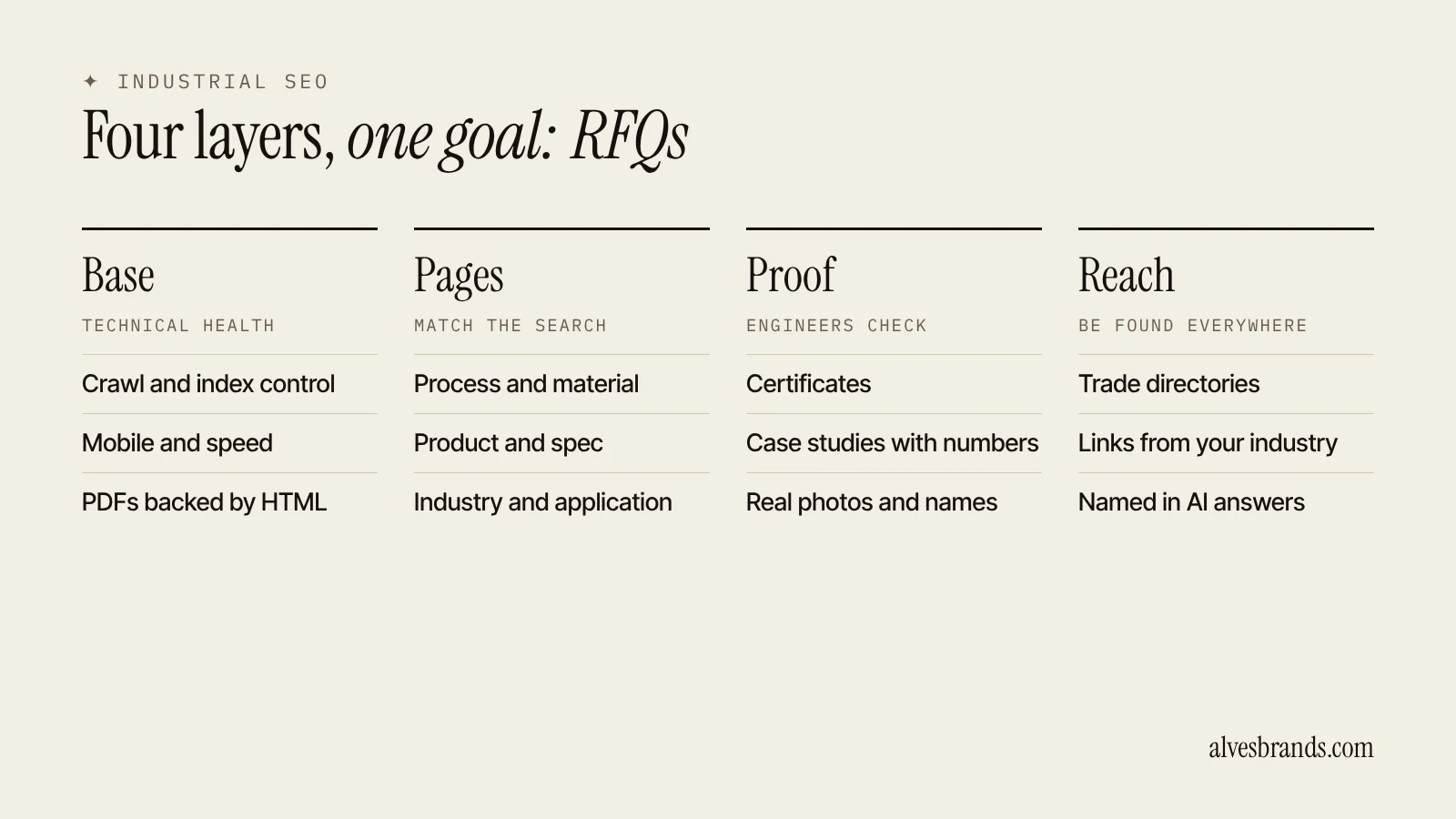
Benefits of industrial SEO
- A wider reach. You show up in searches from buyers in other regions and countries, with no extra sales staff.
- Better leads. People who search for a process, material or standard already know what they need.
- A shorter sales cycle. Buyers read your specs, certificates and case studies before the first call, so the first call starts further along.
- A stronger name. Pages that rank and get cited tell buyers you are a real, established supplier.
Why industrial SEO is different
- Volumes are small, and that’s fine. A term with 20 searches a month can still pay for the whole project if one order is large. Judge a keyword by customer value, not volume.
- The catalog is the website. Thousands of products bring duplicate pages, thin pages and filters that create endless URLs.
- Technical content wins. Engineers want numbers: dimensions, tolerances, ratings, certificates, lead times. Slogans don’t convince them.
- Buyers research alone. Gartner found that 67% of B2B buyers prefer a rep-free buying experience, and 6sense found buyers are nearly 70% through the process before they contact a seller. Your pages do the selling first.
SEO also lasts. A ranking page keeps working after the budget stops, unlike paid ads. If you need leads next month, run a small paid test on your best pages while you build SEO. My guide to manufacturing lead generation shows how to mix them.
SEO or PPC?
| SEO | Paid search (PPC) | |
|---|---|---|
| Speed | Months | Days |
| Cost | Work up front, lower cost per lead later | Pay for every click |
| Lasts | Keeps working | Stops when the budget stops |
| Best for | Steady lead flow | Tests, launches, urgent campaigns |
Many industrial companies run a small PPC test on their best pages and invest in industrial SEO for the long term.
Step 1: Do industrial keyword research
Start with the last 20 quote requests. Copy the exact words buyers used for materials, parts, standards and uses. Ask sales which phrases they hear on the phone. Buyers say "stainless pipe fittings" where you may say "tube connectors", so use both.
Then put each phrase in a tool such as Ubersuggest, Semrush or Ahrefs, and check Google Search Console for pages that rank 8 to 20, which are quick wins. Many industrial terms show zero volume in tools. Check the results by hand. If suppliers like you rank, the term is real.
Group keywords by results: if two keywords share three or more of the top 10 pages, one page can serve both.
Step 2: Plan the structure and internal links
Build in layers: home, category, product or service, industry, application, proof, guides, contact. Each page has one main keyword. Keep URLs short, like /cnc-machining/titanium/.
Group pages in clusters. A main page on CNC machining links to pages for each material, industry and product group, and those link back. Use plain anchors such as "stainless steel machining", not "click here". Buyers move from the general page to the exact part, and Google sees which page leads each topic.
Step 3: Build pages that bring RFQs
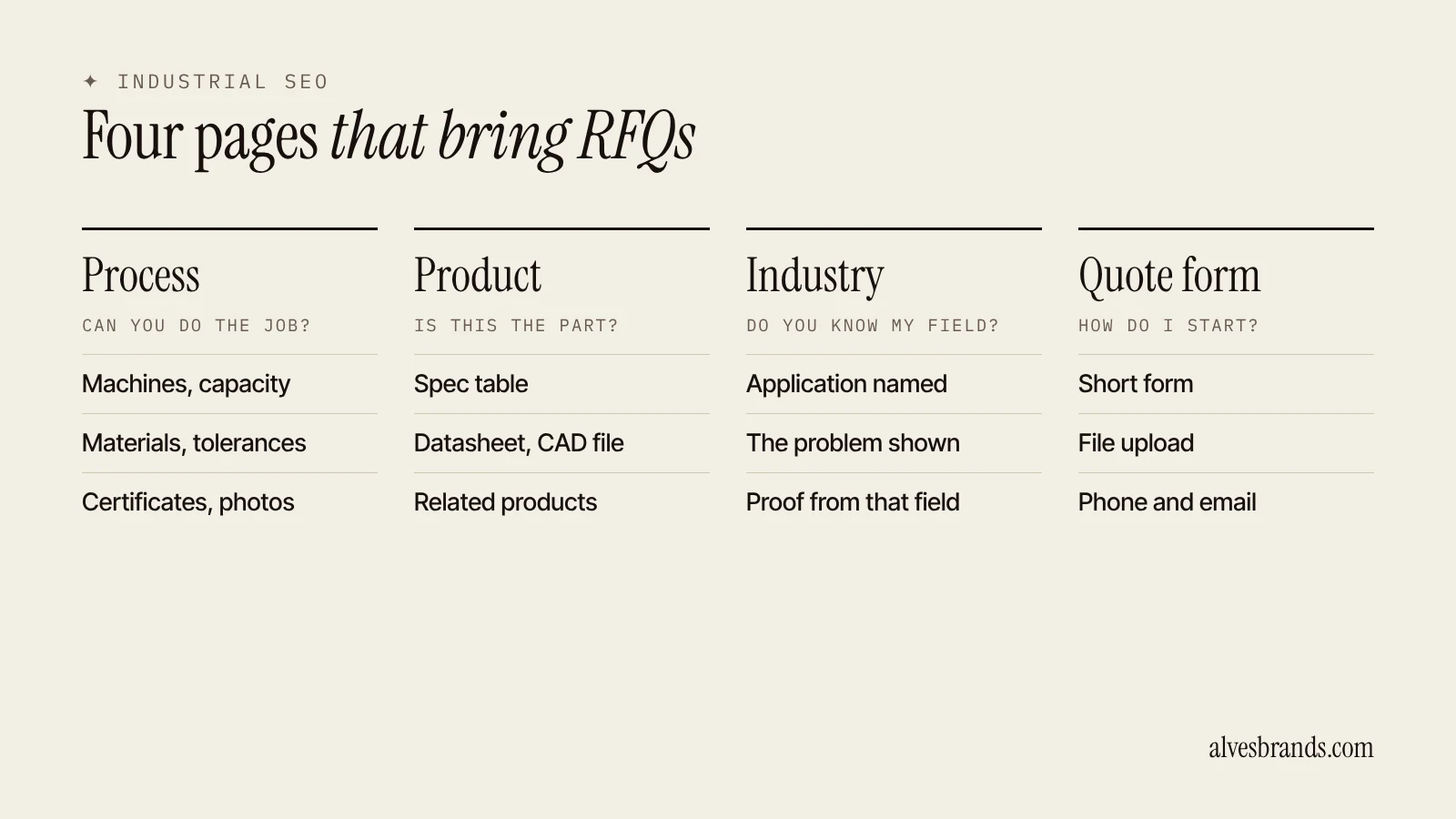
Process page. One clear sentence on what you do, then machines and capacity, materials, tolerances, standards, lead times, real photos and an RFQ form. One page per process or material beats one long "Capabilities" page.
Product page. A clear name with the keyword, a short description, a spec table, downloads (datasheet, CAD file, certificate), related parts and a quote button. Don’t copy the supplier’s text. If a hundred distributors use it, Google has no reason to show yours.
Industry page. "Hydraulic fittings for agricultural machinery" speaks to an engineer more than "Hydraulic fittings." Show the problem, the standards and examples.
Quote form. Ask for name, company, email, country, the need and a file upload. A long form kills requests. See website design for manufacturers for what buyers expect.
Step 4: Fix technical SEO
- Filters and parameters create thousands of near-copy URLs. Use canonical tags and block useless combinations.
- Duplicate and thin pages: merge them. One page with a size table beats one page per size.
- PDFs: Google reads them, but they rank less well and give no next step. Make an HTML page with the main specs and link the PDF as a download.
- Mobile and speed: Google indexes the mobile version, and engineers use phones on the shop floor. Fix the worst Core Web Vitals.
- JavaScript catalogs: test with URL inspection in Search Console that Google can see the products.
- Structured data for organization, products and FAQs, matching what’s visible.
- Redirects: map every old URL to a new one with a 301 when you redesign. My technical SEO page lists what I check.
Step 5: Write content engineers trust
Google asks for helpful, people-first content. In industry that means selection guides ("how to choose a pump for abrasive slurry"), comparisons, standards explained in plain words, troubleshooting guides, calculators and case studies with real numbers. Have an engineer review each page. A line such as "we hold ±0.01 mm on this part" shows first-hand experience. See content marketing for manufacturers.
Step 6: Add local and international SEO
For nearby searches, set up a Google Business Profile and ask customers for reviews. For export, add an export page, translated top pages and hreflang tags. Read how foreign buyers find suppliers and my international SEO page.
Step 7: Earn links from your industry
The best links are ones buyers see. Think of trade directories such as Thomasnet, associations, customers who list suppliers, trade magazines and original test data. Don’t buy links in bulk, since Google’s spam policies call that link spam. My link building page shows the safe way.
Step 8: Get ready for AI search
Forrester’s 2025 survey, cited by WebFX, found that 94% of business buyers use AI in their buying process. Ahrefs found that AI Overviews cut the click-through rate of the top page by 58%, so being named in the answer counts. Google says there are no extra requirements for AI features beyond helpful, indexable pages. Put a clear answer at the top, state facts plainly, use spec tables and keep company details the same everywhere. See how to get recommended by ChatGPT.
Step 9: Measure what pays
Industrial SEO only counts when it brings quotes. Track RFQs, leads by source, organic visits to money pages, rankings, quote-to-order rate and mentions in AI answers. Add a "How did you find us?" field to the form. Review once a month. Look at the pages that bring RFQs and ask what they share: a spec table, a file upload, a certificate. Copy that pattern to the pages that don’t convert. Drop pages that bring visits but never a quote, or rewrite them for a closer search. Small changes to your best ten pages usually beat a new batch of weak ones. You can test your own site with the free website enquiry check.
How long it takes and what it costs
Technical fixes can show results in weeks. New pages usually take two to four months, and steady growth often shows around month three to six. Google warns about providers that guarantee rankings. WebFX, a large US agency, says industrial SEO typically costs $2,500 to $7,500 per month in its industrial SEO guide. Smaller consultants charge less, and an audit plus a focused plan costs a fraction of a retainer. My services page shows what I offer. For a quick estimate, use the free SEO cost calculator.
In-house or agency?
Do it in-house if someone has time and knows both your products and SEO. Hire help for speed or a senior plan. Before you sign, ask who does the work. Ask whether they have results for a manufacturer. Ask whether they report RFQs, not only rankings. Check that you own the content and accounts, and how long the contract runs. My guide on how to choose a manufacturing marketing agency has more.
Common industrial SEO mistakes
- Slogans instead of specs.
- One "Capabilities" page for everything.
- Catalog text copied from suppliers.
- Key data locked in PDFs.
- A redesign with no redirects.
- Chasing volume, which brings students, not buyers.
- No proof: no certificates, photos or case studies.
- No tracking of which pages bring RFQs.
Industrial SEO checklist
- Keywords come from real buyer words and are grouped by search results.
- One page per main keyword, in a clear structure.
- Process, product and industry pages carry real specs.
- Every money page has a short RFQ form with file upload.
- Indexing, mobile, speed and redirects are clean.
- PDFs have HTML pages behind them.
- Proof is visible: certificates, case studies, photos, names.
- You earn links from directories, associations and partners.
Working in engineering? Read my engineering SEO guide.
For the service, see manufacturing SEO services. Product pages are covered in SEO for product pages.
Check your site with the manufacturing SEO checklist.
Frequently asked questions
What is industrial SEO?
It’s SEO for manufacturers, distributors, job shops and industrial service firms. It helps engineers and buyers find your pages for processes, materials, parts and suppliers, and turns visits into quote requests.
How is industrial SEO different from normal SEO?
Volumes are small, catalogs are large, buyers are technical and sales cycles are long. So specs, PDFs, product data and proof matter more than traffic numbers.
How much does industrial SEO cost?
One US agency says $2,500 to $7,500 per month. A consultant’s audit and plan can cost much less. Compare scope, not only price.
How long does it take to see results?
Technical fixes can help within weeks. New pages usually take two to four months, and steady growth shows around months three to six.
Is SEO or PPC better for industrial companies?
They do different jobs. PPC gives fast tests while you build. SEO builds a lower-cost lead flow over time.
Do industrial companies need a blog?
Start with process, product, industry and proof pages. Add guides around real buyer questions after that.
Do we need to rebuild our website to get results?
Not always. Fix indexing, speed, thin pages and missing specs first. Rebuild only when the platform blocks those fixes. If you do rebuild, plan the redirects before launch.
Do backlinks still matter for industrial SEO?
Yes. Links from directories, associations, customers and trade media tell Google your company is real. A few relevant links beat many weak ones.
What is the difference between technical and commercial SEO?
Technical SEO makes sure Google can crawl and index your pages. Commercial SEO makes those pages persuade: specs, proof, a clear quote form. You need both.
Can small manufacturers compete with big distributors?
Yes, on narrow searches. A process plus a material plus a standard is a phrase a small shop can win.
Does AI search change industrial SEO?
It changes where buyers look, but the basics decide who gets named: clear pages, precise facts and mentions on trusted sites.
Not sure why your industrial site isn’t bringing RFQs? Ask me for a free website check. I’ll show you what buyers see and what to fix first.