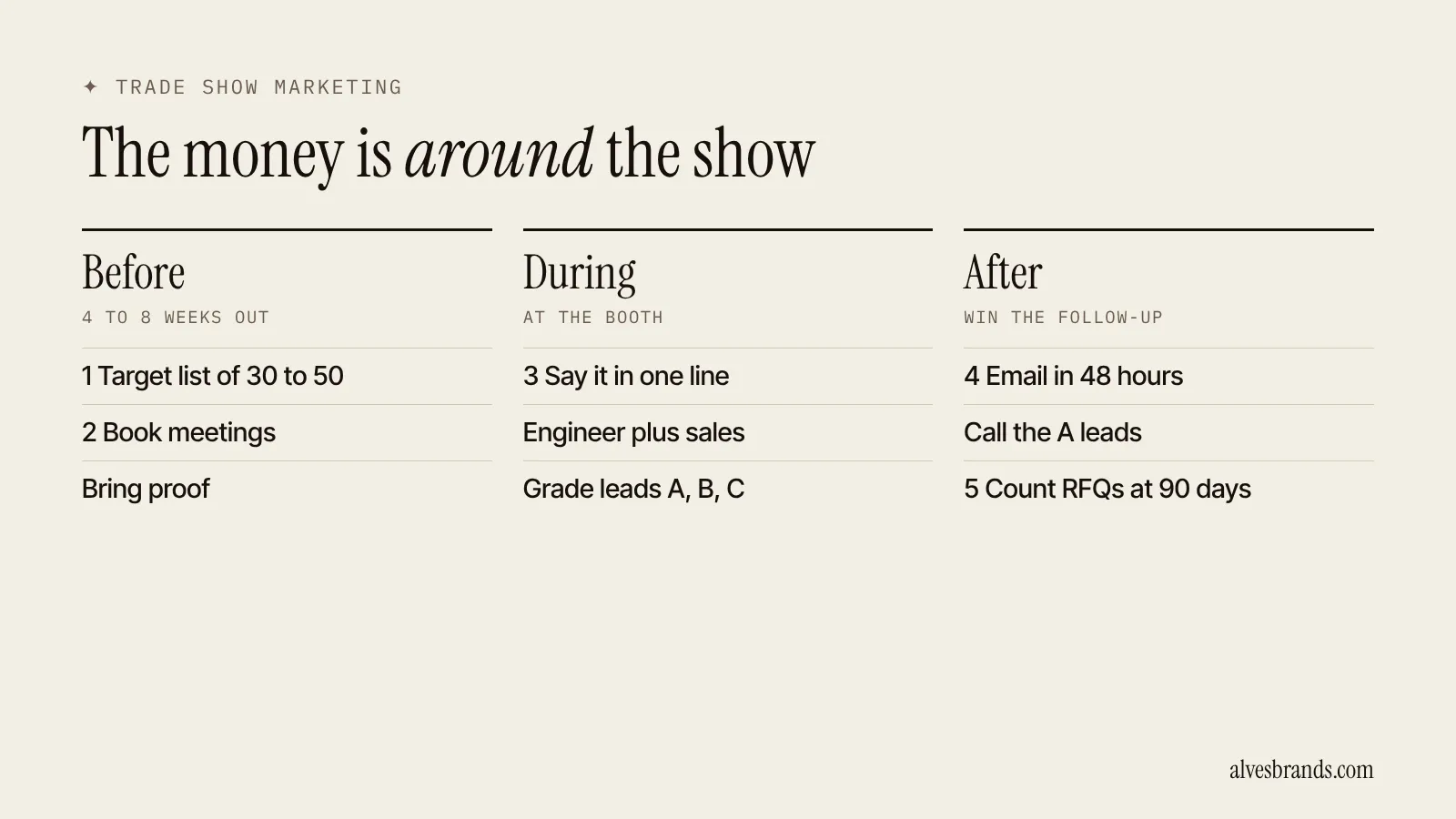
Trade show marketing for manufacturers means picking the right show, booking meetings before it starts, working the booth with a plan and following up fast. Most of the money is made or lost in the weeks around the show, not on the show floor.
A booth costs a lot. Space, build, travel, shipping and staff time add up quickly. So the question isn’t “should we exhibit?” It’s “what will we do before and after, so the booth pays for itself?”
This guide gives you a simple plan for the three stages, a rough budget table, a follow-up routine and a section for exporters who show up abroad. It sits next to the manufacturing lead generation guide, which covers the rest of your lead sources.
Pick the right show first
Don’t choose a show because you always go. Choose it because your buyers go. Before you pay for a booth, check four things:
- Who attends. Ask the organizer for a visitor breakdown by country, job title and industry.
- Who exhibits. If your top three competitors and your best customers’ suppliers are there, it’s a good sign.
- What it costs per useful meeting. Divide your total cost by the number of meetings you can realistically book.
If you export, look for shows with government support. The U.S. Commercial Service helps at U.S. pavilions at many foreign trade shows with market briefings, one-on-one counseling and on-site promotion. The Export-Import Bank of the United States notes that more than 80,000 international buyers attend key U.S. trade shows each year, so shows at home can bring foreign buyers to you without a flight.
If you’re not sure which markets deserve a show, do your market research first.
Before the show: book the meetings
A booth with no plan waits for buyers to walk by. A booth with a plan has a calendar. The best work happens four to eight weeks out.
- Build a target list. Write down 30 to 50 companies you want to meet. Use the exhibitor and attendee lists.
- Reach out personally. Send a short email or LinkedIn message: who you are, what you make, your booth number and one reason to meet. Offer two time slots.
- Use the show’s tools. Many organizers offer a buyer directory or meeting app. Fill in your profile completely. The EXIM guide advises exhibitors at U.S. shows to complete the International Buyer Profile so foreign delegations can find the booth.
- Prepare your proof. Bring samples, a one-page capability sheet and two short case studies. Keep them in a folder buyers can scan with a phone.
Set the goal in numbers: “Book 20 meetings, collect 60 qualified leads, win 5 RFQs.” Without numbers, you can’t tell later if the show worked.
At the booth: make it easy to stop
Buyers walk fast. You have about five seconds to show what you make.
- Say it on the booth. One line, big: “Precision CNC parts for medical devices.” Not your logo alone.
- Show a real part. Something buyers can hold beats a banner.
- Staff the right people. An engineer and a salesperson together. Buyers ask technical questions fast.
- Ask good questions. “What are you sourcing right now?” opens a better talk than “Can I help you?”
- Capture every lead the same way. Use one form or app. Write down the product, the quantity, the timing and the next step.
- Grade leads on the spot. A is an active project, B is a future project, C is just browsing. Do it while the talk is fresh.
- Take notes. You will not remember 60 conversations on Friday.
After the show: follow up in 48 hours
This is where most exhibitors lose the money. The numbers are old but they show the pattern. A 2013 article by Stephanie Millman on PFFC Online said the exhibit industry had claimed for years that 80% of trade show leads never get contacted, though she noted it had never been backed by hard data and put the figure nearer 50% from her own review of company systems. The same piece cited a 2010 Exhibitor magazine survey: fewer than 47% of exhibiting companies track their leads and only 28% can measure return on those leads.
Whatever the exact figure, the lesson is plain. If you follow up fast, you beat most of the competition for free.
A 2012 study by the Centre for Exhibition Industry Research, which interviewed 198 booth exhibitors, found that the most common follow-up was an email tailored to the lead’s needs (64%), followed by a tailored phone call (59%). Only 17% used a CRM to track leads. A simple CRM is cheap and puts you ahead of most.
Use this routine:
| When | What |
|---|---|
| Day 1, on the plane or at the hotel | Sort leads into A, B and C. Fix your notes. |
| Within 48 hours | Send a personal email to every A and B lead. Mention what you talked about. |
| Within one week | Call the A leads. Send quotes. Connect with everyone on LinkedIn. |
| Weeks 2 to 4 | Send C leads a useful guide or case study. Add them to your email list. |
| Month 3 | Check back with the B leads. Projects move slowly. |
Keep each email short, specific and easy to answer. A good one names the show, repeats what they need and asks for one next step.
What a trade show costs
Costs vary a lot by country, show and booth size, so use your own quotes. These are the lines to budget for:
| Cost | What to include |
|---|---|
| Space | Booth fee and any extras from the organizer |
| Stand and graphics | Build, design, storage and transport |
| Travel | Flights, hotels and meals for the team |
| Shipping | Samples, brochures, equipment and customs paperwork |
| Marketing | Pre-show outreach, signs, giveaways and ads |
| Staff time | Days away from the factory and the follow-up work |
Add them up and divide by the number of qualified leads. That’s your cost per lead. Compare it with your cost per lead from search, LinkedIn and email.
Trade show marketing for manufacturers that export
If you sell abroad, a show is one of the best ways to meet foreign distributors and agents face to face. A few extras help:
- Translate your materials. Bring a capability sheet in the local language and make sure the website pages match. My multilingual website checklist shows what to translate first.
- Bring export facts. Certificates, shipping terms, minimum orders and payment terms. Foreign buyers ask on the first day.
- Check the customs rules for samples before you ship them.
- Make your website ready. After the show, buyers check your site. If it’s thin or slow, the meeting goes cold. How foreign buyers find suppliers explains what they look for.
Measure the result
Good trade show marketing for manufacturers ends with numbers. Count these within 90 days:
- Meetings held against the meetings booked.
- Qualified leads against the number collected.
- RFQs and quotes sent.
- Deals won and their value.
- Total cost and cost per qualified lead.
Frequently asked questions
Are trade shows worth it for manufacturers?
Trade show marketing for manufacturers pays off if you pick the right show and follow up fast. Plan the meetings in advance and track the results to see what each show returns.
How soon should I follow up after a trade show?
Within 48 hours for the best leads. Send a personal email that mentions what you talked about and asks for one clear next step.
How do I measure trade show ROI?
Divide your total cost by the number of qualified leads, then track the RFQs and deals that come from them over 90 days or more.
Should exporters exhibit at trade shows abroad?
Yes, if buyers in that market go there. Check whether your trade office runs a national pavilion, since many offer market briefings and counseling.
Want to know if your website is ready for the buyers you meet? Ask me for a free website check. I’ll show you what they see and what to fix first.