Manufacturing marketing budget numbers are all over the place. Published benchmarks run from 1% of revenue to 10%. For a small or mid-size factory, I’d start at 7% of revenue, spend the first money on your website and search, and adjust after 90 days of real numbers.
That 7% is not a magic number. It sits inside the range the best sources give, and it’s easy to defend to a boss or a bank. This guide shows the benchmarks with their dates, why they disagree, how to set your own number in five steps and what to fund first. It sits next to the manufacturing marketing plan, which covers what the money should do.
Manufacturing marketing budget benchmarks (with dates)
Here is what the sources say. I put the date and the group each number covers, because a number without those tells you nothing.
| Source | Date | Figure | Who it covers |
|---|---|---|---|
| Gartner CMO Spend Survey | May 2026 | 7.8% of company revenue (7.7% in 2025) | 401 marketing leaders, most at companies above $1 billion in revenue |
| US Small Business Administration community post | 2012 | 7 to 8% of revenue | Businesses under $5 million in revenue with 10 to 12% margins |
| Geear, quoting Gartner | 2022 | 9.8% of revenue | Manufacturers |
| Market Veep | Jan 2025 | 5 to 10% of revenue | Manufacturers, source not named |
| Salesmate | Aug 2023 | 3.2% of sales | Manufacturers, from a third-party site |
| WebFX | Nov 2024 | 1 to 3% of revenue | Manufacturers, “industry standard” |
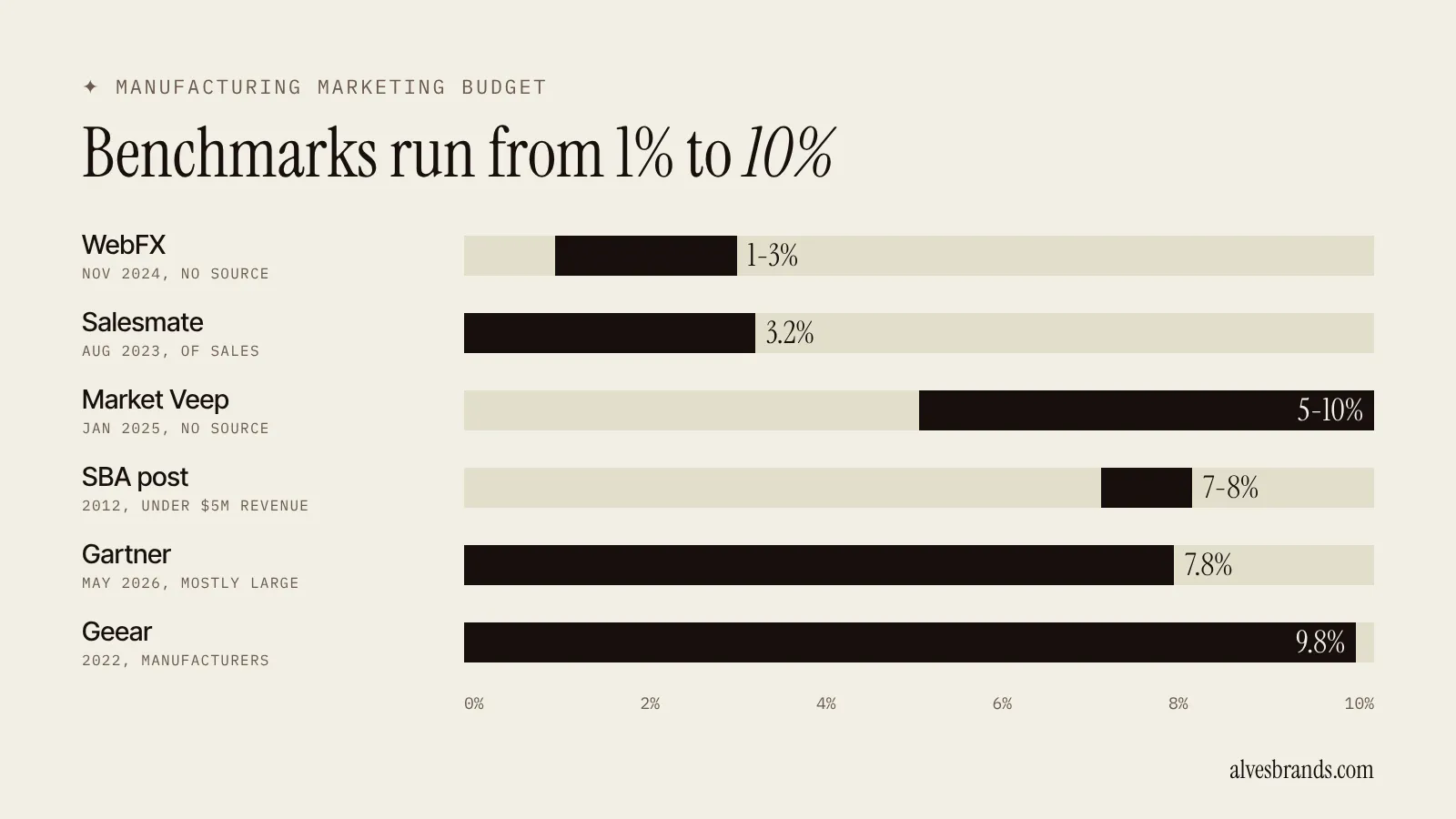
Two things jump out. The best-documented numbers (Gartner and the SBA) sit at 7 to 8%. And the cheapest numbers come from sources that don’t say where they got them.
Why the benchmarks disagree
Three reasons, and you should check all three before you copy a number.
The group is different. Gartner’s survey is mostly big companies. A $1 billion company can run a sales machine on 7.8% because it already has brand, a sales team and repeat customers. The SBA number is for companies under $5 million. Your factory is probably closer to the second group.
The base is different. Some numbers are a share of revenue. Others are a share of the whole company budget or of sales. Salesmate’s own page says marketing is 13% of a manufacturer’s whole company budget in one place and 3.2% of sales in another. Those are two different bases, so you can’t compare them. For a quick estimate, use the free SEO cost calculator.
The source is missing. Look at the WebFX page. It calls 1 to 3% of revenue the industry standard in the body and then says 5 to 10% in its FAQ. When one page gives both, trust neither without the original study.
So use the sources with a named group and a date. Treat the rest as a rough guess.
Set your manufacturing marketing budget in 5 steps
This is the routine I’d follow. It takes an afternoon.
- Start from revenue. Take last year’s revenue and multiply by 7%. A factory with $5 million in sales lands at $350,000 a year, or about $29,000 a month. That’s an example, not a promise. The SBA says the 7 to 8% works if your margins sit around 10 to 12% after marketing. With thinner margins, start lower.
- Set a goal in numbers. “Win 10 new RFQs a quarter from two industries” beats “get more leads”. Budget follows the goal.
- Cost the lines. List what each channel costs in your market. Get real quotes for your website, search work and trade shows.
- Split the money. Put the biggest share in the channels that bring RFQs (more on that below). Keep 10% free for tests.
- Review every 90 days. Keep what brings RFQs. Cut what doesn’t. Don’t change the whole plan every month, because search and content need time.
If the number from step 1 is more than you can spend, shrink the scope, not the quality. Two channels done well beat six done badly. The manufacturing marketing plan explains how to pick them.
What to put in a manufacturing marketing budget
These are the lines I’d check, in the order I’d fund them:
- Website. Your buyers check it before they call. A Thomas survey of 266 industrial buyers found 73% focus on the company website when judging a supplier, against 10% for social media. It’s an older survey (2019), so read it as a direction, not a precise number.
- Search (SEO). The pages that bring buyers who already search for what you make. My SEO for manufacturers guide shows the basics.
- Content. Case studies, capability pages and guides. See the content marketing guide.
- Email. A cheap way to follow up on leads you already paid for.
- Trade shows and events. Often the biggest single line. Count the follow-up cost too. The trade show guide has a cost table.
- Paid ads. Only after your pages convert.
- Tools and tracking. A CRM and analytics. Small cost, big payoff.
- People. Count staff time and agency or freelancer fees. Many factories forget this line.
Example: how a $5 million factory could split $350,000
Here is the split I’d start with for the example in step 1. It’s my starting point, not a published benchmark, so change it to fit your market.
| Line | Share | Per year |
|---|---|---|
| Website and search (SEO) | 35% | $122,500 |
| Trade shows and events | 20% | $70,000 |
| Content (case studies, guides, video) | 15% | $52,500 |
| Paid ads | 10% | $35,000 |
| Email, CRM and tracking | 10% | $35,000 |
| Free money for tests | 10% | $35,000 |
Read it as an order of priority. The website and search take the biggest slice because every other line sends buyers there. If your website is already strong, move part of that money to content. If you sell mostly through trade shows, keep the show line but add the follow-up cost to it, so the leads you pay for don’t go cold.
Check the split again at each 90-day review. If one line brings no RFQs after two quarters, move its money to the line that does.
What real spending looks like
Monthly numbers help more than percentages, because you can compare them with a quote. Here is what WebFX published in November 2024 for manufacturers (it gives no source for the ranges, so read them as a rough guide):
| Channel | Monthly range |
|---|---|
| SEO | $2,500 to $7,500 |
| Paid advertising | $100 to $10,000 |
| Social media | $100 to $5,000 |
WebFX also reports that 52% of manufacturers plan to spend $5,000 to $10,000 or more a month on marketing, and 2% plan to spend under $500. Geear says most of its manufacturing clients spend $3,000 to $5,000 a month on digital marketing. That’s one agency’s own client base, so treat it as one data point.
Put those next to the 7% rule. A factory with $2 million in revenue lands at about $11,700 a month on 7%. Most of the monthly ranges above fit inside that.
Budget by company size
These are starting points, not benchmarks. I built them from the sources above.
| Company | Starting point | Why |
|---|---|---|
| Under $5 million in revenue | 7 to 8% of revenue | The SBA range, if margins allow |
| $5 to $50 million | 6 to 8% | Between the SBA and Gartner numbers |
| Above $50 million | About 7.8% | Close to the Gartner 2026 average |
Is your factory growing fast or entering a new market? Go to the top of the range. Do you already have a full order book and repeat buyers? Go to the bottom.
Manufacturing marketing budget for exporters
If you sell abroad, add three lines most budgets miss:
- Translation and local pages. Buyers search in their own language. My multilingual website checklist shows what to translate first.
- Market research. Check demand before you pay for a booth or a campaign. See the market research guide.
- Foreign trade shows and travel. Booth, shipping, flights and sample customs fees add up fast.
Start with one market. Put your first budget into the pages that foreign buyers actually find, and add a second market only when the first brings RFQs.
When to spend more, and when to spend less
Your number isn’t fixed. Move it up or down with these signs:
- Spend more when you’re entering a new market, launching a new product line or you have spare capacity to fill. You need orders sooner, so you need more channels running at once.
- Spend more when your tracking shows a channel brings RFQs at a cost you like. Put extra money there first.
- Spend less when your order book is full and your lead times are long. More leads won’t help you ship faster.
- Spend less when margins are thin. Start near the bottom of the range, pick two channels and track them closely.
Write the reason down each time you change the number. Six months later you’ll know what worked.
Mistakes that waste a manufacturing marketing budget
Market Veep lists the usual ones:
- Ignoring digital. Buyers research online first. A budget made only of trade shows and print misses them.
- Not tracking return. If you can’t say which channel brought an RFQ, you can’t decide what to cut.
- Cutting marketing in a slow year. Cut the weakest channel, not the whole budget.
- Doing everything in-house. One person can’t cover search, content, email and design. Pay for the gaps.
- Betting everything on trade shows. They can swallow the whole budget. Keep a balance.
How to know it’s working
Count these every month and compare them with your goal:
- Qualified leads and RFQs by source.
- Cost per qualified lead and cost per RFQ.
- RFQs that became orders, and the order value.
- Pages that bring visitors who ask for a quote.
Give search and content six months before you judge them. Paid ads and email show results faster. Gartner’s 2026 survey found 56% of marketing leaders say their budget is too small for their strategy, so you’re not alone if yours feels tight. Tracking is how you win the argument for more.
If you hire help, my guide on how to choose a manufacturing marketing agency shows what to ask. And if you want leads first, read manufacturing lead generation next.
For a wider plan around the budget, see the B2B marketing plan guide.
See what manufacturing SEO services cost.
See where the SEO budget goes in the B2B SEO strategy.
What does search cost? Read manufacturing SEO cost.
Frequently asked questions
How much should a manufacturer spend on marketing?
A good starting point for a small or mid-size manufacturing marketing budget is 7 to 8% of revenue. That matches the SBA range for companies under $5 million and Gartner’s 2026 average of 7.8%. Adjust after 90 days of tracked results.
What percentage of revenue should a manufacturing company spend on marketing?
Published numbers run from 1% to 10%, so check who the number covers and when it was published. The best-documented ones sit at 7 to 8%.
How much does marketing cost per month for a manufacturer?
WebFX reports SEO at $2,500 to $7,500 a month for manufacturers and says 52% plan $5,000 to $10,000 or more a month on marketing in total. Your number should come from your revenue and your goals.
Should a manufacturing marketing budget change for exporters?
Yes. Add translation and local pages, market research and foreign trade show costs. Start with one market and expand when it brings RFQs.
Should I cut my marketing budget in a slow year?
Cut the weakest channel, not the whole budget. Search and content take months to build, and stopping resets the clock.
How long before a marketing budget pays off?
Email and paid ads can bring leads in weeks. Search and content usually need three to six months. Judge each channel on its own timeline.
Want to know if your website deserves the first slice of your budget? Ask me for a free website check. I’ll show you what buyers see and what to fix first.