An industrial marketing strategy is a short written answer to seven questions: which market you’re after, who buys there, what you offer, how they buy, where you’ll reach them, what you’ll spend and how you’ll know it worked. Most industrial companies never write it down. They run a trade show here, a brochure there, a website nobody updates, and call it marketing.
That works until it doesn’t. A strategy gives you a reason to say no to the next shiny idea. This guide walks you through building one in seven steps, with a one-page template at the end you can fill in this week.
What an industrial marketing strategy is (and isn’t)
People mix up three words. Keep them apart and the work gets easier.
| Strategy | Plan | Tactic | |
|---|---|---|---|
| Answers | Where do we play and why do buyers pick us? | Who does what, by when, for how much? | What do we actually do today? |
| Example | “We’ll win mid-size food plants in Germany by being the fastest to quote and best at food-grade proof.” | “Publish 2 guides, fix 5 product pages, run 1 trade show, by March.” | “Write the page for FDA-compliant seals.” |
| Lifespan | 1 to 3 years | 1 year, reviewed every quarter | Days or weeks |
| Owner | Founder or head of sales and marketing | Marketing lead | Whoever does the work |
A strategy that lives only in the owner’s head isn’t a strategy. It’s a hunch. The reason to write it is that your sales team, your marketer, your agency and your engineer can all read the same page and pull in one direction.
Picking outside help? How to choose a manufacturing marketing agency gives you ten questions to ask and a scorecard.
If you want the plan version with dates and owners, see my manufacturing marketing plan. If you want a list of tactics to pick from, see manufacturing marketing strategies. This guide sits before both: it’s how you decide what goes in them.
Why industrial companies need a written strategy
Three reasons, and they all cost money.
Your buyers use many channels. McKinsey’s 2024 B2B Pulse survey found that buyers use about 10 channels on average, up from about 5 in 2016. Without a strategy, you try to cover all ten with a budget for two, and you end up thin everywhere.
Resources are short. The Content Marketing Institute’s research found that 57% of manufacturing marketers say lack of resources is their biggest challenge. When you can’t do everything, deciding what not to do is the whole job.
Results are hard to prove. The same study found that 64% of manufacturing marketers find it hard to tie their content to revenue. A strategy that names the numbers up front fixes much of that, because you decide what counts before you start.
And the buyer has changed. A 2026 Gartner survey of 646 B2B buyers found that 67% prefer a rep-free buying experience. The 6sense 2024 Buyer Experience Report found buyers are nearly 70% through the process before they contact a seller. Your strategy has to work on the part of the journey you can’t see, because that’s where the decision happens.
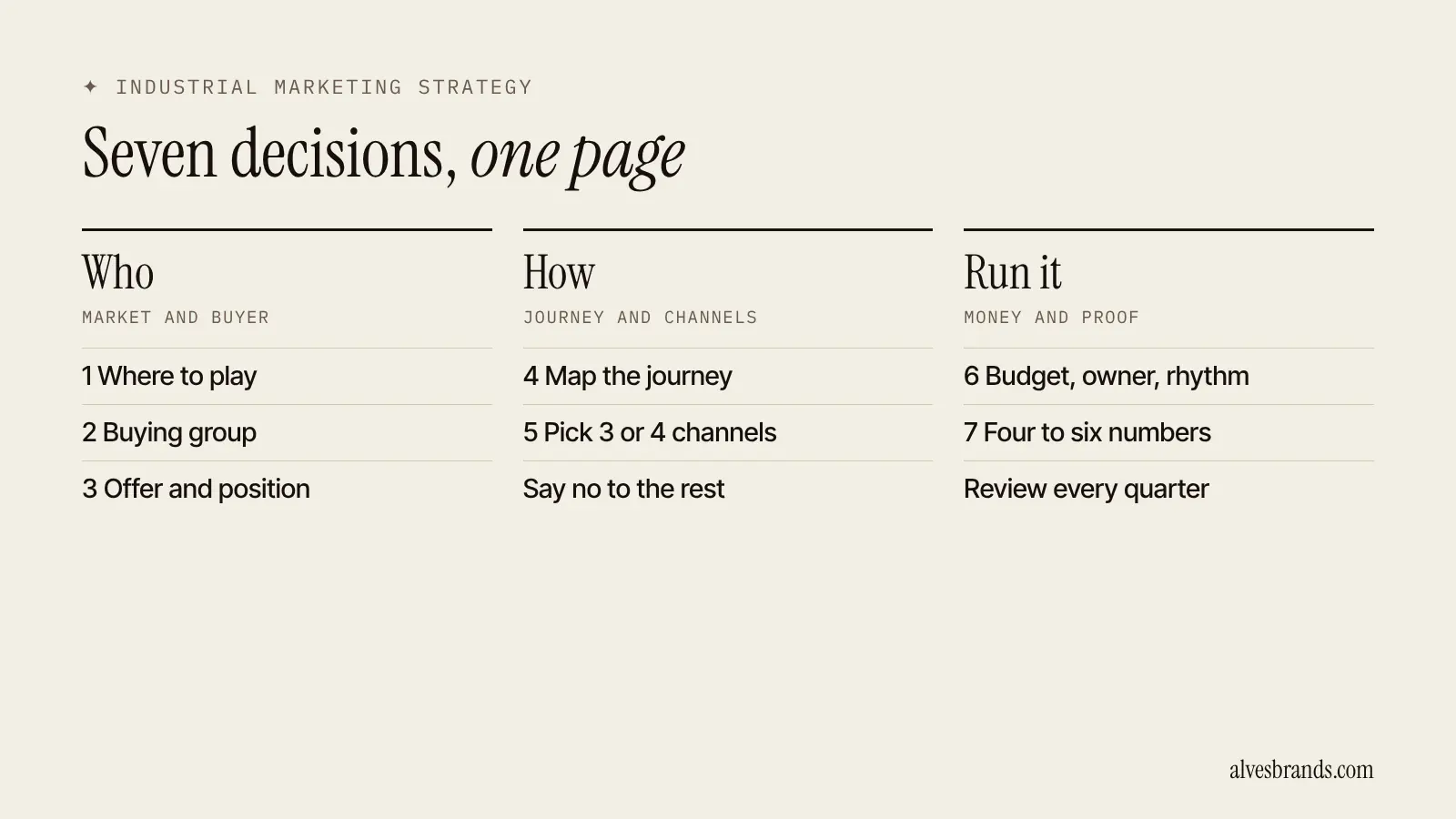
Step 1: Choose where to play
Start with the market, not the tactics. “Everyone who needs our product” is not a market. Pick a slice you can win.
Score each candidate market on five things, 1 to 5:
| Criteria | Question to ask |
|---|---|
| Size | Are there enough buyers to fill your capacity? |
| Growth | Is the segment growing or shrinking? |
| Fit | Does the market want what your plant does best? |
| Competition | Can you stand out, or is it crowded with cheaper rivals? |
| Reach | Can you actually contact these buyers online? |
Add the scores. The best market isn’t the biggest. It’s the one where fit and reach are high, because those two decide whether you can win and whether marketing can find buyers.
Be willing to cut. A 30-person machine shop that tries to serve aerospace, medical, energy and food all at once ends up with four weak websites. Pick one or two industries for the next year and build proof for them.
If you don’t have the numbers to score a market, do a short round of research first. My guide to manufacturing market research covers six free or cheap ways to do it in a few weeks. The NIST Manufacturing Extension Partnership also helps US manufacturers with market and competitor research.
Write down: “We will focus on [industry] in [region], buying [product family].”
Step 2: Describe the buying group
Industrial buyers aren’t individuals. According to Gartner research on the B2B buying journey, a typical buying group for a complex B2B purchase includes 6 to 10 decision makers. In a plant, you can usually name the same few roles every time.
For your chosen market, fill in one line per role:
| Role | Their worry | What they’ll look for |
|---|---|---|
| Engineer | Will it meet the spec? | Data sheets, drawings, tolerances |
| Buyer | Is the price and lead time right? | MOQ, quotes, delivery terms |
| Quality | Can they prove consistency? | Certificates, inspection reports |
| Finance | What’s the total cost? | Payment terms, volume pricing |
| Executive | Is the supplier safe? | References, history, scale |
You don’t guess this. Call ten customers and ask who was in the room when they picked you, what each person cared about and what nearly made them choose someone else. Five of the ten calls will repeat what the other five said. That repetition is your buyer profile.
Also write down where these people look: Google in their language, a directory, LinkedIn, an industry forum, a trade show, an AI assistant. That list feeds Step 5.
Write down: “Our buying group is [roles]. They search [where]. Their biggest worry is [worry].”
Step 3: Write the offer and the position
Your offer is what the buyer gets. Your position is why it’s better than the other options, in a sentence they remember.
Use this template:
For [buyer type] who need [product or service], we are the [category] that [main reason to choose us], proven by [evidence].
For example: “For food plants that need stainless conveyor parts, we are the supplier that ships certified parts in 10 working days, proven by 12 years and 200 plants.”
Good positions have three traits:
- Specific. “Fast” is empty. “10 working days” isn’t.
- Provable. You can show a number, a certificate, a customer or a video.
- Relevant to the chosen buyer. A reason that matters to a food plant can mean nothing to a car maker.
Test it in a call with two customers: read it aloud and ask if it’s true. If they wince, rewrite.
Then make sure the offer can be bought. Buyers need clear starting points: a standard product line, a sample, a trial order, a small first batch. If the only way in is a six-figure contract, you filter out the buyers who’d grow into one.
Write down: The one-sentence position, and the three proofs behind it.
Step 4: Map the buying journey
Now look at how the buyer moves from “we have a problem” to “send the purchase order”. An engineer looking for a new supplier follows a path like this:
| Stage | What the buyer asks | What you need to have |
|---|---|---|
| Problem | “We need a supplier for X” | A page that matches the search words |
| Research | “Who makes X? What are the options?” | Guides, comparisons, directory listing, AI-ready answers |
| Shortlist | “Which three should we ask?” | Specs, certificates, photos, references |
| Quote | “Can they meet our price and date?” | A quote form, fast reply, clear terms |
| Decision | “Is this supplier safe?” | Samples, audit, references, payment terms |
| Repeat | “Should we reorder or switch?” | Good delivery, a contact person, check-ins |
Fill in your own version. Mark the stages where you’re missing something. Most industrial companies are strong at the Quote stage (the sales team handles it) and weak at the Research and Shortlist stages, where no human is involved. That’s where marketing earns its keep.
Where do buyers actually go during the research stage? Google, directories like Thomasnet, and now AI assistants. My guide on how foreign buyers find suppliers shows the search side, and getting recommended by ChatGPT covers the AI side.
Write down: The six stages for your buyer, and the missing asset at each.
Step 5: Pick the channels (and say no to the rest)
Here’s where strategy pays off. You have your market, your buyers and your journey. Now choose three or four channels that reach those buyers at the stages you’re weak in. A simple way to sort them is by job.
| Job | Channels | Pick when |
|---|---|---|
| Capture buyers already searching | Product pages with SEO, search ads, directories, AI visibility | Buyers have a name for what they need |
| Create interest in buyers who don’t know you | LinkedIn, technical guides, video, trade shows, account-based marketing | The market is new or the product needs explaining |
| Keep leads and customers | Email, case studies, check-in calls, fast quotes | Cycles are long or repeat orders matter |
Almost every industrial company should start with capture, because it’s the cheapest demand to win. The Content Marketing Institute found that 68% of manufacturing marketers said search and pay-per-click gave them the best paid results. People who type “316 stainless tube supplier” into Google are close to buying.
Then add one “create” channel that fits your buyer. In the same research, 85% of manufacturing marketers said LinkedIn gives them the most value and 74% rated video the content type that works best. For a short list of big targets, account-based marketing reaches the whole buying group at once.
Finally add one “keep” channel. Email is the easy one, since it costs little and runs on its own once set up.
That’s three or four channels. Write down the ones you’re skipping this year too, and why. A “not now” list stops the same debate from coming back every month. For what’s changing in channels this year, see my industrial marketing trends guide.
Write down: The 3 or 4 channels, the job each does and the list you’re skipping.
Step 6: Set the budget, team and rhythm
The Gartner 2026 CMO Spend Survey found marketing budgets average 7.8% of revenue. The 2025 CMO Survey found B2B product companies spend about 6.4%. Many smaller industrial firms spend far less. Use those numbers as a ceiling to compare against, not a target.
Build the budget from the channels, not from a percentage:
- List the cost of each chosen channel for 12 months: tools, ads, freelancers, video, events.
- Add the time of the people inside the company who will supply facts. Engineers are your scarcest resource.
- Hold back 10 to 15% for tests. Something will surprise you.
- Compare the total with the revenue you want from new customers. If marketing costs more than a quarter of what it’s supposed to bring in, look again.
Decide who owns what:
- One owner inside the company. Someone who knows the products and can say yes.
- Specialists for the pieces you can’t do: SEO and writing, video, ads.
- Sales as a partner, with a shared definition of a good lead and a reply time of one working day.
Then set a rhythm. A monthly one-hour meeting is enough: look at the numbers, review lost deals, pick the next two actions. Quarterly, check the strategy against what happened.
Write down: Budget by channel, the owner and the meeting rhythm.
Step 7: Pick the numbers
Last decision, and the one that keeps the others honest. Choose a few numbers you’ll watch, and decide in advance what “good” looks like.
| Type | Metric | Where to find it |
|---|---|---|
| Result | Orders from new customers, revenue from marketing leads | Sales log or CRM |
| Pipeline | Quote requests per month, qualified leads | Form or CRM |
| Quality | Quote-to-order rate, average order value by source | Sales log |
| Visibility | Search clicks and queries for target terms | Google Search Console |
| Behavior | Visits to product pages, form completions | Google Analytics |
| Speed | Time to first reply | Email or CRM |
Set targets for 12 months, split by quarter. Make them small enough to believe. For example: “Go from 6 to 15 qualified quote requests a month by month nine, with at least 30% from search.”
Skip likes, followers and total traffic. They feel good and tell you nothing about orders. Add a field on every quote form: “How did you hear about us?” It’s crude, but it beats nothing, and buyers who find you through AI answers or a colleague often don’t show up in analytics.
Write down: Four to six metrics, the starting value and the 12-month target.
Three strategies for three situations
The seven steps stay the same. The answers change with your situation. Here are three sketches. All three companies are made up, but the patterns are real.
The job shop that needs more quotes (capture-led). A 20-person CNC shop has spare capacity and few inbound requests. Focus: aerospace and defense suppliers within 500 km. Channels: product and capability pages built around what buyers type, a directory listing and a fast quote form. Skip LinkedIn for now. Number to watch: quote requests per month. This shop wins by being found and answering first. You can test your own site with the free website enquiry check.
The machine builder with long cycles (create-led). A 60-person company sells packaging lines to food plants, and a deal takes a year. Buyers don’t know they need a new line until someone shows them. Focus: ten named plants. Channels: account-based outreach, video of the line running, a technical guide for plant engineers and one trade show a year. Number to watch: meetings booked with the named accounts. This company wins by getting in front of the whole buying group early.
The component supplier with repeat customers (keep-led). A 35-person maker of seals already has 80 regular buyers. Growth comes from selling more to them and from referrals. Focus: existing accounts plus lookalikes. Channels: a monthly email with new products and stock levels, case studies from the best accounts and a check-in call after every delivery. Number to watch: repeat order rate and average order value. This company wins by being the easy, safe reorder.
Find the one closest to you and start from its channel mix. Then change it as your own numbers show what works. Many companies are a blend, say a job shop with a few repeat accounts. In that case, pick the lead job (capture, create or keep) and give it two thirds of the effort. The other two get the rest. Splitting effort evenly three ways is how a small team ends up doing everything badly.
Questions to ask in your customer calls
Steps 1 to 3 rest on what customers tell you, so the calls matter. Keep each one to 20 minutes and ask about the last purchase, not the future. People remember what happened better than they predict what they’ll do.
- When did you last look for a supplier of this kind of part? What started it?
- Where did you look first? Google, a directory, a colleague, an AI assistant?
- Who else was involved, and what did each person care about?
- Which suppliers did you shortlist, and why those?
- What almost made you choose someone else?
- What did you need to see before you felt safe ordering?
- What would make you switch suppliers today?
Write down their exact words. If three buyers say “I couldn’t find the lead time”, you don’t need a survey to know what to fix. Call two buyers who didn’t choose you as well. They tell you the things your friends won’t.
How the strategy shows up on your website
A strategy that never reaches the website is a document. Here’s how each decision becomes something a buyer can see:
| Decision | Where it shows up |
|---|---|
| Focus | Home page headline, navigation, the industries you list |
| Buying group | Pages or sections for engineers, buyers and quality, each with their own proof |
| Position | The first line of every product page and your LinkedIn profile |
| Journey gaps | New guides, comparison pages, FAQ and sample request page |
| Channels | The listings, profiles and campaigns that send people to those pages |
| Numbers | A quote form that records the source, and a monthly report |
Walk through your site with the table in hand. If the home page headline doesn’t match your focus, or the product pages ignore your position, fix those first. They cost nothing and change what every visitor sees.
Write it in a half-day workshop
You don’t need a retreat or a consultant to write an industrial marketing strategy. You need four to six people in a room for half a day: the owner or general manager, the head of sales, someone from engineering, whoever runs marketing and, if you can, someone from customer service. They hear the buyer’s complaints all day.
A simple agenda:
| Time | Job | Output |
|---|---|---|
| 0:00 to 0:30 | Read the notes from ten customer calls out loud | A shared picture of the buyer |
| 0:30 to 1:15 | Score three or four candidate markets (Step 1) | One chosen focus |
| 1:15 to 2:00 | Name the buying group and their worries (Step 2) | The role table |
| 2:00 to 2:45 | Write the position and test it against real deals (Step 3) | One sentence, three proofs |
| 2:45 to 3:30 | Map the journey and mark the gaps (Step 4) | A gap list |
| 3:30 to 4:00 | Pick channels, budget and numbers (Steps 5 to 7) | A draft page |
Two rules make it work. First, nobody brings a slide deck. Everything goes on one shared page. Second, when two people disagree, look at a real lost deal and ask which version of the story it supports. Opinions fade fast when you open a real quote that went to a competitor.
After the workshop, one person cleans up the page, sends it to everyone and sets the first monthly meeting. Don’t let it sit for a week. A strategy goes stale the moment it stops being a conversation.
The one-page strategy template
Copy this into a doc and fill it in. If it doesn’t fit on one page, it’s too long.
- Focus: industry, region, product family.
- Buying group: roles, their worries, where they search.
- Position: one sentence, with three proofs.
- Journey gaps: the missing asset at each stage.
- Channels: 3 or 4 chosen, with the job each does. The “not now” list.
- Budget and owners: cost by channel, internal owner, outside help, meeting rhythm.
- Numbers: 4 to 6 metrics, start and target.
Share it with sales, the owner and anyone who touches the website. Pin it where people can find it.
An example: a 40-person valve maker
Here’s how one looks on paper. This company is made up for the example, but the choices are real ones I see.
- Focus: Water treatment plants in Spain and Portugal, replacing corroded valves in ageing plants.
- Buying group: Maintenance engineer (spec), purchasing (price), plant manager (downtime). They search in Spanish and ask colleagues.
- Position: “Stainless valves that fit your old flange sizes, shipped in 15 days, with a 5-year corrosion warranty.”
- Journey gaps: No Spanish pages. No flange-size chart. No reference from a Spanish plant.
- Channels: Spanish product pages with SEO. A water-industry directory listing. A LinkedIn series by the engineer. A quarterly email to past customers. Skipping: paid social, trade shows this year.
- Budget and owners: Export manager owns it. A freelance translator and an SEO specialist help. Spend is held to one flat monthly fee.
- Numbers: Quote requests from Spain per month, quote-to-order rate, Spanish search clicks.
A year later, if two of the three numbers are moving, the strategy works. If not, the review tells you which of the seven choices to change first, instead of throwing out the whole thing.
Weak positions and strong ones
Step 3 is where most strategies fall apart, so here’s what the difference looks like. The weak lines could appear on any competitor’s site. The strong ones can’t.
| Weak | Strong |
|---|---|
| “Quality products at fair prices” | “Stainless fasteners to ISO 3506, with mill certificates on every lot” |
| “Your trusted partner” | “One named engineer on every account, reachable by phone” |
| “Fast delivery” | “Standard parts ship in 5 working days, 97% on time last year” |
| “Custom work for every need” | “Prototype to 10,000 parts, in aluminum and stainless only” |
| “Experienced team” | “Same toolmakers for 14 years, 40 hours of training each per year” |
(The numbers above are examples. Use your own, and only the ones you can prove.)
Notice the pattern. Each strong line has a noun, a number or a standard in it. Each one tells the buyer something to check. That’s the test: could a skeptical buyer verify it in five minutes?
Where AI fits in an industrial marketing strategy
You’ll see AI in two places, and both belong in the strategy.
AI as a channel. Buyers ask assistants for supplier ideas, and the assistants read your pages. Google says there are no extra requirements to appear in AI Overviews or AI Mode beyond normal search basics. So the work is the same as good SEO: clear pages, real specs, consistent facts, and being mentioned on other trusted sites. Add AI visibility to Step 5 as a capture channel, and check it every quarter by asking the same ten buyer questions in ChatGPT, Gemini and Perplexity. My guide on getting recommended by ChatGPT shows how. Want to see how you show up today? Run the free AI visibility check.
AI as a tool. The Content Marketing Institute’s 2026 B2B research found that 95% of organizations use AI-powered applications. That’s fine for first drafts, summaries of customer calls and translation checks. It’s not fine for specs, claims or certificates, because a wrong number on a data sheet costs you an order. Write one rule into the strategy: “AI drafts, an engineer checks every fact.”
Budget at three company sizes
There’s no right amount. These are sketches to show how the split changes with size, not benchmarks.
| Company | Focus of spend | What to skip at first |
|---|---|---|
| 10 to 30 people | Product pages, SEO, quote form, one video, email | Paid social, big trade shows, a full-time hire |
| 30 to 150 people | All of the above plus a part-time marketer, LinkedIn, one account-based push | Agencies that want a long contract before they learn your field |
| 150 people or more | A small team, an agency for specific channels, a CRM tied to sales | Spreading across every channel because the budget allows it |
At every size, the first dollars go to the pages buyers read when they’re ready to ask for a quote. Fancy campaigns come after.
Keep sales and marketing on the same page
An industrial marketing strategy fails quietly when sales ignores it. Sales hears what buyers really say, closes the deals and owns the relationships. Marketing sets the table.
Give sales three jobs inside the strategy:
- Feed it. After each lost deal, log the reason in one line. After each win, log how the buyer found you.
- Use it. Every sales email links to the right guide or case study instead of a brochure.
- Test it. When the position sentence is wrong, sales finds out first. Ask them every month what buyers pushed back on.
Give marketing one job in return: send leads sales can act on, with the source, the product and the quantity the buyer asked for. If a lead arrives without that, sales wastes a call.
A launch checklist
Before you call the strategy done, check these:
- The focus fits in one sentence.
- You’ve spoken to at least ten customers, including two lost deals.
- The buying group is named, role by role.
- The position is specific and provable.
- Every journey stage has an asset or a plan.
- No more than four channels are on the list, and the “not now” list exists.
- Budget, owner and meeting rhythm are written down.
- Four to six numbers have a start value and a target.
- Search Console and Analytics are set up, and every quote form records the source.
- Sales has read it and agreed on what a good lead looks like.
If you can tick all ten, you have a real industrial marketing strategy. If you can tick six, you have a good draft. Start anyway and fix the rest as you learn.
One last thing. Don’t wait for the perfect version. A rough strategy that sales, marketing and the owner all agree on beats a polished one that nobody read. Put it in front of the team this month, run it for a quarter and let your own numbers tell you what to change. The second version is always better than the first, and you only get a second version if you ship the first.
Industrial marketing strategy for exporters
If you sell abroad, the strategy needs three extra lines.
- Languages. Choose the markets first, then translate the product pages for them, not just the home page. Use
hreflangtags so Google serves the right version, as set out in Google’s guide to localized versions. - Trade terms. Show incoterms, shipping routes, lead times to each region and the documents you handle.
- Local proof. Standards and certificates that buyers in that country recognize, plus references in the region.
My multilingual website checklist covers the build, and my international SEO service is what I do when a company wants it done for them.
Where industrial marketing strategies go wrong
- No choice. “We serve everyone” is not a market. Cut until it hurts a little.
- Tactics first. Starting with “we need a LinkedIn page” skips Steps 1 to 4 and wastes the budget.
- A strategy that’s a slide deck. If sales and the website don’t show it, it doesn’t exist.
- Copying a bigger rival. A company with ten times your budget and a different buyer plays a different game.
- No numbers. Without targets, every result looks fine.
- Never revisiting it. Markets move. Review every quarter, rewrite every year.
When to change your strategy
Review it every quarter and rewrite it every year. Change it sooner if one of these happens:
- A big customer leaves, or a new one changes what your plant does best.
- A new rival takes your best keyword or your main listing.
- Search behavior shifts. For example, buyers start asking AI assistants instead of Google, and your pages stop showing up in the answers.
- Your numbers miss for two quarters in a row.
When you change it, change one thing at a time so you know what worked.
Step 4 gets easier with a content routine. See content marketing for manufacturers.
Related reading: industrial SEO covers the search part of your strategy in detail.
To turn a strategy into actions, follow the B2B marketing plan steps.
Need a partner for the search part? See the manufacturing marketing agency page.
Frequently asked questions
What is an industrial marketing strategy?
It’s a written plan for how an industrial company reaches and wins business buyers. It names the target market, the buying group, the offer, the channels, the budget and the numbers you’ll track.
How is an industrial marketing strategy different from a marketing plan?
The strategy decides where to compete and why buyers should choose you. The plan turns that into tasks, owners, dates and costs. You write the strategy first, then the plan.
How long should an industrial marketing strategy be?
One page. If you need ten, the choices aren’t clear yet. Keep supporting material, like buyer interviews and the budget sheet, in separate files.
How often should I update my industrial marketing strategy?
Check it every quarter against your numbers and rewrite it once a year. Change it right away if you lose a main customer, a new rival appears or your results stall for two quarters.
What channels should an industrial company use?
Start with search, meaning product pages that match what buyers type, plus directories. Add one channel to build interest, such as LinkedIn or video, and one to stay in touch, such as email. Three or four channels done well beats ten done badly.
Do small industrial companies need a strategy?
Yes, and they need it more. A small team can’t afford to waste a quarter on the wrong channel. A one-page strategy takes a day to write and saves months.
Want a second pair of eyes on your strategy? Ask me for a free website check. I’ll show you how buyers find you on Google and in AI answers, and which of the seven steps is the weakest.