Industrial marketing trends change slowly, but 2026 moved fast in one place: how buyers find suppliers. They research alone, use AI assistants and show up at your website already halfway to a decision.
Most trend lists give you ten things to chase. I’ll give you seven trends, tell you which three to act on this quarter and name what to skip. Every number below comes from a source you can open.
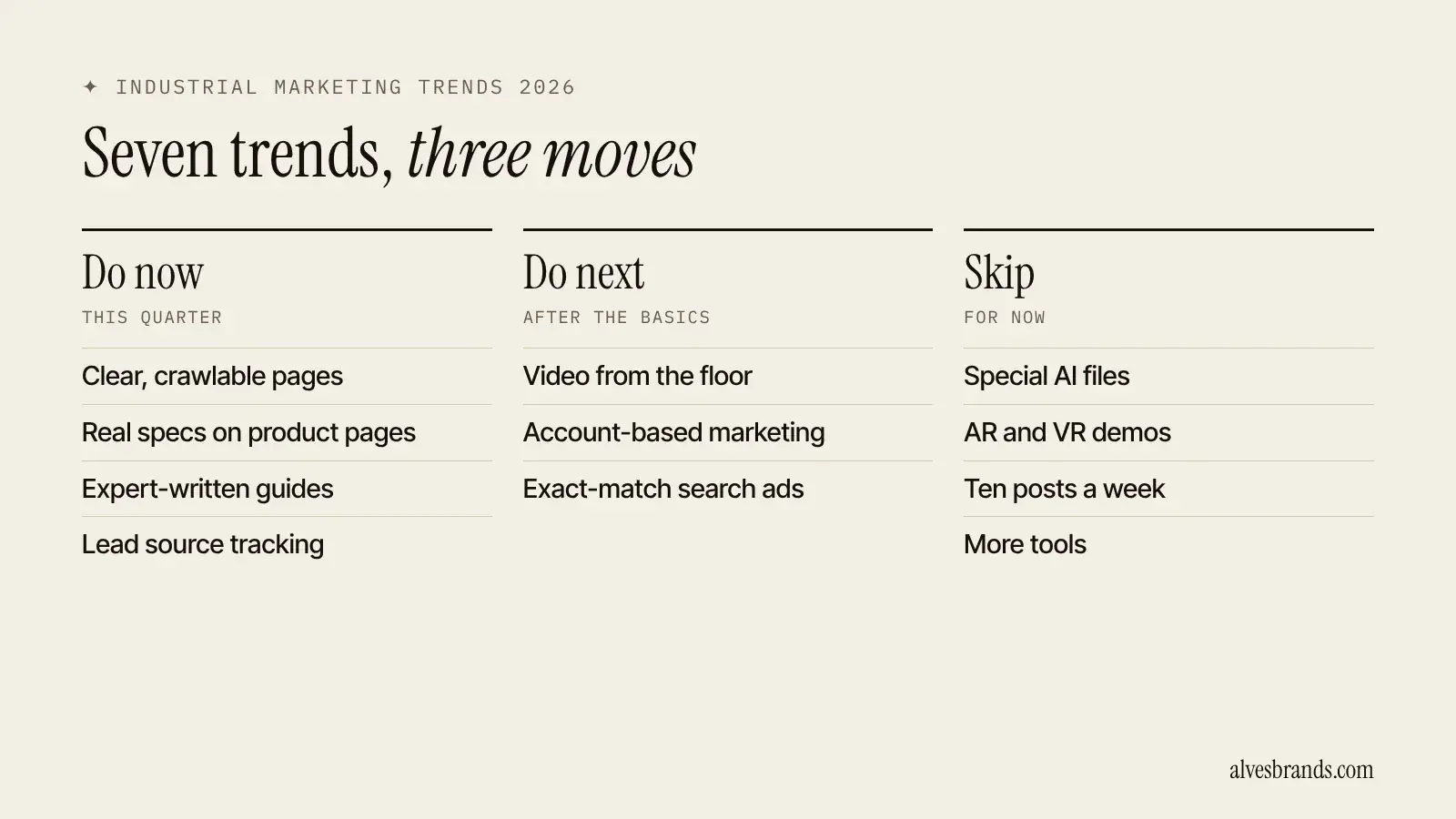
Industrial marketing trends at a glance
| Trend | Do now | Do next | Skip for now |
|---|---|---|---|
| AI answers replace clicks | Make pages clear and crawlable | Track mentions in AI answers | Special “AI files” and tricks |
| Buyers research alone | Product pages with real specs | Downloads and CAD files | A pushy chat pop-up |
| Expert content wins | Engineers write or review | A monthly technical guide | Ten thin posts a week |
| Video | Phone videos from the floor | A short series | A big brand film |
| Buying groups | Content for each role | Account-based marketing | Mass emailing one role |
| Narrow paid search | A few exact-match campaigns | Retargeting | Broad display ads |
| Tracking and alignment | One sheet of lead sources | A shared CRM | Ten dashboards |
1. AI answers take some of the clicks
Buyers now ask ChatGPT, Gemini and Google’s own AI answers for supplier ideas. In a 2026 Gartner survey of 646 B2B buyers, 45% had used AI during a recent purchase. Add it to your industrial marketing strategy as a capture channel. Want to see how you show up today? Run the free AI visibility check.
The click data is harsh. Ahrefs found that AI Overviews cut the click-through rate of the top Google result by 58% in their December 2025 desktop data. And Gartner predicted in 2024 that traditional search volume would fall 25% by 2026. Some analysts doubt that exact number, and I wouldn’t bet on it. The direction is clear, though: fewer clicks, more answers.
Here’s the good news. Google says there are no extra requirements to appear in AI Overviews or AI Mode. No special markup, no new file. Pages need to be indexed and eligible to show a snippet. Google’s advice is the old advice: helpful content, open crawling, text a machine can read, good page experience.
What to do: keep your product pages clear and crawlable, say plainly what you make and who you serve, and get named on other sites buyers trust. My guide on getting recommended by ChatGPT covers the steps. If you want me to look at your site, see my AI search optimization service.
2. Buyers research alone, so your website does the selling
The same Gartner survey found that 67% of B2B buyers prefer a rep-free buying experience. The 6sense 2024 Buyer Experience Report found buyers are nearly 70% of the way through the process before they contact a seller, and 81% already prefer one vendor by then. For how this changes the whole job, read B2B manufacturing marketing.
So the first impression happens without you in the room. McKinsey’s 2024 B2B Pulse survey adds that buyers now use about 10 channels on average, up from about 5 in 2016. They check many places, then compare.
What to do: give each product page the things an engineer looks for: material, tolerances, sizes, certificates, lead time ranges, photos of real work and a quote button. Hiding this behind “contact us” costs you the buyer who wanted to check at 11 p.m. What is industrial marketing explains why this stage matters so much.
Here’s a quick test. Open your best product page on your phone and pretend you’ve never heard of your company. Can you find the material, the size range, one certificate and a way to ask for a price in under a minute? If not, fix that before you spend a cent on anything else.
3. Expertise beats volume
Everyone can now produce content fast. That’s the problem. The Content Marketing Institute’s 2026 B2B report found that 95% of organizations use AI-powered applications, and the report’s own summary is that AI helps marketers type faster, not think better. The same research found that 40% of marketers struggle to create content that drives action.
When every competitor publishes the same generic article, the supplier with real numbers wins. A tolerance chart from your quality manager beats a 1,500-word post on “the importance of quality”.
LinkedIn is where that expertise travels. CMI found it’s the top channel for sharing thought leadership (76%), ahead of email newsletters (54%) and webinars (52%).
What to do: ask your engineers to write or at least review one guide a month. Pick the question customers ask most. Publish it on your site first, then share it on LinkedIn and in your newsletter.
4. Video from the factory floor
In the CMI manufacturing research, 74% of manufacturing marketers rated video the content type that works best. It fits the industry. A buyer can’t visit your plant, but a two-minute video of the line running is the next best thing.
You don’t need a studio. A phone, good light and an engineer who explains the process works better than a polished brand film full of stock footage. Keep each clip under three minutes and say the product name and the job it does in the first sentence, so people and search engines know what they’re watching.
What to do: film one process, one machine and one finished project. Put the videos on the product pages they belong to, not just on YouTube.
5. Buying groups and account-based marketing
A typical B2B buying group has 6 to 10 decision makers, per Gartner. Sending one email to one contact misses most of them.
That’s why account-based marketing keeps showing up in trend lists. You pick a short list of target accounts, then give each role what it needs: data for the engineer, a case study for the plant manager, certificates for quality and total cost for procurement. The ABM study from ITSMA and the ABM Leadership Alliance found that 77% of B2B marketers said ABM drove greater success with target accounts. It’s a survey, not an audit, so treat it as a sign, not a promise.
What to do: start small. Choose 20 accounts, name the roles and write one useful piece per role. My guide to account-based marketing for manufacturers has the 90-day pilot.
6. Paid search gets narrower
Industrial buyers search with exact terms: a material, a standard, a part type. Broad ads waste money. Narrow campaigns on exact searches don’t.
In the CMI manufacturing research, 68% of manufacturing marketers said search and pay-per-click gave them the best paid results. Notice what’s not on that list: broad display and social ads for general audiences.
What to do: run a few exact-match search campaigns for your best products, send each to its own product page and cap the budget. Review it monthly. See my guide on digital marketing for manufacturers for how paid search fits with SEO.
7. Tracking and sales alignment
This one isn’t glamorous, and it’s the trend that decides whether the other six pay off. CMI found that 64% of manufacturing marketers find it hard to tie their content to revenue. Usually, nobody wrote down where the lead came from.
Marketing says “we sent 200 leads”. Sales says “they were junk”. Both are guessing. A shared sheet, with the source of each quote request and what happened to it, ends that argument in a month.
What to do: add a field called “How did you hear about us?” to your quote form. Record the answer. Review it with sales every month.
A trend that helps exporters: buyers are widening their supplier lists
Thomas’s 2025 Annual Sourcing Activity Report, as summarized by Distribution Strategy Group, says procurement professionals increasingly evaluated alternative and secondary suppliers to diversify supply. It also says the fastest-growing categories included automation systems, robots, prototyping services and advanced machinery.
If you export, that’s an opening. A buyer looking for a second supplier will search more widely, and often in their own language. Make sure they can find you. I cover this in how foreign buyers find suppliers online and in the multilingual website checklist. My international SEO service helps with the setup.
Why these trends matter more for manufacturers
In most industries a bad website loses a sale. In industrial marketing it loses a whole project. Orders are large, repeat for years and start with a search. When a buyer opens three supplier sites and only one answers their questions, the other two never get the call.
That’s why I keep coming back to the same basics: clear pages, real specs, fast replies and honest tracking. The industrial marketing trends above change where buyers look. They don’t change what convinces them. For the bigger picture, see my guide to marketing for manufacturers and industrial marketing examples, which show real companies doing it well.
What to skip
Trend lists love shiny things. Here’s what I’d leave for later.
- Special files for AI. Google says you don’t need them. Fix your pages first.
- AR and VR demos. They look great and cost a lot. Start with video. Revisit only if your product is too big or complex to show any other way.
- Posting ten times a week. One expert guide a month beats a daily feed of filler.
- Buying more tools. Most teams use a fraction of the tools they pay for. Get the basics tracked first.
- Chasing every new channel. Pick two where your buyers are and do them well.
How to pick what to do first
You can’t act on all seven industrial marketing trends at once. Use this order.
- Fix visibility and website basics. Product pages, speed, mobile and a quote button. This helps trends 1 and 2 at once.
- Build content around buyer questions. One expert guide a month, shared on LinkedIn and email.
- Add paid search where there’s a clear gap. Only on exact, high-intent searches.
- Track and review monthly. Lead sources, replies and orders.
For a full year plan with budget, see my manufacturing marketing plan. For the tactics behind each step, read manufacturing marketing strategies.
An example: a small CNC shop in 90 days
Take a 25-person CNC shop that gets most of its work from referrals. Here’s how it could use these trends without a big budget. This is an illustration, not a case study.
- Month one. Rewrite the five best-selling product pages with materials, tolerances, lead times and a quote button. Add a “How did you hear about us?” field.
- Month two. The quality manager writes one guide on tolerances. The shop shares it on LinkedIn, emails it to past customers and films a two-minute video of the machine running.
- Month three. The shop runs a small exact-match search campaign for its top two services and checks the lead-source sheet with sales.
None of that needs an agency or a new tool. It needs three people to spend a few hours a week.
How to know if a trend is working
Pick three numbers and check them every month:
- Quote requests from the website, with the source.
- Reply time to each request. Aim for one working day.
- Orders that started from marketing.
If those go up, you’re on track. If traffic goes up and these don’t, you’re collecting visitors, not buyers.
For a simple routine that uses engineers’ knowledge, see content marketing for manufacturers.
Frequently asked questions
What are the biggest industrial marketing trends in 2026?
AI answers that reduce clicks, buyers who research without a sales rep, expert content, video, account-based marketing, narrow paid search and better tracking. The first two change the most for manufacturers.
Is SEO still worth it for manufacturers?
Yes. Google says the same fundamentals apply to AI Overviews and AI Mode: helpful content, open crawling and good pages. SEO now also helps you get named in AI answers.
Should industrial companies use AI to write content?
Use it for drafts, outlines and editing. Don’t use it as the expert. Buyers want specs, numbers and real experience, and those come from your engineers.
How often should a manufacturer publish content?
Once a month is enough if each piece is useful and written with someone who knows the product. More posts won’t help if they’re thin.
Do these trends matter for small manufacturers?
Yes, and small shops can move faster. A big company needs six meetings to change a product page. You can change it today. Buyers compare suppliers on clarity and speed, and a small team can win on both.
Want to know where your site stands on these trends? Ask me for a free website check. I’ll show you how buyers find you on Google and in AI answers, and what to fix first.