Manufacturing market research is how you find out, before you spend money, whether enough buyers want what you make, who they buy from today and what they pay. It’s a few weeks of reading, calling and counting. It isn’t a $30,000 report.
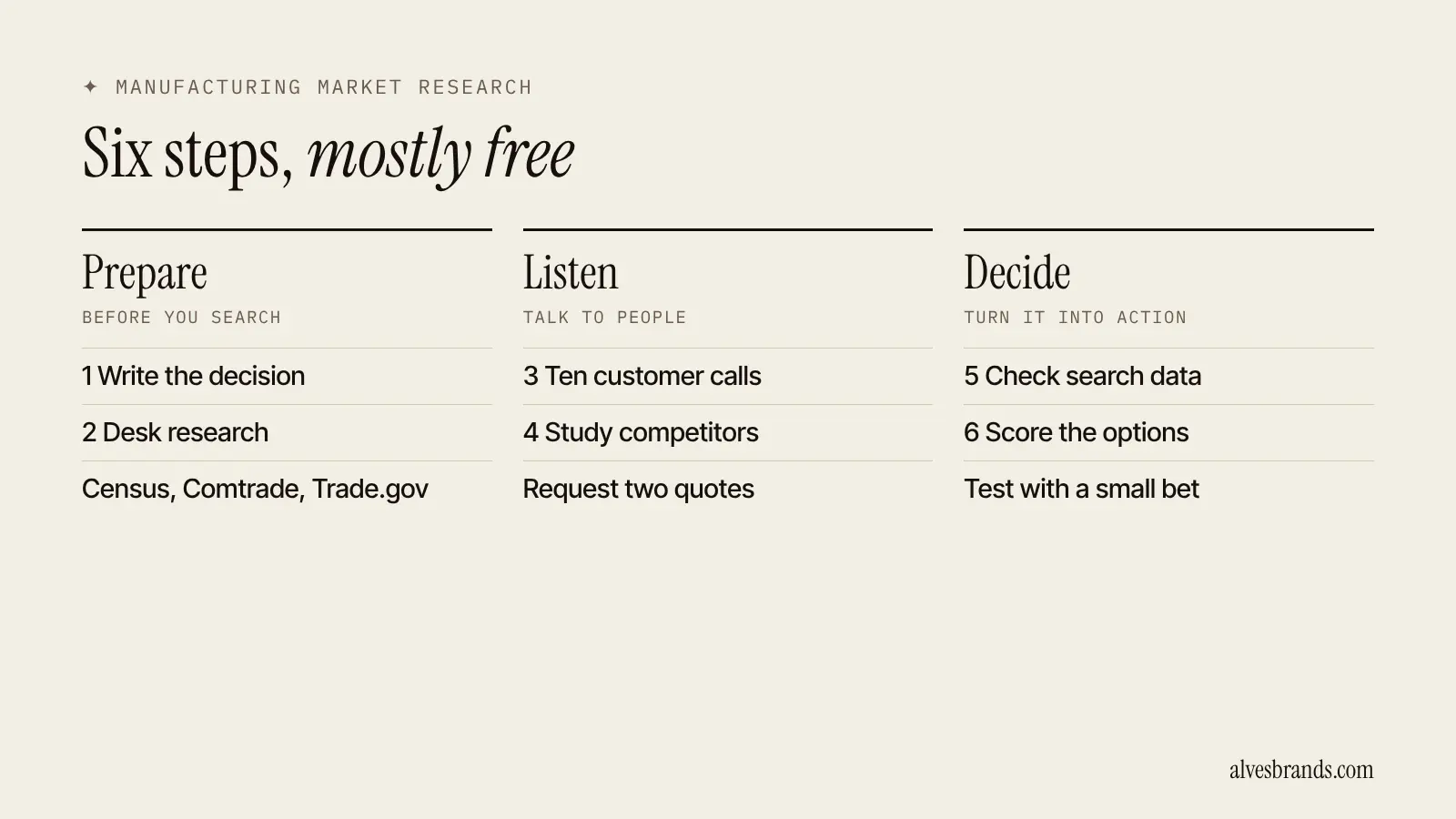
Most factories skip it. They add a product line or open a new country because one customer asked, then find out six months later that nobody else wants it. This guide gives you six steps that cost little or nothing, in the order I’d do them.
What manufacturing market research should answer
Pick one decision first. Research with no decision attached turns into a pile of charts nobody uses. The usual ones are:
- Should we sell in a new country?
- Should we launch this new product or grade?
- Are we priced too high or too low?
- Which customer type should we chase next?
The NIST Manufacturing Extension Partnership frames it the same way: check whether a segment is growing or shrinking, see which markets fit what your plant can do, then turn that into a plan. It also separates two kinds of customer research. Surveys give you numbers. Interviews and focus groups tell you why people act the way they do.
Where to look, and what it costs
| Question | Where to look | Cost |
|---|---|---|
| How big is this industry? | Census Bureau AIES (US), national statistics offices elsewhere | Free |
| Which countries buy this product? | UN Comtrade | Free |
| What do exporters need to know about a market? | Trade.gov Market Intelligence | Free |
| Is interest rising or falling? | Google Trends | Free |
| What do buyers type into Google? | Keyword tools and your own Search Console | Free to low |
| Why do customers pick us or someone else? | 10 customer calls | Your time |
| What do rivals offer and charge? | Their sites, catalogs and quotes | Your time |
| Need a survey of 300 buyers? | A research firm | Paid, quote first |
One warning. The Census Bureau’s old Annual Survey of Manufactures has been replaced by the Annual Integrated Economic Survey, so older guides that point to it send you to a closed program.
Step 1: Write the decision and the number that would change it
One sentence: “We’ll enter Spain if we can find 50 buyers who need our product and the price holds above X.” A number like that tells you when to stop researching.
Step 2: Do the desk research
Start with the free data in the table. For a trade question, look up your product’s HS code in UN Comtrade and see which countries import the most, who exports to them and how the volumes moved over the last five years. For a home-market question, look at your industry’s Census data for shipments and employment. Take notes in one sheet: source, number, date, link.
Treat this step as a filter, not an answer. Data like this tells you where to look next. It can’t tell you whether a specific buyer will pick you.
Step 3: Talk to ten customers
This is the cheapest and best part of any manufacturing market research project. Call ten buyers, five who bought from you and five who didn’t. Ask:
- How did you find your supplier last time?
- What nearly made you pick someone else?
- What would make you switch?
- What do you pay, and what would feel too high?
Ten calls will repeat themselves by the seventh or eighth, even in a small niche. When the answers start sounding the same, you’ve heard enough. If you don’t have contacts in the new market, ask your current customers to introduce you, or ask distributors.
Step 4: Study your competitors
Open the sites of your five closest competitors, then check:
- What they make, in which sizes, grades and tolerances.
- Which certificates they show.
- Whether prices, lead times or minimum orders are public.
- How they sound in the target country’s language.
Then request a quote from two of them, as a buyer would. Note how fast they reply and how clear the quote is. This takes an afternoon and teaches you more than a $5,000 report.
Step 5: Check what buyers search for
Open a keyword tool and look up how people describe your product: “316 stainless tube supplier”, “CNC machining Turkey”, “injection molding services”. Compare the volume and the words buyers use. Search the same terms yourself and see who ranks.
For export markets, search in the local language. Buyers in Spain don’t type English. My guide on how foreign buyers find suppliers shows how to read this and the multilingual website checklist covers what to fix if you’re missing.
A quick example
Say a 25-person CNC shop in Turkey wants to sell brackets to Spain. The owner writes the decision: “Enter Spain if 50 buyers need our parts and we can hold a price above our cost plus 18%.” In UN Comtrade he checks Spanish imports of machined parts and sees which countries ship them in. He looks up how Spanish buyers search, finds the terms are in Spanish and sees three local shops ranking. He then calls four existing customers who sell in Spain and asks two Spanish distributors what they pay. Two weeks later he has a clear answer: yes for one product family, no for the rest. That’s all manufacturing market research needs to be. (The shop is made up for this example. The method is real.)
Step 6: Score it and decide
Build a table with each option in a row and five columns: market size, growth, competition, fit with your plant, price you could hold. Score each from 1 to 5. Add the notes from your calls. Don’t chase a perfect score. Look for the option where fit and price are strong, since those two decide whether the work pays.
Then write down what you’d test next with the smallest possible bet: a landing page, a sample batch or 20 emails to distributors in that country. Research tells you where to place the bet. The bet tells you if you were right.
When to pay for manufacturing market research
Hire a firm when you need a statistically solid survey, say 300 buyers across three countries, or when a board or lender wants a third-party report. Ask for the sample size, how they find respondents and what you get at the end. A firm that can’t answer in plain words isn’t worth it.
If you’re a US manufacturer, call your local MEP center first. It’s built for small and midsize plants and costs less than a private firm.
Common mistakes
- Asking only friendly customers. They tell you what you want to hear. Call lost deals too.
- Reading only big-picture data. An industry growing 5% a year doesn’t mean your niche is.
- Never writing the decision down. Without it, you’ll keep researching forever.
- Stopping at a report. Research that doesn’t change what you do next was a hobby.
Once you’ve picked a market, the next job is getting found there. Start with the manufacturing marketing plan and read what is industrial marketing if the terms are new.
Frequently asked questions
What is manufacturing market research?
It’s the work of finding out how big a market is, who buys, who sells to them and at what price, so you can decide where to invest. For a factory it usually covers a product, an industry or a country.
How much does manufacturing market research cost?
The six steps above cost your time and nothing else. A professional survey or custom report usually costs thousands of dollars, so ask for a written quote and a sample before you sign.
What should I ask in customer interviews?
Ask about the last purchase, not the future. How did you find suppliers? Who else was involved? What nearly made you choose someone else? What would make you switch? People remember what happened better than they predict what they’ll do.
How long does it take?
A focused project takes two to four weeks: one week of desk research, one or two weeks of calls and competitor checks, then a few days to score and decide.
What is the best free source for manufacturing market research?
For trade, UN Comtrade and Trade.gov. For your home market, your national statistics office. For buyer behavior, nothing beats ten honest customer calls.
Do small manufacturers need market research?
Yes, and they gain the most, since one wrong product launch costs a small plant more. A short project with customer calls and a competitor check is enough.
Not sure which market to enter next? Ask me for a free website check. I’ll show you what buyers in your target country search for and where you stand against local suppliers.