Landed cost is the total price of getting a product to your door. It is what you pay the supplier plus freight, insurance, duties, taxes, clearance fees and delivery. It is the number you need before you set a selling price, because the supplier’s price alone is never the real cost.
This guide shows what goes into landed cost, the formula, a worked example with numbers and the costs people forget. You can run your own numbers in the free landed cost calculator. If you sell abroad instead of buying, read Incoterms 2020: who pays what.
What is landed cost?
Landed cost is the full cost of a shipment delivered to your warehouse, divided across the units you bought. Importers use it to find the true cost per unit, compare suppliers in different countries and check whether a product makes money after everything is paid.
Two suppliers can quote the same price and still cost you very different amounts, because freight, duty and fees change with the country, the shipping terms and the product.
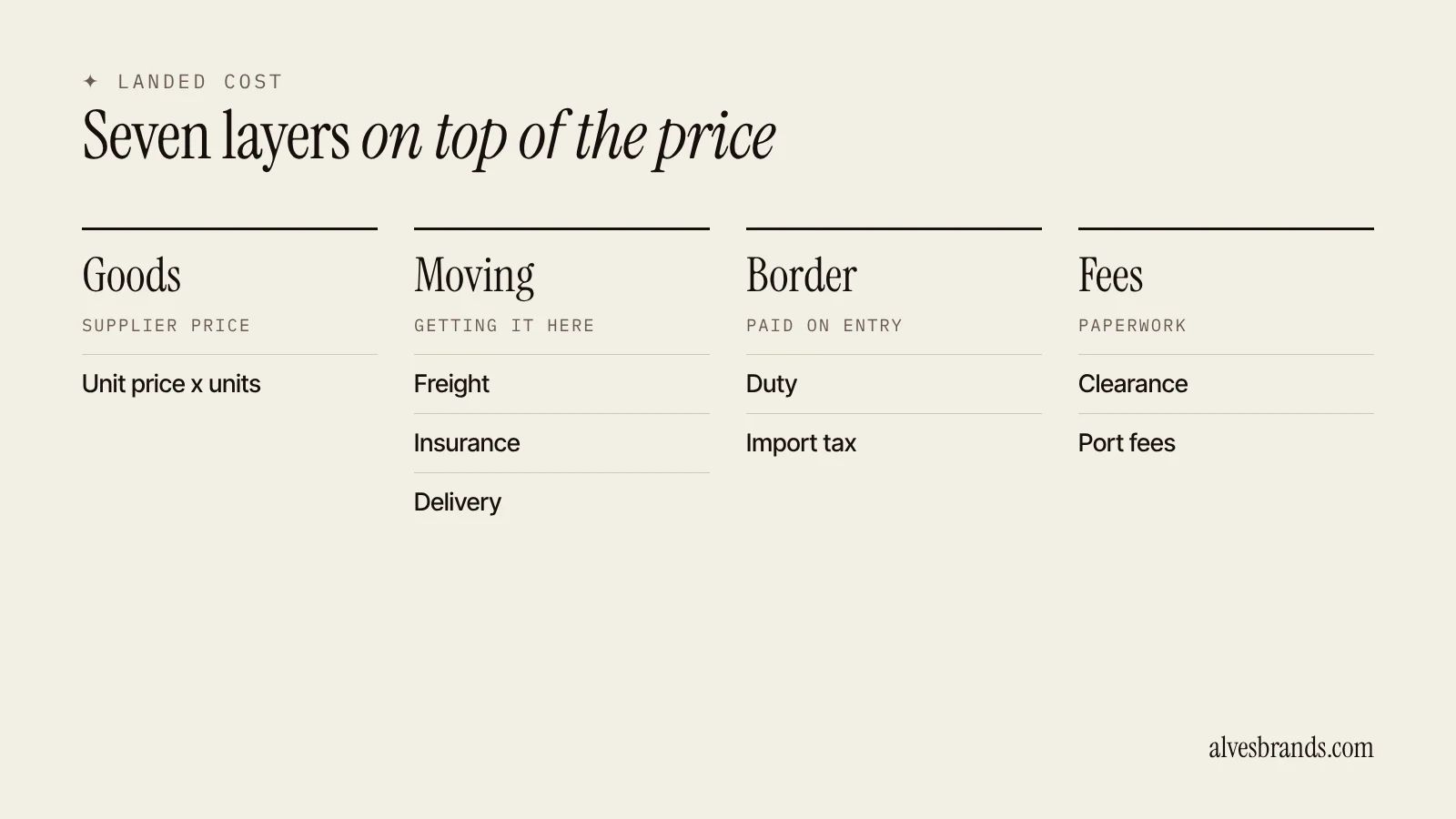
What goes into landed cost
- Goods. The price you pay the supplier, in your currency.
- International freight. Sea, air or road from the supplier to your port or door.
- Insurance. Cover for the goods in transit.
- Customs duty. A percentage of the customs value, set by the product’s code and the country.
- Import VAT or sales tax. Charged on import. If you are VAT registered you can often reclaim it, so it is not a cost for you. Check your own rules.
- Customs clearance and port fees. Broker fees, terminal handling and document fees.
- Delivery. From the port to your warehouse.
- Other. Inspection, testing, storage and currency conversion costs.
The landed cost formula
Landed cost = goods + freight + insurance + duty + import tax (if not reclaimable) + clearance and port fees + delivery.
To get the cost per unit, divide by the number of units.
Landed cost worked example
An importer buys 1,000 units at 4.50 each. Duty is 6.5% on goods, freight and insurance. Import VAT is 20% and the importer can reclaim it.
| Item | Amount |
|---|---|
| Goods (1,000 × 4.50) | 4,500.00 |
| Freight | 1,200.00 |
| Insurance | 40.00 |
| Duty (6.5% on 5,740) | 373.10 |
| Clearance and port fees | 250.00 |
| Delivery | 150.00 |
| Import VAT (reclaimed) | 0.00 |
| Landed cost | 6,513.10 |
| Per unit | 6.51 |
The landed cost is about 45% above the goods price. Check this with your own numbers in the landed cost calculator. The example is simplified. Real duty and VAT rules differ by country.
How duty is calculated
Duty is a percentage of the customs value of the goods. In the UK, the EU and many other countries the customs value includes freight and insurance up to the border. In the US it is usually the goods value. The rate depends on the product code, called the HS code. Look up your product in the customs tariff of your country, for example the UK Trade Tariff. If you are not sure of the code, ask your customs broker.
How Incoterms change landed cost
The shipping term in your contract decides who pays for freight, insurance and export clearance. Under EXW you pay almost everything from the supplier’s door. Under DDP the supplier pays up to your door, including duty. The same product costs you different amounts under different terms, so compare suppliers on the same term. The UK government explains how Incoterms affect customs valuation. Use my Incoterms tool to see who pays what.
Costs that raise landed cost after arrival
- Storage and demurrage if goods wait at the port.
- Inspection or testing by customs.
- Extra duty if the product code is wrong.
- Currency changes between the quote and the payment.
- Damage or loss that insurance does not cover.
- Return shipping for rejected goods.
How to lower landed cost
- Fill the container. Freight per unit falls when you ship full loads. Use the CBM calculator to see how much space you need.
- Compare suppliers on the same term. Ask for FOB or DAP quotes from all of them.
- Check the product code. The right code can mean a lower duty rate.
- Ship by sea when you can. Air is faster and costs more per kilo.
- Pack smart. Better carton and pallet sizes cut freight. Try the pallet calculator.
- Use a broker for the first shipments. They catch errors that cost more later.
- Plan stock. Fewer rush orders means less air freight.
Landed cost mistakes
- Using the supplier price as your cost.
- Forgetting port fees, delivery and clearance.
- Guessing the duty rate.
- Including VAT you can reclaim.
- Comparing quotes on different Incoterms.
- Not updating the calculation when freight rates change.
Landed cost for exporters and manufacturers
If you sell, your buyer is doing this calculation on your product. A buyer who finds your price on a clear page, with the shipping term and lead time, can work out their landed cost and decide faster. State your Incoterm, minimum order, lead time and packing details on your product pages. That is also what helps buyers and AI assistants find you. See my SEO for exporters page.
Landed cost by transport mode
Freight is often the biggest part of the extra cost, and it changes with the mode.
| Mode | Speed | Cost per kilo | Good for |
|---|---|---|---|
| Sea, full container | Slowest | Lowest | Large, heavy or bulky orders |
| Sea, shared container | Slow | Low to medium | Smaller orders that do not fill a container |
| Air | Fastest | Highest | Light, urgent or high-value goods |
| Road or rail | Medium | Medium | Neighboring countries and regions |
The cheapest mode is not always the cheapest landed cost. Slow shipping means more stock sitting in transit and a longer wait for your money. Count that too.
How to use landed cost to set your price
Landed cost is your floor. In the example above, one unit lands at 6.51. Add your other costs, such as storage, marketing, payment fees and returns, then add your margin. If the market price is below that total, the product does not work, and it is better to learn that before you order.
Run it the other way as well. Take the price you can sell at, subtract your margin and other costs, and see what landed cost you can afford. Then check whether any supplier gets you there.
Landed cost checklist before you order
- Get quotes on the same Incoterm from every supplier.
- Confirm the product code and the duty rate with a broker or the customs tariff.
- Ask for the carton size and weight, so you can check the freight.
- Add clearance, port fees and delivery from your own broker, not a guess.
- Decide whether you can reclaim import VAT.
- Leave a small buffer for currency moves.
- Save the final numbers, then compare them with the real invoices after the shipment arrives.
Frequently asked questions
What is landed cost?
It is the total cost of a product delivered to your door: supplier price, freight, insurance, duties, taxes, clearance fees and delivery.
How do I calculate landed cost?
Add goods, freight, insurance, duty, import tax if not reclaimable, clearance and port fees and delivery. Divide by the number of units for the cost per unit.
Is VAT part of landed cost?
Only if you cannot reclaim it. If you can reclaim import VAT, leave it out.
What is the difference between landed cost and FOB?
FOB is a shipping term and a price that stops when the goods are on board at the port of loading. Landed cost is everything you pay to get the goods to your door.
How do I find the duty rate?
Look up the product’s HS code in your country’s customs tariff, or ask a customs broker.
Why is my landed cost higher than expected?
Usual causes are missed port fees, a higher duty rate than assumed, a wrong product code, storage charges and currency moves.
Is there a free landed cost calculator?
Yes. Use the free landed cost calculator. It runs in your browser and stores nothing.
Want buyers to find your products? Ask me for a free website check. I’ll show how your pages look to buyers and to AI assistants.