What is industrial marketing? It’s how a company that makes or supplies industrial products gets found and chosen by other businesses. The buyer is a plant, a contractor, a distributor or a procurement team, not a person shopping for themselves.
If you sell, install or service equipment instead of making it, read marketing for industrial companies.
That changes how you market. The order is bigger, the decision takes months and a group of people has to agree. This guide explains what industrial marketing is, how it differs from consumer marketing, how buyers really buy and how to start.
What is industrial marketing in simple words?
Industrial marketing is marketing aimed at organizations that buy goods and services to run their business: raw materials, components, machines, tools, spare parts and services. You’ll also hear it called B2B marketing or business marketing. “Industrial” usually means the buyer works in manufacturing, construction, energy or another heavy sector.
A few examples:
- A steel mill selling coil to an auto parts maker.
- A CNC shop quoting brackets for an aerospace supplier.
- A resin producer selling to plastic molders.
None of them needs a billboard. Each one needs the right engineer or buyer to find them, trust them and ask for a quote.
Industrial marketing vs consumer marketing
The basics are the same: know your buyer, say something useful, make it easy to act. The weight is different.
| Industrial marketing | Consumer marketing | |
|---|---|---|
| Buyer | A company with a budget and rules | A person or a household |
| Who decides | A group: engineer, buyer, quality, finance | One person, maybe two |
| Sales cycle | Weeks to months | Minutes to days |
| Order size | Large, often repeated | Small, one at a time |
| What persuades | Specs, certificates, proof, total cost | Brand, emotion, convenience |
| Where they look | Google, AI answers, directories, LinkedIn, trade shows | Social media, ads, shops, reviews |
| Relationship | Long. A good supplier stays for years | Short, often one purchase |
In consumer marketing a good ad can sell the product. In industrial marketing a good ad gets you a glance. The data sheet gets you the order.
How industrial buyers actually buy
Three facts shape everything you do.
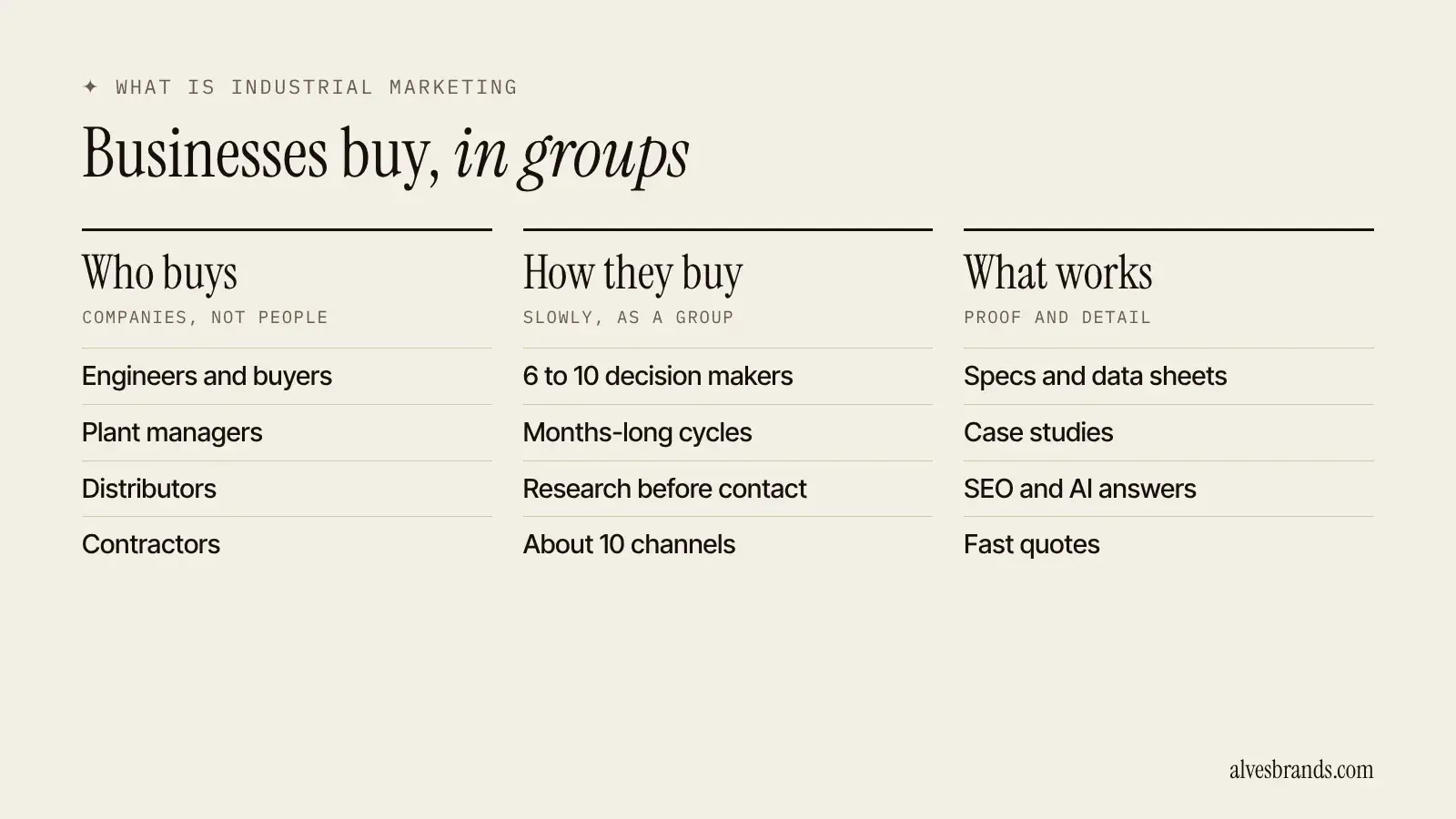
A group decides. According to Gartner research on the B2B buying journey, a typical buying group for a complex B2B purchase has 6 to 10 decision makers. In a plant that means a design engineer, a process engineer, quality, procurement and someone from finance. Each one worries about something different, so one message to one person won’t close the deal.
They research before they call you. A 2026 Gartner survey of 646 B2B buyers found that 67% prefer a buying experience without a sales rep. The 6sense 2024 Buyer Experience Report found buyers are nearly 70% through the process before they contact a seller. Your website is your first salesperson, and it works at 2 a.m.
They use many channels. McKinsey’s 2024 B2B Pulse survey found that buyers use about 10 channels on average, up from about 5 in 2016. Google, supplier sites, directories, videos, email, LinkedIn and AI assistants all play a part. You don’t need every channel. You need the ones your buyers use.
Who is the buyer, by the way? Thomas’s 2025 sourcing report, as summarized by Distribution Strategy Group, says two-thirds of active buyers on Thomasnet are small and midsize businesses. It also says younger buyers often start online and compare suppliers before they talk to a rep. For what’s changing this year, read my industrial marketing trends guide.
A buyer’s journey, step by step
Say an engineer needs a new supplier for stainless brackets. Here’s what usually happens.
- She searches Google, or asks an AI assistant, for suppliers and compares the first few names.
- She opens three websites and looks for specs, tolerances, materials, certificates and photos of real work.
- She asks a colleague in purchasing, who checks price, lead time and whether you export.
- They send two or three quote requests. The first supplier to reply with clear answers often gets the first real conversation.
Notice how little of this involves you. Your marketing works in steps one to three, before anyone speaks to you. That’s why industrial marketing is mostly about being easy to find, easy to check and easy to contact.
The main parts of industrial marketing
You don’t need all of these on day one. Know what each one does.
- Your website. Product pages with specs, drawings, certificates and a quote button. If this is weak, nothing else works.
- SEO. Be on page one when an engineer searches “316 stainless tube supplier”. My digital marketing guide shows how to set it up.
- AI search. Buyers now ask ChatGPT and Gemini for supplier ideas. Here’s how to get recommended by ChatGPT.
- Technical content. Guides, calculators and case studies written by your engineers.
- Directories. Listings on sites like Thomasnet put you in front of people already sourcing.
- Email and LinkedIn. They keep you in view during a long decision. See email marketing for manufacturers.
- Account-based marketing. For a short list of big targets, ABM reaches the whole buying group.
For real companies doing this well, read my industrial marketing examples.
What industrial marketing is not
It’s not a logo refresh. It’s not ads for the general public. It’s not a brochure that sits on a shelf. And it’s not the same as sales.
Marketing gets the buyer to the table informed and ready to talk. Sales closes the order. When the two don’t talk to each other, leads go cold. If you remember one thing, make it this: industrial marketing earns trust before the first call, and sales turns that trust into an order.
Common mistakes
- Talking about yourself. “Leading supplier since 1985” says nothing a buyer can use. Say what you make, to which tolerance, in what volume.
- Hiding the details. If specs live in a PDF nobody can find, the buyer leaves.
- No next step. Every page needs one clear action, usually a quote request.
- Slow replies. A buyer who waits a week has already talked to your competitor.
- Counting the wrong things. Traffic is nice. Quote requests pay the bills.
Industrial marketing for exporters
If you sell abroad, add one more layer. A buyer in Spain or Turkey searches in Spanish or Turkish, often on a local version of Google. If your site only speaks English, you’re invisible to them.
Start with how foreign buyers find suppliers online, then use the multilingual website checklist. If you want help, that’s what my international SEO service covers.
How to start in 30 days
- Talk to five customers. Ask how they found you and what almost made them pick someone else.
- Fix your top five product pages. Add specs, photos, a certificate list and a clear next step.
- Add a quote button and a reply rule. Answer every request within one working day.
- Set up tracking. Add Google Search Console and Google Analytics so you can see what buyers search and where leads come from.
- Publish one useful guide. Pick the question customers ask most and answer it well.
Then count what matters: quote requests, where they came from and how many turned into orders. Skip likes and followers. For the full plan, see my manufacturing marketing plan.
Related reading: industrial SEO explains how engineers and buyers find suppliers on Google and in AI answers.
Frequently asked questions
What is industrial marketing in simple words?
It’s marketing from one business to another. A factory, supplier or contractor gets found and trusted by the companies that buy its products, so they ask for a quote.
Is industrial marketing the same as B2B marketing?
Almost. B2B marketing covers every business-to-business sale, including software and consulting. Industrial marketing is the part aimed at manufacturers, plants, builders and the suppliers who serve them. For the factory side in depth, read B2B manufacturing marketing.
What are examples of industrial marketing?
A product catalog with full specs, a video of a machine running, a case study with real numbers, a listing in an industry directory, a newsletter to past customers and a technical guide on your website.
How much should an industrial company spend on marketing?
Gartner’s 2026 CMO Spend Survey found marketing budgets average 7.8% of revenue. Small manufacturers often spend less. Start with the website, SEO and tracking, then add more once you know what a lead is worth.
Does industrial marketing work for small manufacturers?
Yes, and small shops often gain the most. A buyer can’t tell a 20-person factory from a 2,000-person one until they open the website. Clear product pages, honest specs and fast replies make a small supplier look as solid as a big one.
Want more quote requests from your website? Ask me for a free website check. I’ll show you how buyers find you on Google and in AI answers, and what to fix first.