Marketing for industrial companies is the work of getting plant managers, engineers, contractors and buyers to call you first when they need a part, a repair, a crew or a supplier. Most guides on this topic talk to factories. This one talks to everyone else in the industrial world: distributors, MRO suppliers, contractors, installers, repair shops and service firms.
You sell differently from a factory. You often carry other people’s brands, your buyer has ten names on a list and your edge is speed, stock, know-how and trust. So the marketing has to show those four things, fast, to someone who’s in a hurry because a line is down or a bid is due.
If you run the factory itself, read my guide on manufacturing company marketing. If you sell, install or fix what factories use, keep going.
Who counts as an industrial company here
Different firms, same buyers. This guide covers:
- Industrial distributors and MRO suppliers: bearings, fasteners, pumps, tools, safety gear, electrical parts.
- Contractors and installers: mechanical, electrical, piping, millwrights, rigging, industrial construction.
- Service and repair firms: field service, equipment repair, calibration, maintenance contracts, testing.
- Fabricators and shops that serve local plants: welding, machining, coating, cutting.
- Industrial equipment dealers: forklifts, compressors, cranes, machine tools.
They sell to plants, utilities, mines, warehouses, builders and other firms. Their customers are people with a job to finish, not people who browse.
How industrial buyers pick a supplier
Three buying moments cover most of the work you’ll win.
The emergency. A pump failed, a conveyor stopped, a certificate expired. The buyer searches, calls the first two that look real and picks whoever picks up. Here you win on visibility, a phone number and a fast reply.
The planned job. A shutdown, an expansion, a maintenance contract. There’s a spec, several bidders and weeks of review. You win on proof, references and a clean bid.
The supplier switch. A buyer is tired of late deliveries or high prices and quietly looks for a replacement. You win by already being known when the frustration peaks.
Research backs the pattern of early online research. A 6sense report found that buyers are nearly 70% through the process before they contact a seller, and Gartner found that 67% prefer a buying experience without a sales rep. Thomas’s 2025 sourcing report, as summarized by Distribution Strategy Group, also says younger buyers often start online and compare suppliers before they talk to a rep. If your company isn’t findable and clear online, you’re cut from the list before the first call.
Where marketing for industrial companies differs from factory marketing
| Factory | Distributor, contractor or service firm |
|---|---|
| Sells its own product | Sells availability, skill and service |
| One product, many buyers | Many products or services, often local buyers |
| Long design-in cycle | Mix of urgent orders and planned jobs |
| Proof: specs and certificates | Proof: uptime, response time, jobs finished, safety record |
| Reach: national or export | Reach: often a region, sometimes national for catalog sellers |
Two things follow. First, your location and service area matter, so local search and your Google Business Profile carry more weight. Second, your people are the product. Photos of your techs, their licenses and their years on the job do more than a stock picture of a gear.
Step 1: Say what you do in one line
Most industrial company websites open with “Your trusted partner for all industrial needs.” That says nothing. Replace it with a line a plant manager can repeat to a boss:
- “24/7 hydraulic pump repair for Ohio plants, back in 48 hours.”
- “Stocked bearings and power transmission parts, same-day shipping before 3 p.m.”
- “Industrial electricians for shutdowns, upgrades and emergency calls.”
Pair it with a clear action: call, request a quote, upload a parts list. Put the phone number at the top, on every page, as a tap-to-call link on mobile.
Step 2: Build pages around what people search
Buyers don’t search for your company. They search for the job. Write a page for each service, product family, industry and location you want work from:
- “Hydraulic pump repair in Cleveland”
- “Industrial electrician for food plants”
- “Roller chain and sprocket supplier”
- “Millwright services for paper mills”
Each page should name the problem, explain how you solve it, list brands or equipment you handle, show a real photo, give response times and end with a quote form. If you serve several cities, give each one its own page with real details, such as local plants served and a local phone line, not copied text with the city name swapped.
Use plain language. Plant managers read like they work: fast, skeptical, hunting for the one fact they need.
Step 3: Make the Google Business Profile do real work
If you serve a region, your Google Business Profile is a main lead source. Check these:
- Your category matches your main service, plus a few secondary ones.
- Your service area lists the cities and counties you cover.
- Hours include after-hours and emergency lines, if you offer them.
- You have 20 or more photos of your trucks, shop, team and finished work.
- You ask every happy customer for a review, and reply to each one.
- You post updates now and then: a new line, a finished job, a holiday schedule.
Industrial firms often ignore this and lose emergency calls to a competitor with a better profile. It’s free and takes an afternoon.
Step 4: Show proof that fits your kind of company
Different companies need different proof. Pick what your buyer checks first.
| Company type | Proof to show |
|---|---|
| Distributor | In-stock count, brands carried, ship-by time, catalog or portal, returns policy |
| Contractor | Licenses, insurance, safety record (EMR), project photos, references |
| Service firm | Response time, certified techs, uptime numbers, maintenance plans |
| Fabricator | Equipment list, certifications, sample parts, turnaround |
| Equipment dealer | Brands, service department, parts stock, rental and financing options |
Add short case stories. “A packaging plant lost its main conveyor on a Friday. We had a tech on site by 6 a.m. Saturday and the line ran by noon.” Add the numbers you can back up and leave out the ones you can’t. If a customer won’t let you name them, use the type of plant and the region instead.
Step 5: Pick channels that fit a smaller team
Most industrial firms don’t have a marketing department. Choose a few channels and do them well.
| Channel | Best for | Notes |
|---|---|---|
| Google search and local search | Everyone | Highest intent; buyers search the job |
| Google Business Profile | Anyone with a region | Free; reviews drive calls |
| Email to your customer list | Distributors, service firms | Cheap; keep it useful, not salesy |
| Contractors, service firms, dealers | Good for reaching plant and facility managers | |
| Paid search | Emergency services, catalog sellers | Fast; watch cost per lead |
| Trade shows and local events | Dealers, contractors | Pick one or two that your buyers attend |
| Print and direct mail | Local plants | Still works for a short list of known accounts |
The Content Marketing Institute’s manufacturing research found that 68% of manufacturing marketers said search and pay-per-click gave them the best paid results, and that 85% said LinkedIn gives them the most value. Those numbers describe manufacturers, but the buyers are the same people who read your pages.
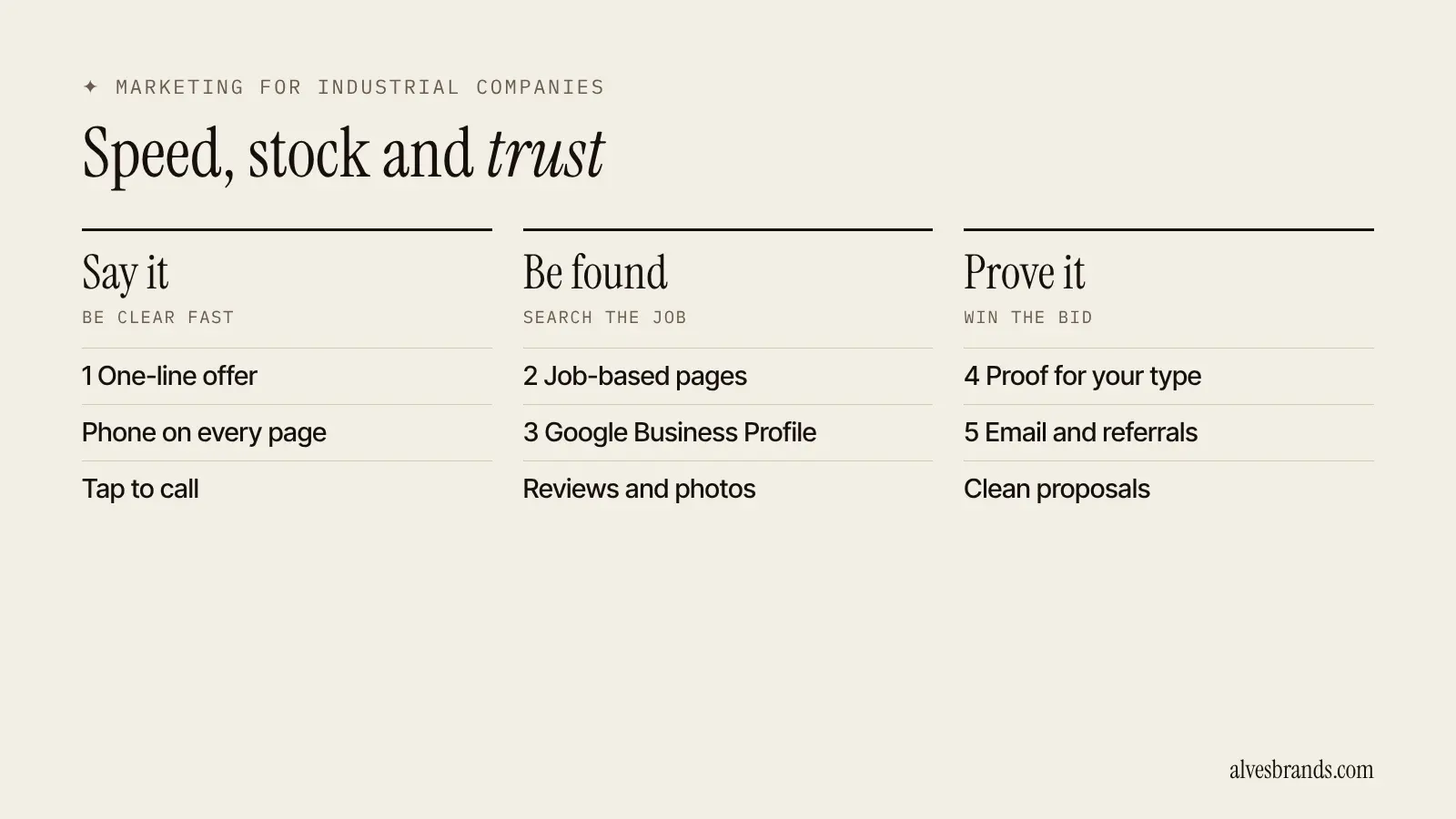
What each type of company should do first
The five moves above fit everyone, but the first thing to fix differs.
Distributors and MRO suppliers
Your product data is your marketing. A buyer searching “6205-2RS bearing” wants a page with the part number, dimensions, brand, price or a quote button and stock status. Thin pages with a name and a photo lose to the manufacturer’s site and to big catalog sellers.
- Give every product or family its own page with specs, a spec sheet download and a clear stock note.
- Group pages by use (“conveyor components,” “pumps for chemical plants”) as well as by brand.
- Add a fast way to send a parts list: upload, paste or email.
- Show delivery cut-off times and your service area.
You won’t beat the giants on every part. Win on the narrow slice where you have deep stock and real advice, like fasteners for a certain industry or a regional brand rep.
Contractors and installers
Plants hire contractors they trust with safety and schedule. Put those two things first.
- Show your safety record, training and certifications on a dedicated page.
- Post project photos with scope, duration and headcount.
- List the plants and industries you’ve served, as far as clients allow.
- Add a page for shutdown and turnaround work, since buyers plan those months ahead.
- Recruit in public. A “Careers” page with real stories also tells buyers you’re stable.
Service and repair firms
Your product is uptime. Sell it that way.
- Publish response times you actually hit.
- Offer maintenance plans on a page of their own, with what’s included.
- Write short guides on common failures in the equipment you service. Buyers search “why does my [machine] overheat” before they call anyone.
- Keep an emergency number that a human answers.
Equipment dealers
You compete with the manufacturer’s site and other dealers. Your edge is local service, parts and training. Make your service department as visible as your showroom, list brands and models you support and show used or rental stock if you have it.
Referrals and partners: the second engine
Word of mouth still drives much industrial work, so build it on purpose instead of waiting.
- Ask for referrals after a good job, while the customer’s happy. Give them a one-line description to forward.
- Partner with non-competing firms. An electrician and a millwright, a distributor and a repair shop. Swap leads and put each other on your sites.
- Join one local group your buyers attend, like a manufacturers’ association or a safety council, and show up.
- Thank people in writing. A short note after a referral costs nothing and gets you the next one.
Track referrals the same way as web leads, so you know how much work they bring.
Email: the cheapest win for distributors and service firms
You already have a list: past customers, quote requests, people who bought once. Use it. Send a short email every two to four weeks with one useful thing:
- A new line you stock, with a link to specs.
- A seasonal tip, like pre-shutdown checks in spring.
- A reminder that you handle emergency calls.
- A short story about a fix and what it saved.
Keep it plain text or close to it, under 150 words, one link. My guide on email marketing for manufacturers has subject lines and a simple cadence you can copy.
Win bids with a better proposal
Contractors and service firms win or lose on the proposal. Small changes help:
- Lead with their problem, not your history.
- Put the price and scope on page one, then the details.
- Attach two references with a name, a company and a phone number.
- State your safety record and certificates up front.
- Name the people who’ll do the work and show photos.
- Follow up within three days, and ask what’s holding up the decision.
A good proposal is marketing. It’s the last page the buyer reads before saying yes.
Track what matters
Pick four numbers and look at them monthly:
- Calls and form fills from the website.
- Quote requests by source (search, profile, email, referral).
- Quotes sent and won, with the reason for each loss.
- Average job value from marketing leads.
You don’t need fancy software. A shared spreadsheet and call tracking will do. If your site is slow to show up for the searches you care about, an SEO audit is the fastest way to find the fix list. The industrial marketing strategy guide and the manufacturing marketing plan both help you turn these numbers into a yearly plan.
A 90-day plan for marketing for industrial companies
Month 1: fix the basics.
- Write your one-line offer and put it on the homepage.
- Add tap-to-call and a quote form on every page.
- Clean up your Google Business Profile.
- Ask your ten best customers for a review.
Month 2: build job-based pages.
- Write four pages for your most profitable services or product families.
- Add photos of your team, trucks and shop.
- Publish two short case stories.
- Set up call tracking and a simple lead sheet.
Month 3: get in front of buyers.
- Send your first customer email.
- Post on LinkedIn twice a week, with job photos.
- Contact 20 plants or accounts you’d like to win, with a useful note, not a pitch.
- Review leads by source and shift your time to what works.
What good looks like in practice
Picture two repair shops in the same city. Shop A has a homepage that says “quality service since 1985,” a contact form and a phone number in the footer. Shop B has a page for each machine type it fixes, a response time on every page, photos of its own techs, forty reviews and a number at the top that connects to a person after hours.
A plant manager with a failed pump at 4 p.m. calls Shop B. Nothing about Shop B is fancy. It just removes doubt at every step: can they fix it, how fast, who are they, and how do I reach them. That’s what marketing for industrial companies comes down to. Take away the buyer’s doubts, one by one, in the order they ask.
You can run this check on your own site in 15 minutes, with no tools. Search the main job you want work for, from a phone, and open your own page. Time how long it takes to find the phone number, the service area and one proof point. If it takes more than ten seconds, you’ve found your first fix.
Start with your best customers
Your next best customer looks a lot like your last five. Pull their names and write down what they bought, how they found you, what they asked for first and why they stayed. Call two of them and ask why they picked you over the other names on their list. Whatever they say goes on your homepage, in their words. It’s the cheapest market research you’ll ever do, and it tells you which of the five moves to make first. Do it before you spend a cent on ads, a new logo or a redesign.
Common mistakes
- Copying factory marketing. Catalog language and product specs don’t fit a service company.
- No phone number above the fold. In emergency work, that’s the whole game.
- Stock photos of generic workers. Buyers want to see your people.
- Ignoring reviews. A 3.8 rating with no replies loses to a 4.8 with 40 reviews.
- Waiting for referrals. They’re good, and they’re not growth you control.
- Slow replies. A quote request that sits for two days goes to someone else.
For more ideas, look through these industrial marketing examples and see what’s changing in industrial marketing trends.
Related reading: industrial SEO shows how distributors and suppliers get found for products, parts and services.
Contractors and engineering firms can also read digital marketing for construction companies and marketing for engineering firms.
Frequently asked questions
What is marketing for industrial companies?
It’s the set of actions that get plants, builders and facility managers to choose you for parts, repairs, installs or supplies. For distributors and service firms it focuses on speed, proof and being easy to find.
What’s the best marketing for an industrial distributor?
Search-friendly product and brand pages, a clear stock and shipping promise, an email list of past buyers and a Google Business Profile for your region. Add LinkedIn and trade events if your buyers use them.
How do contractors get industrial customers?
Through local search, a strong Google Business Profile, references, a clear safety record, LinkedIn and direct contact with plant and facility managers. A clean proposal wins most bids.
How much should an industrial company spend on marketing?
There’s no fixed rule. Start with the free basics, then add a small paid budget once you can track which source brings quotes. Review it every quarter.
Does SEO work for industrial companies?
Yes. Buyers search for specific jobs, and few industrial firms have pages built for those searches. Expect 4 to 9 months to see steady results.
What should I put on an industrial company website?
Your one-line offer, a phone number on every page, pages for each service or product family, proof such as photos, licenses and references, and a quote form. Add your service area and response times near the top.
Should I use LinkedIn or Facebook?
LinkedIn, in most cases. Plant managers, engineers and facility leads use it for work. Facebook helps a little for hiring and local reputation, but it rarely brings quote requests.
How do I get more emergency calls?
Rank for urgent searches like “24/7 pump repair near me,” keep your Google Business Profile complete, show an emergency number everywhere and answer it. Reviews that mention speed help a lot.
How is it different from marketing a factory?
You sell availability, skill and service instead of your own product, so proof, response time and location matter more, and your people are part of the offer.
Not sure how buyers in your area find you? Ask me for a free website check. I’ll show you which job searches you’re missing and what to fix first.