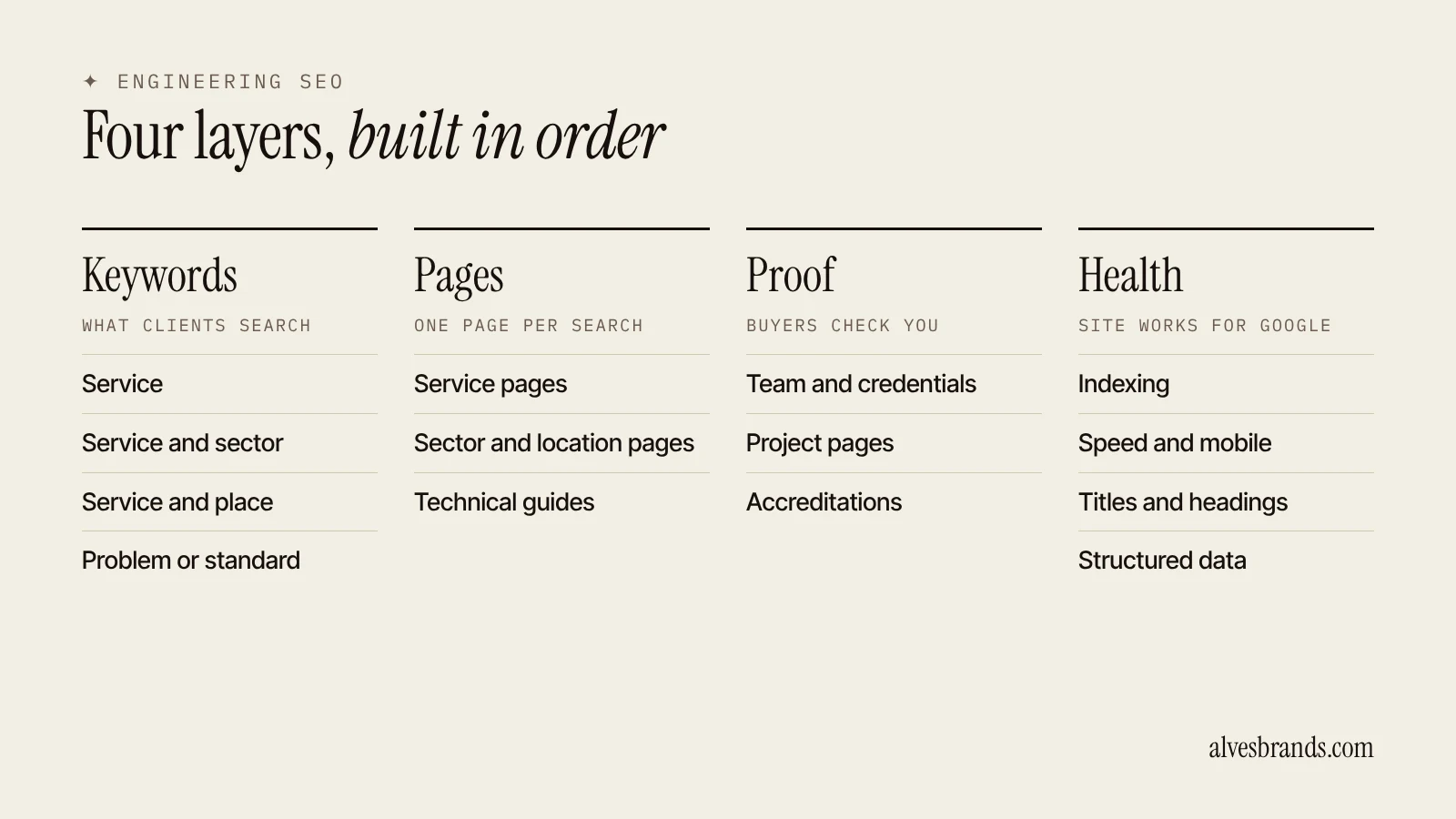
Engineering SEO is the work of making your firm easy to find when a client searches for what you do. It covers the words you target, the pages you build, the proof you show and the technical health of your site.
Volumes are small in engineering, and that’s fine. A search for "structural engineers Leeds" has few searches a month, but one enquiry can be worth tens of thousands of pounds. This guide shows what to do, in order. For the wider picture read industrial SEO and my SEO for manufacturers guide, and for the full marketing mix see marketing for engineering firms.
What engineering SEO is, and what it isn’t
SEO means search engine optimisation: improving your pages so Google shows them to the people who need them. Engineering SEO is the same craft, aimed at engineering firms, with technical buyers and long decisions in mind.
It isn’t a trick to get traffic. Visits from people who will never hire you are worth nothing. The goal is enquiries from the clients, sectors and places you want.
Why engineering SEO is different
- Low volume, high value. Few people search, but each search can lead to a large contract.
- Technical searches. Buyers search for a standard, a process or a problem, not only for a firm.
- Many people decide. Gartner says a buying group for a complex purchase has 6 to 10 decision makers, so you need pages for each of them.
- Research before contact. 6sense found buyers are nearly 70% through the process before they contact a seller. Search is where that research starts.
- Proof matters more than slogans. A Thomas survey of 266 industrial buyers found 73% focus on the company website when judging a supplier.
Step 1: Choose the keywords
Start with what you sell, then add the sector and the place. Build a list in four groups.
| Group | Example | What the buyer wants |
|---|---|---|
| Service | structural engineering design | A firm that does this work |
| Service and sector | mechanical engineering for data centres | A firm that knows their sector |
| Service and place | civil engineers in Birmingham | A firm nearby |
| Problem or standard | how to size a pressure relief valve | An answer, then maybe a firm |
Check each term in Google Search Console and in a keyword tool for rough volume. Then search the term yourself and read the first page of results. If the results are service pages, build a service page. If they are guides, write a guide. Don’t build a page the results show Google doesn’t want.
Good places to find keyword ideas:
- Your own enquiries. Read the last 20 emails and calls. Clients use their own words, and those words are your keywords.
- Google Search Console. It shows the searches that already bring impressions to your site.
- The search results. The "People also ask" box and the related searches at the bottom of the page show what buyers ask next.
- Competitor pages. Look at the headings on the pages that rank, and note what they cover and what they miss.
Step 2: Give each keyword one page
One page per search goal. If two keywords bring up the same results, one page can serve both. If the results differ, make two pages. Two pages that chase the same search compete with each other.
| Page type | Example target | Goal |
|---|---|---|
| Service page | structural engineering design | Enquiries |
| Sector page | engineering for the water sector | Enquiries |
| Location page | engineering consultants in Leeds | Enquiries |
| Guide | how to choose a structural engineer | Trust and links |
| Project page | hospital refurbishment, 12,000 m² | Proof |
| Technical note (PDF or page) | beam deflection limits explained | Trust and visits |
Here is a made-up page plan for a small structural engineering firm in Leeds, to show how it fits together.
| Page | Target search | Links to |
|---|---|---|
| Structural engineering design | structural engineering design | Project pages, team page |
| Structural engineers in Leeds | structural engineers Leeds | Service page, contact |
| Engineering for the education sector | structural engineering for schools | Two school projects |
| Guide: what a structural survey includes | structural survey what is included | Service page |
Four pages, four searches, each with one job.
Step 3: Build service pages that rank
Service pages do the heavy lifting. A good one has:
- A clear title with the service and, if it fits, the place: "Structural Engineering Design in Leeds".
- A first paragraph that says what you do, for whom and where.
- The method: steps, deliverables, software and standards.
- Who does the work, with names and qualifications.
- Two or three project examples that link to project pages.
- A short list of questions buyers ask, with plain answers.
- One clear next step: a short form, a phone number or both.
Write for a project manager first and an engineer second. Short sentences. No filler.
Titles and descriptions. The title is the blue link in search, so make it plain: service, place and firm name, about 60 characters. "Structural Engineering Design in Leeds | Firm Name" works. The description is the short text under it. Say what the page offers and end with a reason to click, such as "Get a quote within two working days" if that is true.
Step 4: Add sector and location pages
A sector page answers: "Do you understand my world?" Use the sector’s words, name typical regulations and show two or three relevant projects.
Location pages help if you serve a region. Don’t create dozens of thin pages that swap one town name. Build a page only where you have projects, people or an office, and give each one real local detail.
Step 5: Publish technical content
Technical guides bring in engineers and specifiers who have never heard of you. Pick questions that come up in your calls:
- How to choose between two design approaches.
- What a standard requires, in plain words.
- What a typical project costs and how long it takes.
- Common mistakes on site and how to avoid them.
Google says it ranks helpful, people-first content. A guide written by a named engineer who has done the work is the best kind.
PDFs count too. Google lists PDF among the file types it can index, so a data sheet or a technical note can show up in search. Give each PDF a clear file name, a title and a link from a normal page.
Step 6: Show proof of experience
Google’s guidance asks for content that shows real experience. For engineering firms, that means:
- Team pages with names, photos, chartered status and years of work.
- Project pages with scope, role, method and results.
- Accreditations and memberships in plain text, not only as logos.
- Client quotes, with permission.
- The same firm name, address and phone number everywhere.
Never invent a project, a number or a review. A short, true case study beats a long, vague one.
Step 7: Fix the technical basics
Technical SEO means the site works for people and search engines. Check these:
- Indexing. Every key page should be reachable from the menu or from another page, and not blocked by robots rules. Search Console shows what Google has found.
- Speed. Google’s Core Web Vitals cover loading, interaction and layout shifts. Compress images and avoid heavy scripts. My website design for manufacturers guide lists what a fast, clear page needs.
- Mobile. Google uses the mobile version of your site for indexing, as explained in its mobile-first indexing guide. The mobile page needs the same content as the desktop page.
- Titles and descriptions. One clear title and one short description per page.
- Headings. One H1 per page, then H2 and H3 in order.
- Structured data. Mark up your firm and your articles. Google’s intro to structured data explains how.
- Sitemap and clean URLs. Submit a sitemap in Search Console. Use short, readable URLs.
- Images. Add a short, true description to each image.
Step 8: Earn links and mentions
Links from other sites are a sign of trust. Ask for links where they make sense:
- Your professional body or accreditation scheme.
- Clients and partners you’ve worked with.
- Suppliers whose products you specify.
- Universities where you give talks.
- Trade magazines that publish your articles.
Don’t buy links. Google’s spam policies call this out, and it can get your pages removed from search.
Local engineering SEO
If you serve a region or have an office, set up a Google Business Profile. Google says local results are based on relevance, distance and prominence. Choose the right category, add your services and photos, and ask real clients for reviews.
International engineering SEO
If you work abroad, publish the pages in the buyer’s language and tell Google which version is which. Google explains how in its guide to localized versions of your pages. Translate the pages that bring enquiries first. My multilingual website checklist shows the steps.
Engineering SEO and AI search
Buyers ask ChatGPT, Gemini and Perplexity for firm names. Ahrefs found that AI Overviews cut the click-through rate of the top page by 58%. Being named in the answer counts. Google says there are no extra requirements for AI features beyond helpful, indexable pages. Write clear pages with exact facts. See how to get recommended by ChatGPT.
A simple 90-day engineering SEO plan
Weeks 1 to 2: Prepare.
- Set up Google Search Console and analytics.
- List services, sectors and places. Check the results for each.
Weeks 3 to 6: Build.
- Write or fix the top five service pages.
- Add team pages, accreditations and two project pages.
- Fix speed, mobile and indexing problems.
Weeks 7 to 10: Grow.
- Publish two technical guides from real client questions.
- Add one sector page and one location page.
- Ask three partners for a link.
Weeks 11 to 13: Check.
- Look at Search Console: which pages got impressions and clicks?
- Improve the pages that are close to page one.
How to measure engineering SEO
Track these each month:
- Impressions and clicks for service and sector pages, from Search Console.
- Enquiries from search, using a "How did you find us?" field and your analytics.
- Rankings for your top ten terms.
- Enquiries that became proposals and wins.
SEO is slow. Expect three to six months before pages rank, and keep the plan going for a year.
Common engineering SEO mistakes
- One page that lists every service.
- Copying a competitor’s text.
- Publishing projects without facts.
- Building many near-identical town pages.
- Hiding the team and accreditations.
- Buying links.
- Never checking Search Console.
DIY or agency?
A small firm can do the basics alone: service pages, a team page and two project pages. Consider an agency when you need a site rebuild, a large content plan or help with technical problems. You can see what I offer on my SEO services page. Ask for engineering clients, who does the work and how they report. See how to choose a manufacturing marketing agency for ten questions you can reuse.
For links, read B2B link building.
Frequently asked questions
What is engineering SEO?
It’s SEO for engineering firms: finding the searches your clients use and building pages, proof and technical health to answer them.
How does SEO help engineering companies?
It puts your firm in front of clients who are already searching for your service, sector or place. They arrive with intent, so enquiries are warmer.
How long does engineering SEO take?
Usually three to six months to see pages rank, longer in a crowded market. Technical fixes can show effects sooner.
How much does engineering SEO cost?
It varies with scope, so ask for a clear plan and a price per month. A small firm can start by doing the basics in-house.
Do engineering firms need blog posts?
Yes, if each one answers a real client question. Ten useful guides beat fifty thin ones.
Is local SEO worth it for engineering firms?
Yes, if you win local work or have an office. Set up a Google Business Profile and build pages for places where you have projects.
What’s the difference between SEO and PPC for engineering firms?
SEO earns free visits over time. Pay-per-click buys visits straight away and stops when you stop paying. Many firms use PPC to fill gaps while SEO grows.
Can I do engineering SEO myself?
Yes, for the basics. Start with service pages, proof and a clean site. Get help for technical problems or a large rebuild.
Want help with your engineering SEO? Ask me for a free website check. I’ll show you which pages to build or fix first.