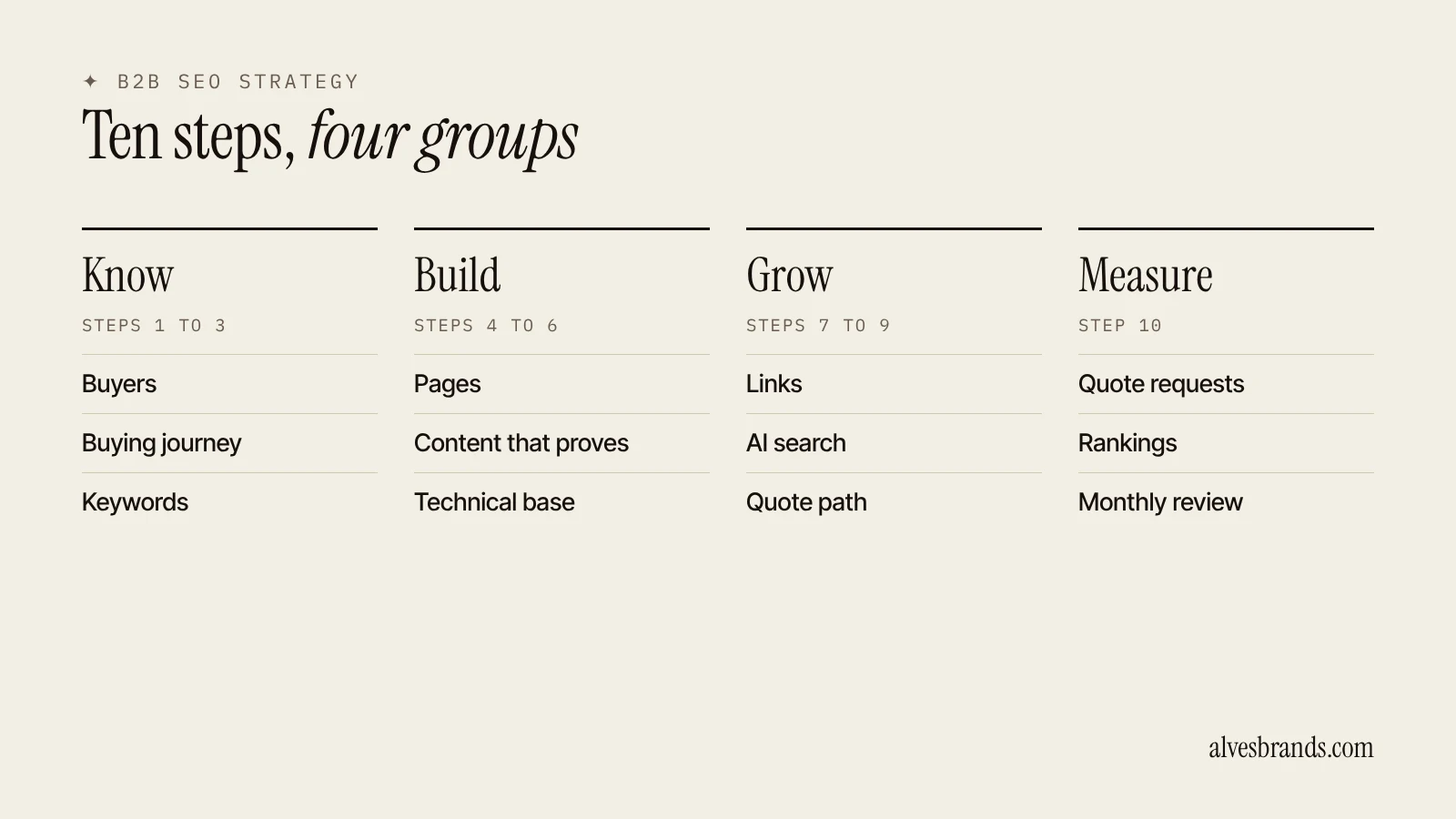
A B2B SEO strategy is a plan for getting found on Google and in AI assistants by the businesses that buy what you sell, and for turning those visits into sales conversations. It starts with the buyer, not with keywords. You find out who decides, what they search at each stage, and then you build the pages, fixes and links that answer them.
This B2B SEO strategy guide gives you the plan in ten steps, with examples from manufacturing and export. If you want someone to run it for you, see my B2B SEO agency page. If you are new to the topic, start with my guide on SEO for B2B companies.
What is B2B SEO?
B2B SEO is search engine optimisation for companies that sell to other companies. The goal is the same as any SEO: show up when the right person searches. What changes is who searches, how long they take to decide and what they need to see before they write to you.
A B2B buyer is rarely one person. Gartner says a buying group for a complex purchase has 6 to 10 decision makers. An engineer checks specs, a buyer checks price and terms, a manager signs off. Each one searches for different things.
B2B SEO vs B2C SEO
| B2B SEO | B2C SEO | |
|---|---|---|
| Who searches | Engineers, buyers, managers, often several people | One shopper |
| Search volume | Low, specific searches | High, broad searches |
| Sales cycle | Weeks to months | Minutes to days |
| What converts | A quote request, a call, a demo | A purchase |
| Content needed | Specs, proof, comparisons, case detail | Reviews, price, images |
| Trust signals | Certificates, standards, references | Ratings and reviews |
Two points matter most. B2B searches are small in volume but large in value: a search nobody else bothers with can be worth one big order. And B2B buyers do most of their research before they speak to you. 6sense found buyers are nearly 70% through the process before they contact a seller. If you are not in the results during that research, you are not on the list.
Step 1: Define your buyers and what they need
Write down who is in the buying group for your main product. For a machine part, it can be three people:
| Person | What they search | What they need from your site |
|---|---|---|
| Design engineer | Material, tolerance, standard | Specs, drawings, data sheet |
| Purchasing manager | Supplier, price range, lead time | Minimum order, lead time, terms |
| Operations or plant manager | Reliability, support, delivery | Proof, certificates, references |
Add the buyer’s country and language. A buyer in Spain does not search like a buyer in the UK. If you export, see my multilingual SEO guide.
Do not invent buyers. Ask your sales team who answers the phone, who asks for the quote and who asks the hard questions. Their answers are better than any persona template.
Step 2: Map the buying journey
Buyers search different things at each stage. Your site needs a page for each stage that matters.
| Stage | Example search | Page you need |
|---|---|---|
| Problem | how to reduce scrap in sheet metal forming | A guide that answers the question |
| Options | cnc machining vs sheet metal fabrication | A comparison or guide |
| Suppliers | cnc machining services uk | A service page with proof and a quote form |
| Checking | your company name plus certificates | About page, certificates, clear contact details |
| Decision | your phone number | A fast, simple contact path |
Most B2B sites have pages only for the "suppliers" stage and nothing before it. Buyers who are still learning never find you, and a competitor who wrote the guide gets the first call.
Step 3: Do keyword research for B2B
In a B2B SEO strategy, keyword research is about intent and fit, not volume. A search with 30 monthly visits can be worth more than one with 3,000.
- List what you sell by product, process, material and standard.
- Add buyer words: supplier, manufacturer, wholesale, services, company.
- Add questions your sales team hears.
- Check each search on Google in your target country and read the results.
- Group searches by result. If two searches show the same pages, one page can serve both. If the results differ, make two pages.
- Score each search by fit with your offer, difficulty and value of an order.
Reading the results is the step most people skip. It tells you what Google thinks the searcher wants. If page one shows service pages, build a service page. If it shows guides, write a guide. If it shows both, choose one and say why.
Long-tail searches win in B2B
Long searches with a product, a spec and a buyer word have low volume and high intent. "304 stainless steel sheet supplier uk" brings fewer visits than "stainless steel", but the people who search it are ready to ask for a price. Competitors skip these searches because the numbers look small, so they are easier to win.
Check the gap against competitors
List your three main competitors and the pages they rank with. Mark the searches where they have a page and you do not. Then mark the searches where nobody has a good page. That second list is where a small company wins fastest.
Step 4: Build the pages buyers need
Each search in your plan gets one page. Three page types do most of the work in B2B:
- Service or product pages for buyers who are ready to ask for a quote.
- Capability and industry pages for buyers who search by process or sector.
- Guides for buyers who are still learning.
A good product or service page has a clear name, specs, certificates, lead time and minimum order, a data sheet to download and a quote form near the top. I covered this in detail in SEO for product pages.
One page, one search. Do not target the same search with two pages: they compete with each other and both rank lower.
Step 5: Write content that proves you know the job
B2B buyers are judging risk. They want to know you understand their problem. Content that does this:
- Exact specs and numbers, not slogans.
- Process explanations written by someone who does the work.
- Comparisons that help the buyer choose, even when the answer is "not us".
- Answers to the questions your sales team hears every week.
Google’s guidance on helpful content asks for original information and first-hand knowledge. A page that copies the same text as ten other sites gives Google no reason to rank yours.
Do not publish case studies you cannot prove. A short, honest page with real numbers beats a long page with invented ones.
Step 6: Fix the technical base
Technical SEO is what Google reads and buyers never see. If it is wrong, good pages still do not rank.
| Check | What to look for |
|---|---|
| Indexing | Important pages are in Google, no page blocked by mistake |
| Speed | Pages load fast on a phone |
| Mobile | Text readable, buttons usable |
| URLs | Short, clear, one address per page |
| Structured data | Matches what the page shows |
| Duplicates | Filter and variant pages do not flood the index |
| Language setup | Hreflang for each language version |
| Catalog and PDFs | Thousands of SKUs and data sheets indexable without thin pages |
Google lists PDF among the file types it can index, so data sheets count. For the full list of fixes, see my technical SEO page.
Step 7: Earn links and mentions
Links from other sites tell Google your company is real. In B2B, the best links come from places your buyers already trust: trade associations, chambers of commerce, industry media, supplier and customer pages and directories for your sector.
Quality beats quantity. A handful of relevant links is worth more than hundreds from sites made to sell links. Google’s spam policies warn against buying links. I wrote a full guide on B2B link building, and you can see how I handle it on my link building page.
Step 8: Get named in AI search
Buyers also ask ChatGPT, Gemini and Perplexity for supplier ideas. Ahrefs found that AI Overviews cut the click-through rate of the top page by 58%, so being named in the answer counts as much as the click.
Google says there are no extra requirements for AI features beyond helpful, indexable pages. What helps in practice:
- Clear pages with exact facts, written so a sentence can be quoted.
- Your company name, address and details the same on every site.
- Mentions on other trusted sites, not only links.
- An llms.txt file that points to your key pages.
Read how to get recommended by ChatGPT for the steps.
Step 9: Make the next step easy
Traffic that does not ask for a quote is wasted. On every page that can bring a buyer:
- Put a short form and a phone or WhatsApp button near the top.
- Ask only for what you need: name, company, product, quantity and country.
- Tell the buyer when to expect a reply.
- Test the form on a phone.
Then connect search to money. Add "How did you find us?" to your form and record the page the visitor came from.
Step 10: Measure what pays
Track fewer numbers in your B2B SEO strategy, and the right ones.
| Metric | Why it matters |
|---|---|
| Quote requests from search | The result you want |
| Rankings for your main searches | Shows progress before leads arrive |
| Impressions and clicks by page | Shows which pages work |
| Branded vs non-branded search | Non-branded growth means new buyers find you |
| Referring domains | Shows link growth |
| Pages indexed | Shows Google sees your work |
Use Google Search Console for queries and indexing, and your analytics for leads. Traffic alone proves nothing. Ten visits that become two quote requests beat a thousand visits that become none.
How to prioritise your B2B SEO strategy: a simple scoring table
You will end up with more ideas than time. Score each search from 1 to 5 on four points, add them up and start with the highest totals.
| Search | Fit with your offer | Value of an order | Competition | Ease of page | Total |
|---|---|---|---|---|---|
| 304 stainless steel sheet supplier | 5 | 4 | 3 | 4 | 16 |
| stainless steel | 2 | 2 | 1 | 3 | 8 |
| how to choose a stainless steel grade | 4 | 3 | 4 | 4 | 15 |
| sheet metal cutting service near me | 4 | 3 | 3 | 3 | 13 |
The numbers are examples. Use your own. The point is to stop arguing about keywords and start with the pages that match your offer, pay well and have weak competition.
The types of B2B SEO strategy
B2B is not one thing. The first pages change by what you sell.
Manufacturing and industrial
Buyers search by process, material, standard and country. Your best pages are product and capability pages with specs, certificates and a quote form. Catalogs with thousands of SKUs need careful structure so Google does not index thin pages. See SEO for manufacturers and industrial SEO.
B2B software
Buyers search by problem, by use case and by "alternative to" and "vs" searches. Comparison pages, integration pages and use-case pages do most of the work.
B2B e-commerce and wholesale
Buyers search by product and brand, often with a minimum order. Category and product pages carry the weight, and account and price-list pages need to stay out of the index.
Enterprise B2B
Large sites have thousands of pages and several teams. The work is mostly governance: one owner per section, clear templates and a way to stop teams from publishing pages that compete with each other.
International B2B
When you sell in other countries, each market needs pages in its own language, with keywords researched there. See international SEO.
Local B2B
Some B2B companies sell to a region: a fabricator that serves a 100 km radius, a distributor with a warehouse. A Google Business Profile, a clear service area and searches with city names matter here.
What AI search changes for a B2B SEO strategy
More buyers start with a question to an AI assistant instead of a list of results. Three things change for you.
- Fewer clicks for the top results. When an AI answer sits above the links, fewer people click. That makes being named in the answer valuable.
- Mentions matter more. AI answers draw on what many sites say about you. A mention on a trade site counts even without a link.
- Clear facts win. Pages that state who you are, what you make and where you ship in plain sentences are easier to quote than pages of slogans.
None of this replaces classic SEO. The pages that rank are the same pages AI tools can read and quote. What changes is that you also check, month by month, whether assistants name you. Ask them the questions your buyers ask and write down who they mention.
Content types that work in a B2B SEO strategy
| Type | Job | Example for a manufacturer |
|---|---|---|
| Service or product page | Win the supplier search | "5-axis CNC machining services" |
| Capability page | Win the process search | "Anodising for aluminium parts" |
| Comparison | Help the buyer choose | "CNC machining vs 3D printing for prototypes" |
| How-to guide | Win the early search | "How to choose a stainless steel grade" |
| Cost page | Answer the price question | "What affects CNC machining cost" |
| Checklist | Give something to share | "Supplier audit checklist" |
| Data sheet (PDF) | Get shared inside the buying group | "304 sheet data sheet" |
| Case page | Prove you can do it | Only with real clients and numbers |
Pick the types that match your searches. A company with five strong product pages and three guides beats one with fifty thin posts.
E-E-A-T in a B2B SEO strategy: show who is behind the page
Google’s quality guidance talks about experience, expertise, authoritativeness and trust. In B2B, buyers want the same. Show:
- Who wrote the page, with a short bio and real credentials.
- Who runs the company, with a name and a photo.
- Certificates and standards you hold, with numbers a buyer can check.
- A real address and phone number on every page.
- Original facts: your own tolerances, lead times, materials and process notes.
Do not fake any of it. A page that says little but says it truthfully is safer than one that claims everything.
A worked example: the first 20 pages for a small manufacturer
This B2B SEO strategy example is an illustration, not a client case. Take a company that makes stainless steel sheet and cut parts and sells in the UK and Spain. A first set of 20 pages could look like this:
| Group | Pages | Count |
|---|---|---|
| Product pages | One for each grade and finish that sells | 6 |
| Capability pages | Laser cutting, bending, finishing, cut to size | 4 |
| Industry pages | Food, construction, marine | 3 |
| Guides | How to choose a grade, cost drivers, finish guide | 3 |
| Spanish pages | Home, top two products, contact | 4 |
Each page has its own search, checked on Google. Each links to two or three others. Each has a quote form. That is a full quarter of work for one person, and it gives Google a clear picture of what the company does.
Budget: where the money goes in a B2B SEO strategy
| Item | Share of effort |
|---|---|
| Research and planning | 10% to 15% |
| Writing and building pages | 40% to 50% |
| Technical fixes | 10% to 15% |
| Links and mentions | 15% to 20% |
| Reporting and review | 5% to 10% |
These are rough shares from how I plan work, not an industry rule. Adjust them to your site: a site with bad technical health needs more fixes first, and a site with good pages and no links needs more link work.
Tools for a B2B SEO strategy
A B2B SEO strategy needs few tools.
- Google Search Console: queries, indexing, errors. Free.
- Google Analytics or similar: visits and leads.
- A keyword tool: volume and difficulty. Check the numbers against the Google results.
- A crawler: finds broken links, missing titles and duplicate pages.
- A page speed test: shows what slows your pages.
- A spreadsheet: the keyword map, one row per search with page, status and owner.
You can start with the free ones. Add paid tools when the free ones stop answering your questions.
Who does what
Every B2B SEO strategy needs four roles. In a small company, one person can hold several.
| Role | Job |
|---|---|
| Owner | Decides priorities and approves pages |
| Subject expert | Gives exact specs, process notes and answers |
| Writer or consultant | Researches, writes and builds the pages |
| Developer | Fixes technical problems and adds markup |
The weak point is usually the subject expert. A page without real facts from someone who does the work is a generic page. Give the writer an hour a week with your best engineer or salesperson.
B2B SEO strategy by business type
| Business | Where to start |
|---|---|
| Manufacturer or job shop | Product and process pages with specs and quote form |
| Exporter | Pages in buyers’ languages, hreflang, market-specific searches |
| Importer or distributor | Brand and product pages, catalog structure |
| Engineering firm | Service and sector pages, proof of work |
| SaaS or software | Use-case pages, comparisons, integrations |
The B2B SEO strategy steps are the same. The first pages you build change.
How to read your results month by month
A B2B SEO strategy moves in a pattern. Knowing it keeps you from changing course too early.
| Month | What you should see | What to do if you do not |
|---|---|---|
| 1 | Fixes done, first pages live | Check indexing in Search Console |
| 2 | New pages indexed, first impressions | Add internal links, request indexing |
| 3 | Impressions rising, first clicks on long searches | Rewrite titles on pages with impressions and no clicks |
| 4 to 6 | Rankings on page one or two, first quote requests | Add pages around the ones that move |
| 7 to 12 | Steadier enquiries, more searches covered | Double down on what works, drop what does not |
If a page has impressions but no clicks, the title or the description does not match the search. If a page has clicks but no enquiries, the page or the quote path is the problem. If a page has no impressions after eight weeks, check that it is indexed and linked from other pages.
The metrics behind the metrics
A few numbers give you early warning before leads change.
- Share of voice. Of your 20 to 30 target searches, how many show you on page one? Track the count each month.
- Non-branded impressions. Impressions for searches that do not contain your company name. This is the number of new buyers who could find you.
- Click-through rate by page. Low rates on pages with high impressions point to weak titles.
- Pages with links. The share of your key pages with at least one link from another site.
- Lead source. From the form field "How did you find us?", the share that says Google, an AI assistant or a referral.
Check them once a month on the same day. A trend over three months tells you more than any single number.
A 12-month B2B SEO strategy roadmap
| Months | Focus |
|---|---|
| 1 | Research, audit, technical fixes |
| 2 to 3 | Pages for your best products and services |
| 4 to 6 | Capability and industry pages, first guides, trade body links |
| 7 to 9 | Comparison and cost pages, more languages if you export |
| 10 to 12 | Review, update old pages, double down on winners |
Keep updating old pages. A product page with a changed lead time or a new certificate should be changed the same week, and a guide older than a year should be checked for dated facts.
A 90-day B2B SEO plan
Days 1 to 30: Know and fix.
- Interview sales about buyers and questions.
- Run keyword research and check each search on Google.
- Audit the site and fix indexing, speed and titles.
- Pick your first five pages.
Days 31 to 60: Build.
- Publish the first five pages for your best products.
- Add internal links from existing pages.
- Set up the quote path and tracking.
- Ask for the first links from trade bodies and directories.
Days 61 to 90: Grow and check.
- Add the next five pages and two guides.
- Add structured data and an llms.txt file.
- Read Search Console: which pages get impressions but no clicks?
- Rewrite titles and plan month four.
Common B2B SEO strategy mistakes
- Chasing the biggest keyword. A search with ten strong competitors is a poor first target.
- Pages only for the bottom of the funnel. Buyers who are learning never find you.
- Low-quality landing pages. Thin pages with no specs and no proof do not rank or convert.
- Ignoring E-E-A-T. Show who writes the page, who runs the company and what you have done.
- Treating SEO as a project. SEO that stops after launch loses ground to competitors who keep publishing.
- Not tying SEO to sales. Without lead tracking, you cannot tell what works.
- Buying links. It puts your rankings at risk.
How much does a B2B SEO strategy cost?
It depends on how many pages you need, how competitive your market is, how many languages you want and who does the work. You can do the first steps yourself for the price of your time. If you hire help, ask who writes the pages, how they report and whether there is a minimum term. I publish my prices: an SEO audit from €199, Growth at €790 a month and Rank #1 at €2,900 a month. See all packages on the services page, and read how to choose a manufacturing marketing agency for questions to ask any provider.
B2B SEO strategy and other channels
SEO works better when it connects to the rest of your marketing. Your sales team gives you the questions. Your email and LinkedIn bring buyers to your best pages. Your ads can test which searches convert before you invest in SEO pages. Read SEO vs Google Ads to see which to fund first, and use the B2B marketing plan to fit SEO into a full plan.
B2B SEO strategy checklist
- Buyers and buying group written down.
- Buying journey mapped to pages.
- Keyword list checked on Google, one page per search.
- Service, product and guide pages built.
- Technical base fixed.
- Links from trade bodies and directories.
- Clear pages and llms.txt for AI search.
- Quote form on every page that can bring a buyer.
- Search Console and lead tracking set up.
- Monthly review of what moved.
Start the plan with a B2B SEO audit, and use construction SEO keywords as an example of keyword grouping for a trade.
Frequently asked questions
What is a B2B SEO strategy?
It’s a plan for getting found by the businesses that buy what you sell. It covers who your buyers are, which searches they use, which pages you build, how you fix your site and earn links and how you measure quote requests.
How is B2B SEO different from B2C SEO?
B2B searches are fewer and more specific, the buying group has several people and the sales cycle is longer. The goal is a quote request or a call, not a purchase.
How long does B2B SEO take to work?
Indexing takes days and first rankings take weeks. Quote requests from search usually follow after three to six months, because buying cycles are long.
How many keywords should a B2B SEO strategy target?
Start with 20 to 30 searches, each with its own page. Add more as the first pages rank.
Do I need a blog for B2B SEO?
You need guides that answer the questions buyers ask before they look for a supplier. Whether you call them a blog or not does not matter.
Should I hire an agency or a consultant?
For a small or mid-size company, a senior consultant who does the work is often better value than a large team. Ask who writes the pages and how they report.
How do I measure B2B SEO?
Track quote requests from search, rankings for your main searches and impressions and clicks by page in Google Search Console.
Does B2B SEO help with AI search?
Yes. AI assistants quote clear, factual pages and mentions on trusted sites. The same pages that rank on Google are the ones they can name.
Want a B2B SEO strategy built for your company? Ask me for a free website check. I’ll show you which five pages to build first.