Manufacturing industry marketing is everything a factory does to get found, trusted and chosen by the companies that buy what it makes: its website, search visibility, content, trade shows, directories, email, distributors and sales material. The goal isn’t likes or followers. It’s quote requests from the right buyers.
The manufacturing industry is huge and very mixed. A plant that makes industrial valves and a company that makes packaged snacks both “work in manufacturing”, but their buyers, sales cycles and best channels look nothing alike. That’s why most advice for the whole industry feels too general to use.
This guide covers what’s true across the manufacturing industry, then what changes by sector, so you can pick the parts that fit your business. If you want the full channel-by-channel version, read my complete guide to marketing for manufacturers. If you need a plan with a template, use the manufacturing marketing plan.
Why manufacturing industry marketing matters now
Two things changed. Buyers stopped waiting for sales reps, and the industry got more competitive online. I track the bigger shifts in industrial marketing trends for 2026.
The industry is big. The US National Institute of Standards and Technology (NIST) reports that manufacturing contributed $2.4 trillion, or 10.2% of US GDP, in 2023, and employed 15.0 million people in 2024. Every one of those plants competes for buyers who can now compare suppliers from their desk, in any country.
And buyers do it alone:
- In a 2026 Gartner survey of 646 B2B buyers, 67% said they prefer a rep-free buying experience, and 45% had used AI during a recent purchase.
- The 6sense 2024 Buyer Experience Report found buyers are nearly 70% through their buying process before they talk to a seller, and 81% already have a favorite supplier by then.
If your company isn’t visible during that quiet research phase, your sales team never gets the call. Marketing is what puts you on the shortlist before anyone picks up the phone.
What makes marketing in the manufacturing industry different
A few things are true almost everywhere in the industry:
- Long sales cycles. Buying a machine, a custom part or a bulk material can take months. Marketing has to keep you in the picture the whole time.
- Several people decide. An engineer checks specs, purchasing checks price and terms, a manager signs off. Each one searches for different things.
- Technical buyers want proof. Data sheets, tolerances, certifications, test results and customer references matter more than slogans.
- Orders are large and repeat. One new customer can be worth years of revenue, so a few good leads beat thousands of visitors.
- Middlemen are common. Distributors, agents and resellers often stand between you and the end user.
I go deeper on this in the section on how manufacturing marketing differs from consumer marketing. What matters here is the result: you market to a small group of well-informed people, and you win by being clear and easy to check.
How marketing changes by sector
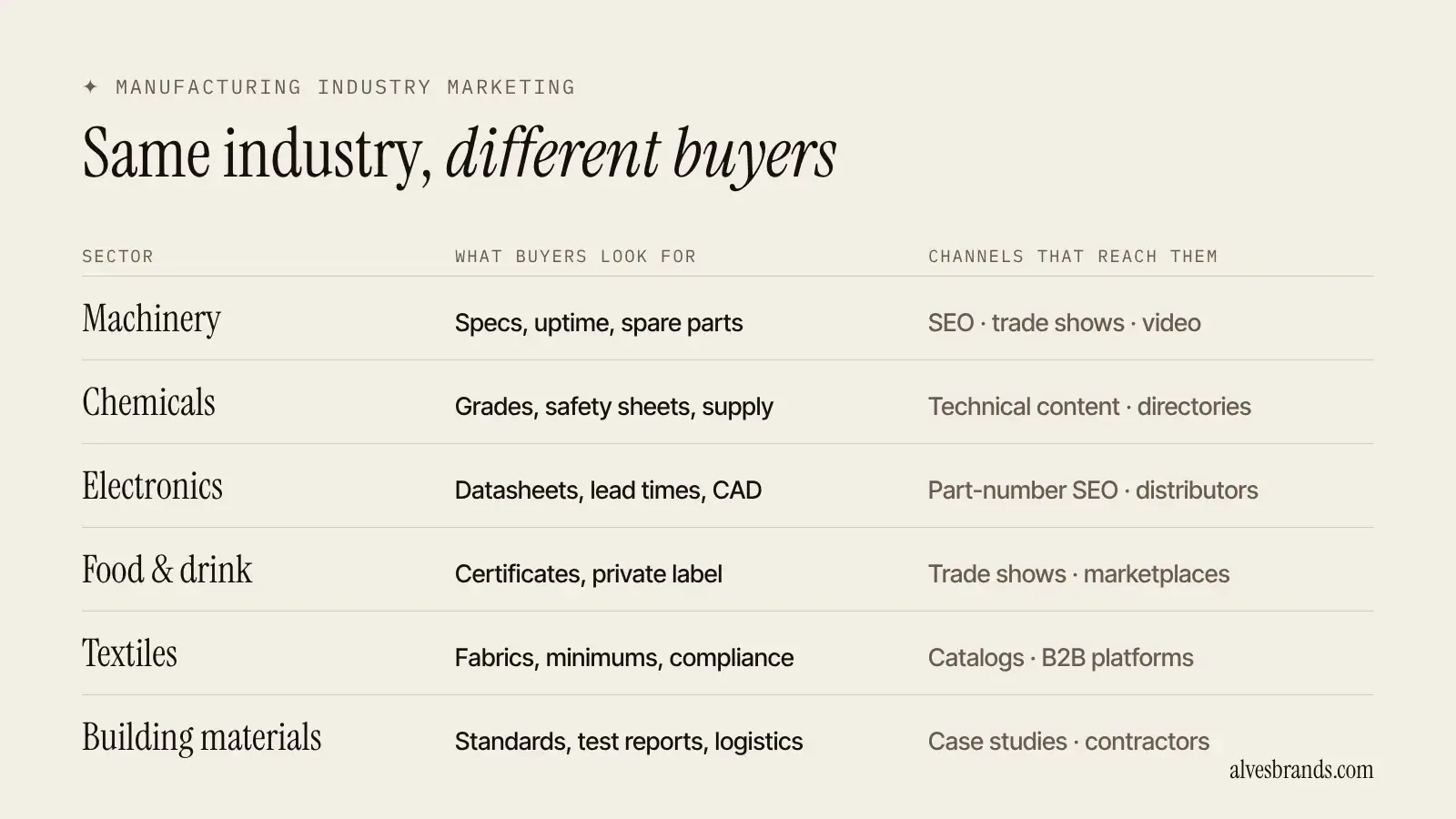
The biggest mistake in manufacturing industry marketing is copying what another sector does. NIST’s data shows chemical products as the largest manufacturing subsector, followed by computer and electronic products, then food, beverage and tobacco. These sectors sell in completely different ways.
| Sector | What buyers look for | Best channels |
|---|---|---|
| Machinery and equipment | Specs, uptime, service and spare parts, references | SEO for product pages, trade shows, video demos, distributors |
| Chemicals and materials | Grades, safety data sheets, certifications, consistent supply | Technical content, directories, email to existing buyers |
| Electronics and components | Datasheets, availability, lead times, CAD files | Part-number SEO, distributor listings, technical downloads |
| Food and beverage | Quality certificates, private label options, minimum orders | Trade shows, B2B marketplaces, buyer samples, LinkedIn |
| Textiles and apparel | Fabric options, minimums, compliance, speed to production | Catalogs, trade fairs, B2B platforms, Instagram and Pinterest for brands |
| Building materials | Standards, test reports, price per project, logistics | Project case studies, distributor and contractor networks, local SEO |
Use the table as a starting point, then check it against how your own buyers behave. Ask your last ten customers how they found you. Their answers tell you more than any industry report.
What buyers type into Google, by sector
The same table works as a keyword guide. Buyers in each sector search in a different style:
- Machinery: “industrial packaging machine manufacturer”, “CNC lathe spare parts supplier”.
- Chemicals and materials: “food grade silicone supplier”, “bulk polyethylene pellets price”.
- Electronics: part numbers, “PCB assembly service low volume”.
- Food and beverage: “private label olive oil manufacturer”, “organic pasta wholesale”.
- Textiles: “organic cotton fabric manufacturer”, “custom hoodie factory minimum order”.
- Building materials: “fire-rated door manufacturer”, “ceramic tile exporter”.
A page that says “high quality products for every need” matches none of them. A page about “stainless steel storage tanks, 500 to 20,000 liters, food grade” matches buyers exactly. Write for the narrow search, and you’ll meet fewer competitors and more real buyers.
What manufacturing industry marketing should achieve
Set goals that sales will recognize. The most useful ones are:
- More qualified quote requests. Not traffic, not impressions. Requests from companies you’d be happy to supply.
- A shorter sales cycle. Good content answers questions before the buyer asks them.
- Less dependence on a few customers. Marketing opens new industries and countries.
- Better prices. Buyers who understand your quality argue less about price.
- Easier work for your sales team. Leads arrive informed and ready to talk specs.
Pick three and put a number and a date on each. The plan guide shows how.
Is marketing worth it for manufacturers?
Yes. Manufacturing industry marketing pays off for a simple reason: buyers research before they call, so the supplier they find first and trust most gets the first quote request. Salesforce asks the same question in its article on whether marketing is worthwhile in manufacturing. The benefits show up in a few places:
- Reach. You get in front of buyers in cities and countries your sales team will never visit.
- Trust. A clear site, real case studies and reviews tell buyers you’re established before they’ve spoken to you.
- Efficiency. One good guide or product page works every day for years, while a sales trip works once.
- Data. You can see which pages, products and countries bring interest, and use that to decide where to invest.
The marketing strategies that work in the manufacturing industry
You don’t need every channel in manufacturing industry marketing. You need the few that match your buyers. Here’s what holds up across sectors, with the evidence we have.
A website built for technical buyers
Your website is your main salesperson, and it works at night. It needs one page per product or service, clear specs, certifications, photos of your factory, and a simple way to ask for a quote. Fast loading and a good mobile version aren’t optional, because engineers browse on phones too. Google’s own guidance on creating helpful, people-first content is a good test for every page: does it help a buyer decide?
SEO: be there when buyers search
Search is where buyers start. They type things like “CNC machining services for aerospace” or “polypropylene resin supplier”. SEO puts your product pages and guides in front of them. Start with the words buyers use, not the words you use internally, then build a page for each. The Content Marketing Institute’s manufacturing research found that 68% of manufacturing marketers said search and pay-per-click ads gave them the best results of any paid channel, which shows how much buying intent there is in search. Organic results get the same buyers without paying per click. My technical SEO service covers the site-health side of this.
Content that answers real questions
Write about what buyers ask your sales team: how to choose between two materials, what a part costs and why, how long production takes, how to avoid common defects. In the same research, 74% of manufacturing marketers called video their most effective content type. A two-minute video of your machine running, with the specs on screen, often beats a long brochure.
For business-to-business sales, LinkedIn is where the right people already are. In the CMI research, 85% of manufacturing marketers said it delivers the best value among social networks. Post your products, projects and plant news from the company page, and have your sales team and engineers share them too.
Trade shows and events
In-person events are still strong: 51% of manufacturing marketers in the CMI study said they’re the most effective distribution channel. The trick is what happens after the show. Follow up within a week, with a message that mentions what you discussed, and add the contact to your email list.
Sales cycles are long, so email keeps you present. Send useful things, such as a new case study, a spec update or a short market note, every month or two. Don’t send weekly promotions.
Directories, marketplaces and distributors
Many buyers start on industry directories like Thomasnet or on sector-specific lists in their region. A complete listing with your capabilities and a link to your site brings visibility and a useful backlink. Distributors extend your reach into markets you can’t cover yourself, so give them good material and a “Become a distributor” page. My link building service focuses on these kinds of relevant mentions.
Account-based marketing for big targets
If you sell to a short list of large accounts, treat each one as its own campaign. Research the people who decide, send them content tied to their projects, and coordinate with sales. This is account-based marketing, or ABM, and it suits manufacturers who sell expensive, custom products to a few dozen companies.
Lead generation: turning visitors into quote requests
Traffic is only useful if some of it asks for a quote. Four small things make the biggest difference:
- A visible quote button on every product page, not just on the contact page.
- A short form. Name, company, email and what they need. Every extra field loses people.
- A useful download. A datasheet, a catalog or a materials guide in exchange for an email address brings buyers who aren’t ready to ask for a quote yet.
- A fast reply. Answer within one business day. Many buyers send the same request to several suppliers, and the first useful answer often wins.
Then follow up. Most manufacturing leads don’t buy on the first contact, so a simple email sequence over a few weeks keeps you in the picture until their project starts.
Marketing and sales on the same team
In many factories, marketing brings leads and sales ignores them, or sales promises things marketing never said. Avoid that with two habits. First, agree on what a “qualified lead” is: the industry, the order size and the timeline you want. Second, meet once a month to look at the leads together. Sales tells marketing which ones were good and why, and marketing adjusts what it publishes. This is also where you collect the questions buyers ask, which become your next guides.
In-house, freelancer or agency?
Many manufacturers have one marketing person, or none. Here’s how the options compare.
| Option | Good for | Watch out for |
|---|---|---|
| In-house person | Daily work, knowing your products deeply | One person can’t cover SEO, video, email and design |
| Freelancers or specialists | Specific jobs, such as SEO, video or translation | You must coordinate them |
| Full-service agency | Big budgets and many channels | Cost, and agencies that don’t understand technical products |
Whichever you pick, check that they understand your sector. Ask for examples from industrial clients, and ask how they’d measure success in quote requests, not just traffic. If you only need help being found on Google and in AI answers, a specialist for that one area is usually enough to start with.
The tools you actually need
- A CRM to record every lead and what happened to it. HubSpot, Pipedrive and Zoho are common. Without one, you can’t connect marketing to orders.
- Google Search Console to see which searches show your site and what’s blocking indexing.
- Google Analytics to see which pages and channels bring quote requests.
- An email tool for newsletters and follow-ups after trade shows.
That’s enough to start.
The challenges manufacturers face
The CMI research gives a clear picture of what holds manufacturers back:
- Not enough resources. 57% of manufacturing marketers name this as their top challenge.
- Content that doesn’t lead to action. 66% struggle to create content that makes the reader do something.
- Proving results. 64% find it hard to attribute return on investment and follow the customer journey.
- No scalable way to produce content. 54% lack a repeatable model.
The fixes are simple. Do fewer things and do them well. Put a quote button on every page. Ask every new customer how they found you and write it in the CRM. And turn the work of your engineers and sales team into content: every question a customer asks is a blog post waiting to be written.
What the industry’s marketing usually misses
Most advice written for the manufacturing industry stops at the border. Two gaps matter more every year.
Exports and buyers in other countries
Foreign buyers search in their own language and trust sites that speak to them. A buyer in Germany searching “Aluminiumguss Hersteller” won’t find an English-only site. Translated pages, set up properly so Google shows the right version in each country, open new markets with the same factory. Google explains the setup in its guide to localized versions of pages. I wrote about the whole process in how foreign buyers find suppliers online and the multilingual website checklist. This is the core of my SEO for exporters and international SEO work.
Being named by AI assistants
With 45% of buyers in the Gartner survey already using AI in a purchase, it matters what ChatGPT, Gemini and Perplexity say when someone asks for a supplier in your field. They name companies that have clear, consistent information across the web: a good website, directory listings, mentions in industry sites and the same facts everywhere. I explain the steps in how to get recommended by ChatGPT and offer it as AI search optimization. Want to see how you show up today? Run the free AI visibility check.
Mistakes to avoid
These are the ones I see most in manufacturing industry marketing:
- Copying consumer marketing. Flashy social posts won’t convince a purchasing manager. Specs and proof will.
- Hiding your capabilities. If a buyer can’t see your materials, tolerances, certificates and minimum order in 30 seconds, they leave.
- No clear next step. Every page should lead somewhere: request a quote, download a datasheet, book a call.
- Ignoring existing customers. Repeat buyers are your cheapest source of orders. Keep them informed.
- Doing everything at once. Three channels done well beat ten done badly.
- Not tracking. If you can’t say which channel brought last quarter’s orders, you’re guessing with your budget.
How to measure manufacturing marketing
Track what sales cares about:
- Qualified quote requests per month
- Cost per qualified lead
- Share of leads that become quotes, and quotes that become orders
- Revenue from new customers
- Organic traffic to product pages (and which countries it comes from)
- Where each lead first heard about you
Review these once a month with the sales team. Keep what brings orders, fix what doesn’t, and stop what does neither after three months of honest effort. SEO and content take time: expect the first results in three to six months, and stronger ones after that.
Where to start this month
If manufacturing industry marketing feels like a lot, do these five things first (or see how to market a manufacturing company from zero):
- Write down your three best customer types and how each one found you.
- Make sure each main product has its own page with specs, photos and a quote button.
- Set up Google Search Console and Google Analytics.
- Fill in or fix your listing on the main directory for your sector.
- Publish one useful guide that answers a question your sales team hears every week.
Then build from there with the 90-day plan in my marketing for manufacturers guide.
To see what to publish, read content marketing for manufacturers.
Related reading: marketing for manufacturing companies adds a channel guide by business type.
Frequently asked questions
What is manufacturing industry marketing?
It’s the set of activities a manufacturer uses to be found, trusted and chosen by business buyers: website, SEO, content, trade shows, directories, email and sales support. It focuses on qualified quote requests, not general awareness.
What is the best marketing strategy for manufacturers?
For most, it’s a strong website with a page per product, SEO for what buyers search, useful content and trade shows with good follow-up. Add LinkedIn and email once the base works.
How much should a manufacturer spend on marketing?
Benchmarks vary, but marketing budgets average around 7.8% of revenue in Gartner’s 2026 CMO survey, and often less for small manufacturers. Start with what you can sustain, measure the results and grow what works. The manufacturing marketing plan guide shows how to set the budget step by step.
Does marketing work for small manufacturers?
Yes, and often better than for big ones, because a small number of good customers changes the business. Focus on one or two channels, a clear website and honest case studies. The SBA’s guide to planning your business is a useful free place to start.
Is marketing different if I export?
Yes. You need pages in your buyers’ languages, set up so Google shows the right version in each country, and you need to be present in the directories and search engines they use. See how foreign buyers find suppliers.
If you want to know where your company stands today, ask me for a free website check. I’ll show you how you appear on Google and in AI answers in your most important markets, and what to fix first.